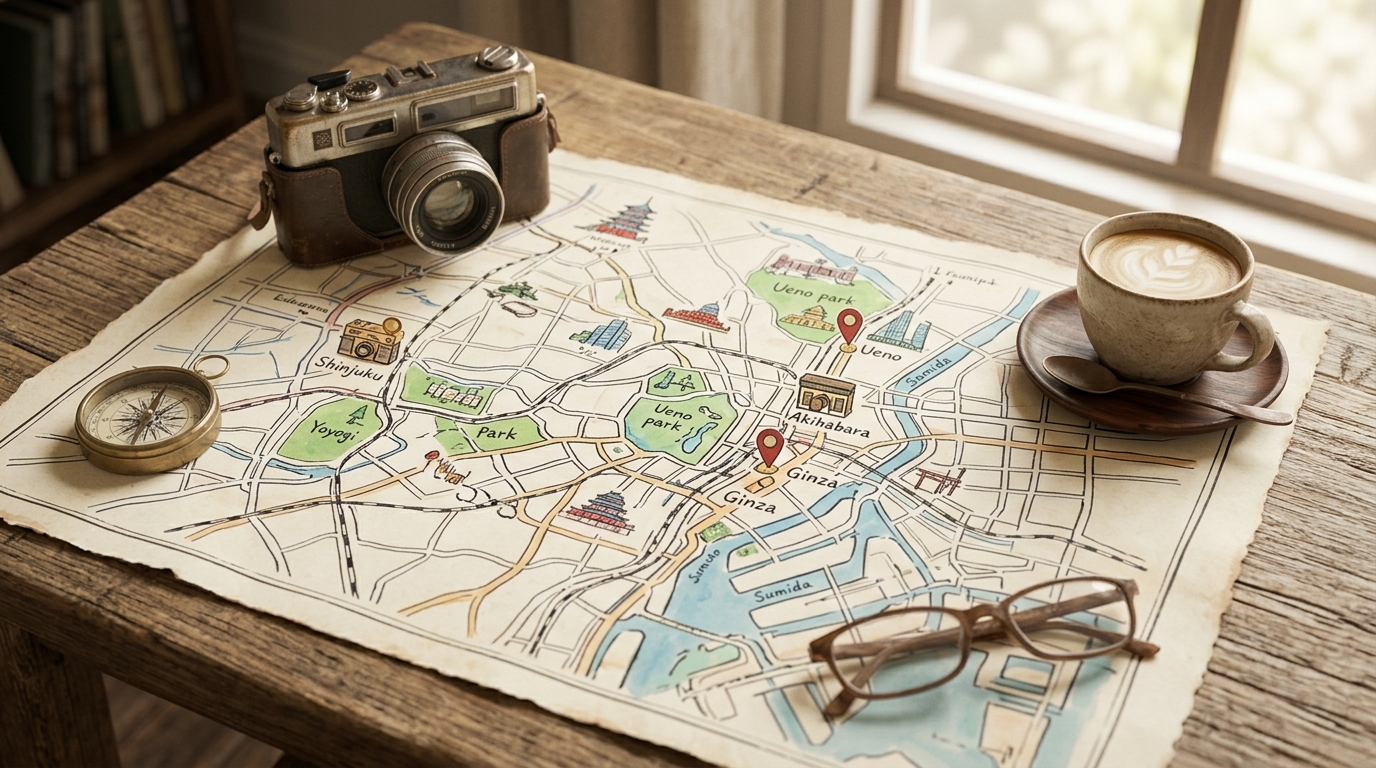
This page is a map of everything on this site.
Quick introduction, in case this is your first article here: I work in Japan’s used camera business. Selling cameras from Japan to buyers overseas is my day job, and on my days off I visit Tokyo’s camera shops in person and write about what I find. Every article linked below comes from that — a shop I walked into, or a part of the job I did with my own hands.
Since July 2026 those articles have piled up, and I realized a new reader has no easy way to see how they fit together. So here they are — all 33 of them — arranged in the order of an actual trip: what to know before you fly, how things work inside a Japanese shop, where to go, how to get your camera home, and what to know if you skip the flight and buy from your own couch.
Pick the stage you are at and start there.
Before you fly
Five things are worth knowing before your plane leaves the ground.
First, how used camera stock works here. In How to Find a Specific Camera in Tokyo I explain the single most important fact about shopping for used gear in Japan: everything is one of a kind. There is no shop that “carries” the Nikon FM2 — only a shop that has one today. The article shows how to check the big shops’ online stock before you fly, including one chain’s system for moving an item to a store near you.
Second, opening hours. Japanese camera shops close on days you would not expect — several of the shops I visit are closed on Wednesdays — and each shop posts its real schedule in a different place. Closed on Wednesdays is my guide to not standing in front of a shuttered door.
Third, condition labels. Japanese listings and price tags use grades like “Near Mint,” “Exc+++,” and “Junk.” I write labels like these as part of my work, so in the condition grades article I explain what they mean in practice — and where the words end and your own eyes have to take over.
Fourth, the word “junk.” It does not mean garbage. Buying “Junk” Cameras in Japan covers what the word really means here, and what to check before you hand over money for something sold with no promises at all.
Fifth, the price question. Is Japan actually cheaper than buying on eBay from home? In Is Japan Really Cheaper for Cameras? I compared Tokyo shelf prices with eBay listings for three famous film cameras on the same day. The short version: sometimes yes, sometimes no — and the article shows which is which.
In the shop
You are standing in Tokyo, in front of a glass case. Now what?
Japanese Camera Shop Etiquette is a relaxed guide for first-time visitors: what shops expect from you, and how much less scary it all is than the internet makes it sound.
Worried about the language? In Nobody Spoke to Me in Seven Akihabara Camera Shops I describe how little talking a camera shop visit actually requires, and the one small phrase that opens every conversation when you do need one.
For the price tags themselves, How to Read a Japanese Camera Shop Price Tag covers the good news (the price you see almost always includes tax) and the handful of Japanese words on a tag that are actually worth recognizing.
And when it is time to actually pay, Cash or Card? looks at what the big shops officially accept — the “Japan is cash only” warning turns out to be mostly retired in Tokyo’s camera world, though a little cash still earns its place in your pocket.
And if you are hoping to shop tax-free, the tax-free quick reference compares three shops in Nakano and Shinjuku in one table — which of them offer it, and what to bring.
Where to go
So far I have covered three areas of Tokyo in depth: Akihabara, the Nakano–Shinjuku line, and now Ginza. I add new areas as I visit them.
Akihabara
Start with the overview — Used Camera Shops in Akihabara, where I walked the whole area in one very hot day — then go deeper with the shop-by-shop articles:
| Shop | What it is |
|---|---|
| 2nd BASE | Street level under the train tracks, English signs from the entrance, gear you can pick up and handle. The shop I would send a first-timer to. |
| Kitamura | A big chain’s junk floor, marked by a TAX FREE sign. Colored stickers on the tags tell you which month each item arrived. |
| Lemon Camera | Third floor of an office building. English condition ranks printed on the tags, and a three-items-per-person rule for junk. |
| Tokyo CAMERA | A junk garage with no staff inside — signs in English invite you to mount lenses and test batteries yourself. Lenses from 3,000 yen. |
| Nisshin Camera | A small showcase shop, and the most local stop on my route. It turns into a bar at night — or so a sign says. |
Nakano and Shinjuku
The overview is Tokyo Camera Shop Guide: Nakano & Shinjuku, a walk I did myself across both neighborhoods. Three shops from that walk got their own articles:
| Shop | What it is |
|---|---|
| Fujiya Camera’s Junk Annex (Nakano) | A treasure box of genuine Japanese accessories — hoods, caps, small parts — across the street from the main shop. |
| Lemon Company (Shinjuku) | The Tokyo shop where you can browse at your own pace, with nobody hovering. |
| Map Camera (Shinjuku) | Tokyo’s camera department store: which floors you actually need, the Leica floors, and tax-free tips. |
Ginza
The newest area on this site, from a September 2026 walk. The first article is Lemon Camera Ginza — a camera shop on the 8th floor of a church building, with photos taken inside the shop and a tax-free rule I had not seen explained anywhere else. The second is Shimizu Camera, a shop with no website at all, where the street-facing show window does the job instead — a Ginza habit I did not see in Akihabara or Shinjuku. More Ginza shops are coming.
Only have one day?
I wrote two ready-made itineraries you can follow as they are:
- A Full Camera Day in Akihabara — my one-day route through the shops above, with coffee breaks and a beer at the end.
- A Camera Day in Nakano and Shinjuku — two towns, one train ride, one day.
After you buy
You found it. You bought it. Four articles for the trip home.
Getting Your Camera Home in One Piece comes straight from my old job at a shipping desk: the damage I saw over and over was predictable, and you can rebuild a proper shipping box in your hotel room with bubble wrap, a T-shirt, and a pair of socks.
That 6-Month Warranty on Your Used Camera answers a question most travelers only think of at the airport: does the shop warranty mean anything once you fly home? I read three major chains’ warranty pages the same day I wrote it — one of them states in English that the warranty is valid only in Japan. My conclusion: choose your camera as if the warranty does not exist, and treat it as a gift if it does.
And if film is coming home with you, Flying Home With Film collects what Kodak, Fujifilm, and the airports officially say about the new CT scanners — written by someone who does not fly, from the published sources, with the exact phrase for requesting a hand inspection in Japanese.
And the practical sequel: Buying and Developing Film in Tokyo covers where the film is, what it cost on the day I checked, and how to get your shot rolls developed before you fly — the move that makes the scanner question disappear for them.
Buying from home
Maybe there is no flight. Plenty of readers buy Japanese cameras from their own couch, on eBay or elsewhere — and this is the part of the pipeline I know from the inside, because shipping cameras to overseas buyers is what I do. Five articles walk through the whole journey of a box:
- How to Buy from a Japanese Seller on eBay — tips from the other side of the screen: how we read your messages, and what makes a smooth transaction.
- What I Check Before Listing a Camera — my inspection routine, plus the ten-minute check you should do the day your camera arrives.
- How Japanese Sellers Pack a Camera — a look inside the box before it is sealed.
- After the Box Is Sealed — what happens on shipping day, and why tracking sometimes goes quiet without anything being wrong.
- Your Camera from Japan Arrived Damaged — the three photos to take first, and why the message you send today beats the perfect message you send next week.
Bookmark this page
That is the whole site, as of September 2026 — 33 articles, one trip, start to finish.
The site keeps growing: I visit new shops and new areas, and each time an article goes up, I will add it to this page. So if you are planning a camera trip to Japan — next month or next year — this is the one page worth bookmarking. Everything else lives one click away from here.
Safe travels, and I hope the shelves have something good waiting for you.
コメント