
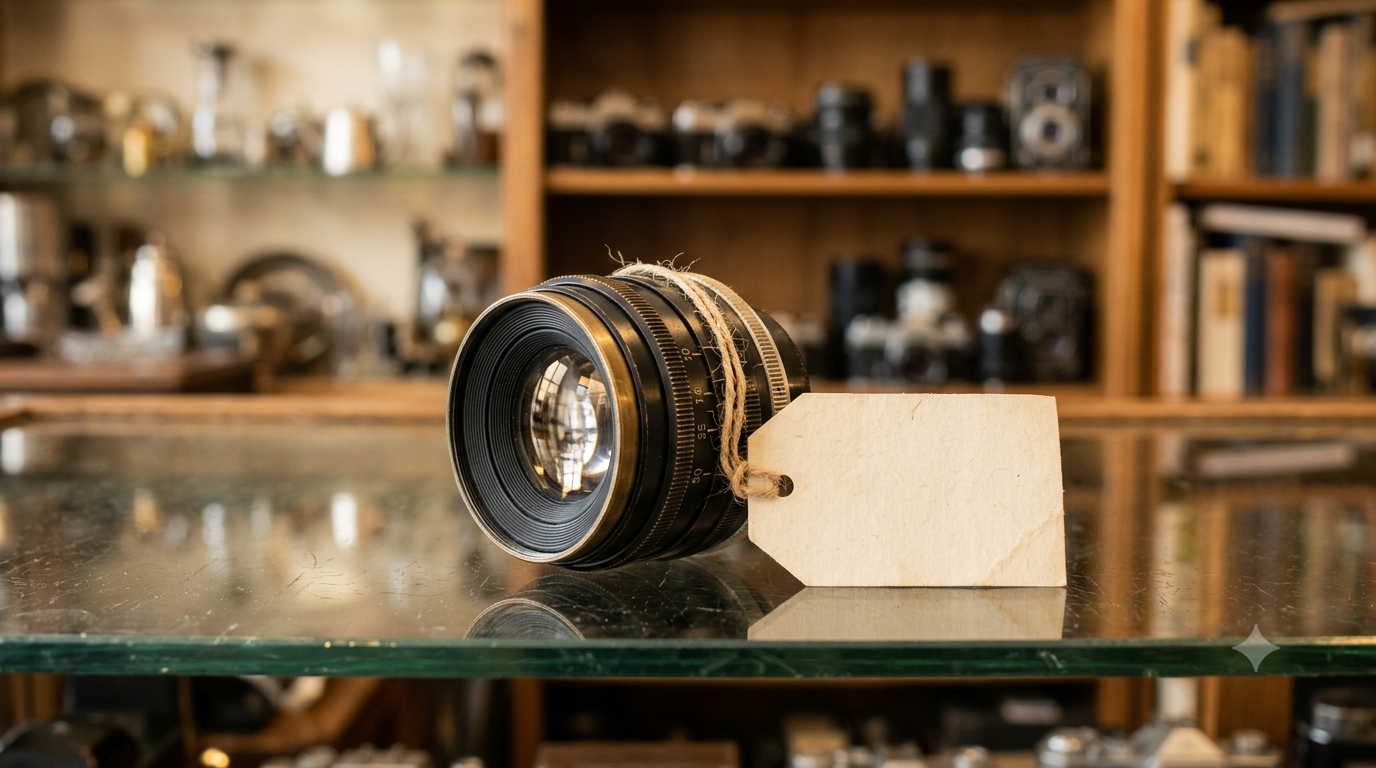
On August 1, 2026, I was on the used floor of the Kitamura Akihabara used-buying center, and I noticed something that I think sums up the whole problem for a visiting buyer.
The shop has an English guide to how to read the price tag. It shows you where the price sits, where the condition note sits — the layout, explained in your language. Genuinely helpful.
But the condition note on each individual item is written in Japanese only.
So you end up knowing exactly where to look, and still not knowing what it says. That gap is what this article is for. Below is what a Japanese price tag usually contains, how to read the price, and — the part that actually matters — the short list of Japanese words that show up on those tags again and again.
A note on scope first. This is about paper price tags in physical shops in Japan. If you are buying online and want to know what “Exc+++” or “Near Mint” means in an eBay listing, that is a different vocabulary, and I covered it separately in Japanese camera condition grades explained. The two overlap a little, but a shop tag and an eBay title are not the same language.
Everything here is from shops I walked into myself in July and August 2026. Other shops will do it differently.
What is on the tag
The tags I looked at generally carried five things:
- Model name and number — usually readable, since it is mostly Latin letters and numbers.
- Price — see the next section.
- Condition rank — either the shop’s own code (AB, B+, and so on) or a Japanese word such as 美品 or 並品.
- Specific faults — written out in Japanese, quite plainly: fungus, haze, scuffs, yellowing.
- Arrival date — not every shop, but some mark when the item came in.
The condition rank is the shop’s summary. The specific faults are the detail. When both are present, read the faults — that is where the real information is.
The price is almost always tax included
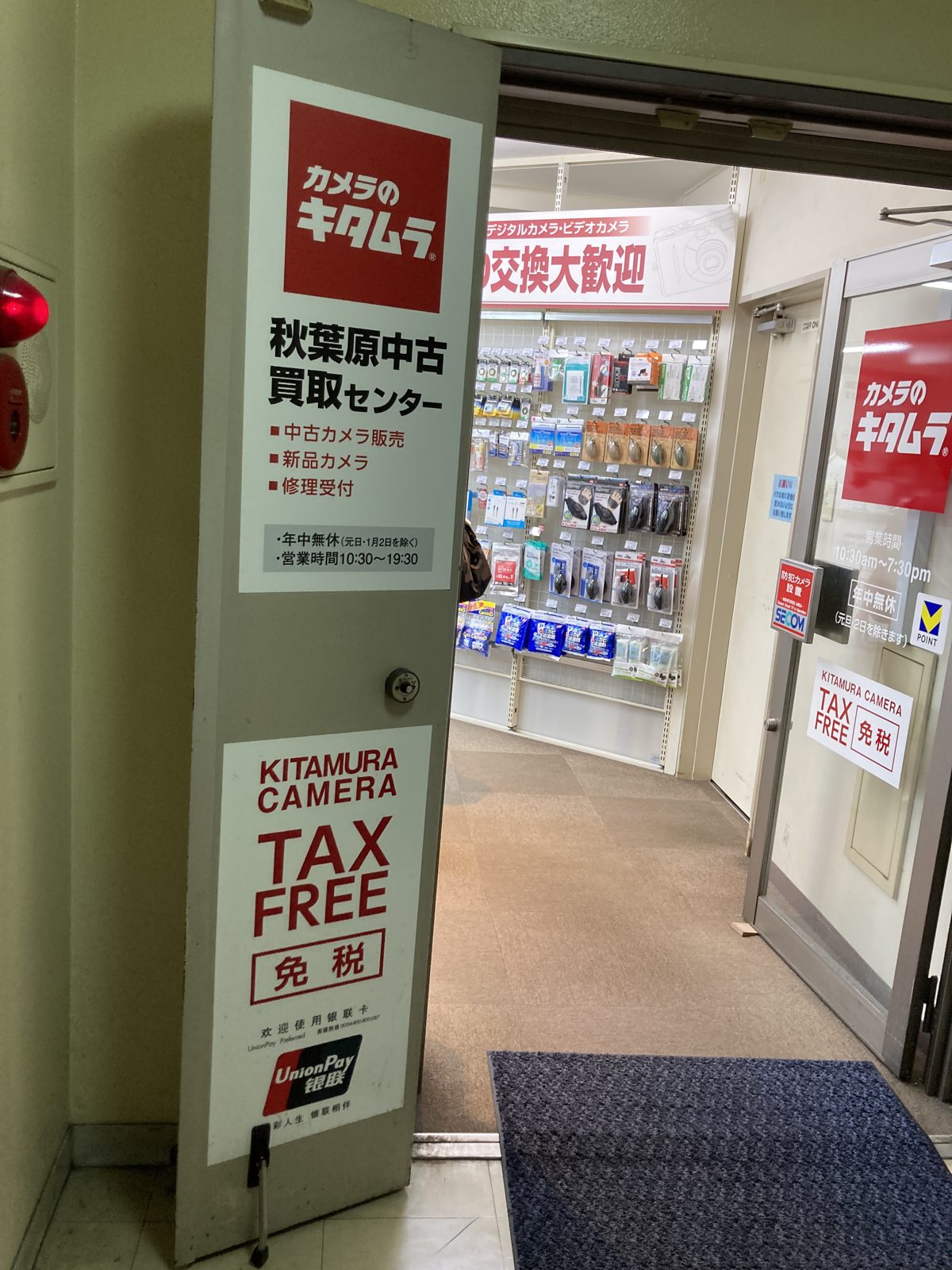
This is the easy win. Every price tag I saw in Akihabara was tax included (税込). The number on the tag is the number you pay at the register. No mental arithmetic at the counter.
You can often spot it in the number itself. Japanese consumption tax is 10%, so a tag that reads 12,100 yen is a round 11,000 yen before tax. Once you notice that pattern, the slightly odd-looking prices start making sense.
Two caveats. Tax-free purchasing is a separate process — if you go through it as a visitor, the amount changes, and shops handle the paperwork their own way. And I am describing the tags I saw, not a national rule; if a tag says 税抜 (tax excluded), the tax gets added at the register.
The words to learn
This is the core of the article. You do not need to read Japanese. You need to recognise maybe fifteen written shapes. Photograph a tag with your phone and compare it against this table — that works fine in a shop, and it is what I would do in a foreign country myself.
Faults
| Japanese | Reading | What it means |
|---|---|---|
| カビ | kabi | Fungus in the glass. The one to take most seriously. |
| クモリ | kumori | Haze — a milky cloudiness inside the lens. Cuts contrast. |
| キズ | kizu | A scratch. Can be on the glass or the body — the tag may not say which. |
| スレ | sure | Scuffs and rubbing on the exterior. Cosmetic wear. |
| チリ・ホコリ | chiri / hokori | Dust inside the lens. Very common, usually harmless. |
| 黄変 | ōhen | Yellowing of the glass, typical of certain older lenses. |
| バルサム切れ | barusam-gire | Separation — the cemented elements coming apart. |
| 絞り粘り | shibori-nebari | Sticky aperture blades. A mechanical fault, not a glass fault. |
Overall grade
| Japanese | Reading | What it means |
|---|---|---|
| 美品 | bihin | Excellent. Clean, well kept. |
| 並品 | namihin | Average. Normal used condition for its age. |
| 難あり | nan-ari | Has a defect. Usually the tag then says which one. |
| ジャンク | janku | “Junk” — as-is, often untested. Not the same as broken. |
Testing and sale terms
| Japanese | Reading | What it means |
|---|---|---|
| 動作確認済 | dōsa kakunin-zumi | Tested and working. |
| 動作未確認 | dōsa mi-kakunin | Not tested. The shop is not making a claim. |
| 現状品 | genjō-hin | Sold as-is, in its present state. |
| 税込 | zeikomi | Tax included. |
| 免税 | menzei | Tax free. |
If you learn only two of these, learn カビ and クモリ. Those are the two that change how a lens actually performs. And if you want the longer explanation of what “junk” really means on a Japanese shelf, it is in buying junk cameras in Japan.
A written fault does not mean a big discount
This one surprised me enough to write it down. I had assumed that a tag saying “fungus” or “haze” would come with an obviously low price. On the tags I saw, it did not.
Three examples from August 1, 2026:
- FD 50mm f1.4, tag reading haze and fungus marks — 10,000 yen (an Akihabara shop)
- Takumar 50mm f1.4, tag reading fungus — 20,000 yen (the same shop)
- SMC Takumar 50mm f1.4, tag reading yellowing — 12,100 yen (another Akihabara shop)
That is n=3. Three tags in one afternoon in one neighbourhood is not a market study, and I am not going to pretend otherwise. But it was consistent enough to change how I read a tag: the disclosure is information, not a discount signal. Do not assume “難あり” means cheap, and do not assume a clean tag is the reason a lens costs more.
For context, here is what the tags said on items with nothing noted, same day, same area: Canon AE-1 body only 60,500 yen and Ai-S Nikkor 50mm f1.4 30,000 yen at one Akihabara shop; Super Takumar 55mm f1.8 14,300 yen and a Rokkor at 6,600 yen at the same shop; two Canon AE-1s at another Akihabara shop at 33,000 and 36,000 yen. Prices move, so treat these as a sense of the level on one particular day.
More of the tags I saw, sorted by budget, are in How Much Does a Used Film Camera Cost in Tokyo?
How much English you get depends on the shop
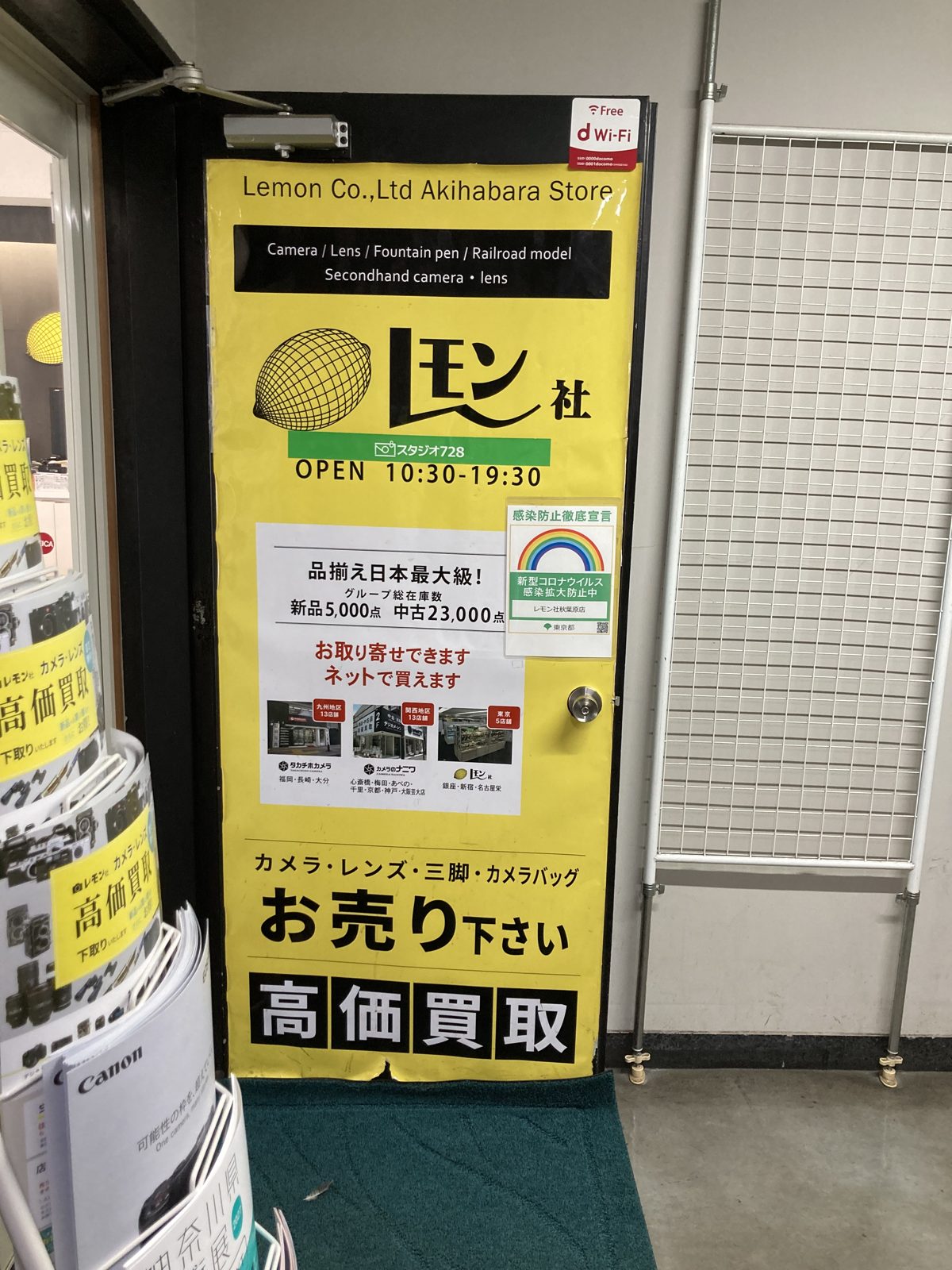
Three shops, three different levels, all within a short walk of each other in Akihabara:
- Lemon-sha Akiba — the condition rank on the price card has an English translation printed on it. This is the most helpful version of a price tag I have come across.
- Kitamura Akihabara used center — an English guide to the tag layout, but the item-by-item condition notes are Japanese only. Tax-free service and cards accepted.
- Tokyo CAMERA’s Junk Garage — no condition note at all. Price only, stuck onto the item. Lenses from around 3,000 to 5,000 yen. There is an English sign telling you that you are free to check things yourself, which is the shop being straight with you: nothing is written down, so go look.
Outside Akihabara I saw the same spread. Map Camera in Shinjuku has English signage and Tax Free displays; Lemon-sha Shinjuku handles English, tax free and cards. Fujiya Camera in Nakano has little English inside the shop, but there is an English floor map on the stairway landing and an English as-is notice on the junk annex door. My area write-ups are here: Akihabara and Nakano and Shinjuku.
The coloured sticker tells you how long it has been sitting there
A small detail worth knowing. At the Kitamura Akihabara used center, each item carries a small coloured sticker for the month it arrived. When I visited, blue was July and red was earlier than that.
The colours will have moved on by the time you read this — that is the point of the system. But the idea is stable: if you see two colours on a shelf, one of them is new stock and one of them is not. A red-sticker item that is still there has been passed over by every Japanese customer who walked by for a month or more. That is not automatically bad. It is one more piece of context the tag is quietly giving you.
Putting it together
The whole reading routine takes a few seconds once the words are familiar:
- Read the price as the final price. It is almost certainly tax included.
- Find the condition rank for the shop’s one-word summary.
- Read the specific faults — that is the real content. Look for カビ and クモリ first.
- Check the testing status: 動作確認済 (tested), 動作未確認 (untested) or 現状品 (as-is).
- If there is an arrival sticker, note whether the item is new stock or long-standing.
- Then check the item yourself anyway. The tag is the shop’s opinion, not a warranty.
That last step still matters, and my own routine for it is in what I check on every used camera.
None of this makes you fluent. It makes you able to stand in front of a shelf in Akihabara and understand what the shop is telling you — which, going by that English tag guide at Kitamura, is more or less what the shops would like you to be able to do anyway.
コメント