
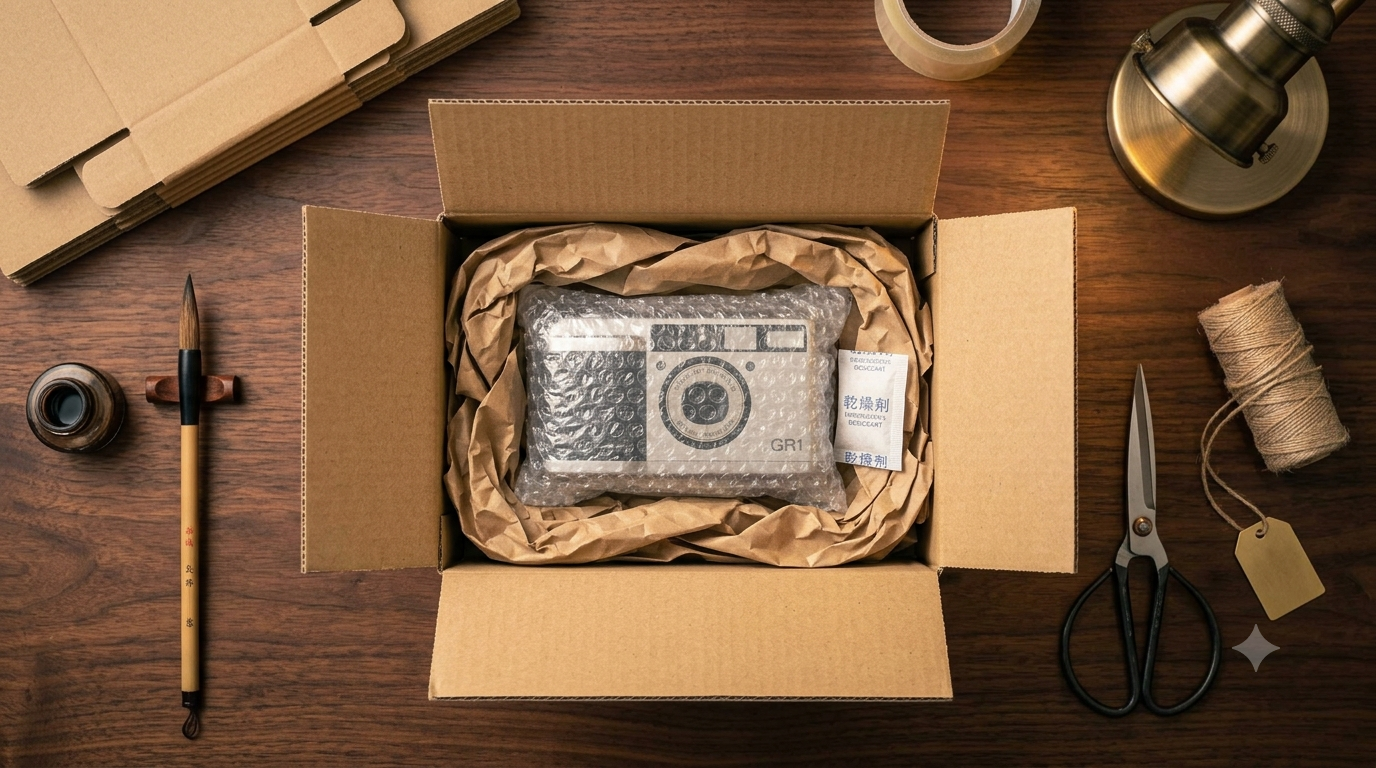
If you have ever bought a camera from Japan, you may have had this experience: the box arrives, you open it, and there is a moment of mild disbelief. Layer after layer of paper, bubble wrap wound around the lens like a cocoon, and somewhere in the middle, your camera — sitting perfectly still, as if it never left the shelf.
Buyers mention this a lot. In my own feedback, thank-you notes about the packing came up surprisingly often. So today, as a follow-up to my article on buying from Japanese sellers, I want to open the box from the other side: how I actually pack a camera, why the materials are what they are, and — the part I most want you to read — what I would ask of you, the person opening it.
One caveat before we start. This is my way of packing. I cannot promise every Japanese seller works like this. But I can tell you the thinking behind it, and I believe a lot of Japanese sellers share that thinking, even if the details differ.
Where my packing habits come from
Two jobs shaped how I pack. Years ago I worked at a parcel delivery company, receiving packages at the counter. Part of that job was a small ritual you have probably never seen: when a customer handed over a box, I would gently shake it. If something rattled inside, I would ask the customer’s permission, open the box, and pack the empty space with newspaper or bubble wrap until the contents could not move. The delivery side knows exactly which packages break — the ones with room to move.
These days I work at a camera shipping operation, so packing cameras for overseas buyers is literally my day job. What follows is the routine I use.
My packing routine, step by step
- Wrap the camera or lens in bubble wrap, three to four layers. Not one polite layer — three or four, wound around until the item is a soft, slightly ridiculous-looking ball. Depending on the item and the destination, a packet of silica gel goes inside the wrap too (more on that below).
- Build a nest in the box. I take bogus paper — a soft cushioning paper I will explain in a moment — loosely crumple three to four layers of it, and lay it in the bottom of the box, shaping a hollow that matches the item.
- Place the item in the nest and pack the sides. More bogus paper goes around the item until it sits snugly, with roughly 3–4 cm of cushioned space between the item and every wall of the box. (That margin is for bare items. If the camera still has its original maker’s box, that box already does the cushioning — so I choose a shipping box that fits it closely and line the gap with a thin layer of bogus paper instead.)
- Top layer. Another three to four loose layers of bogus paper go on top before the box is closed.
- The shake test. This is the old delivery-counter habit. I lift the sealed box and shake it. If I hear anything — the faintest shift or knock — I open it and repack. The box only ships when it is silent.
That silent box is the whole goal. A camera cannot be damaged by a drop it never feels, and it never feels the drop if it cannot move.
The materials, and why
What is “bogus paper”?
The crumpled paper filling most of the box is called bogus paper here in Japan — an odd name for a very honest material. It is a soft, unprinted recycled paper, a bit like newspaper stock but with no ink on it, sold in big rolls specifically as cushioning. Crumpled loosely, it springs back like a paper cushion. It is cheap enough to use generously, which matters, because generous is exactly how it needs to be used. Bubble wrap is the expensive armor that goes directly on the item; bogus paper is the affordable filling that does everything else.
Why not newspaper?
Practical reason first: like a lot of people in Japan these days, I simply do not buy a newspaper anymore. But there is a second reason that I think says something about how sellers here think. The thing in the box is not “my old camera” anymore — the moment you paid for it, it became merchandise, a product being delivered to a customer. And wrapping a customer’s product in old used newspaper feels, to me, slightly rude. Like handing someone a gift in a grocery bag. Clean, unprinted paper that was made to be cushioning feels right; yesterday’s news around your new lens does not.
Silica gel, and the pink signal
Japan is humid, and humidity is the natural enemy of lenses — fungus loves a damp lens. So at the shipping operation where I work, silica gel (the little desiccant packets) is not an afterthought; it is standard practice. Items wait in storage in zip-seal bags with silica gel inside. The packets we use hold blue beads that turn pink once they have absorbed all the moisture they can hold — pink means the packet is done working. Before an item ships, the packet gets checked — if it has gone pink, it is swapped for a fresh one, so the item travels with active protection, not a spent packet.
Why bother, when a courier like FedEx reaches the US in just two or three days? Because I do not know your weather. A package might sit in a hot, humid cargo hold, or clear customs in a tropical port. And honestly, with summers here lately, Japan itself is halfway to tropical. A fresh silica gel packet costs almost nothing and removes one entire category of worry.
A new box, with room to spare
The box itself is always new — a reused box has already been crushed once, and cardboard remembers. For a bare item, I size the box so there is that 3–4 cm of cushioned space on every side; if the item comes in its original maker’s box, I pick a shipping box that fits it closely and pad the small gap with a thin layer of bogus paper. (If you read my previous article, you may remember the shipping-insurance rule that demanded about 8 cm of cushioning — that is a separate, stricter standard for formal insurance. The 3–4 cm here is simply my own working margin for a box that passes the shake test without ballooning the shipping cost.)
Why are Japanese sellers like this?
I can only speak for myself with certainty, but here is my honest guess, and it is the same idea as the newspaper thing: the word merchandise. Once something is sold, it stops being a used camera and becomes a product owed to a customer, and a product should arrive the way a product would — clean materials, nothing rattling, nothing improvised. I do not think most sellers here could even articulate this; it is just the water we swim in. I will not claim every Japanese seller packs the way I do. But from what I have seen of packages in this country, the ones who take it seriously are not rare.
Now, a request for the person opening the box
This is the section I actually wanted to write, and it may go against advice you have read elsewhere.
You have probably heard the tip: always film yourself unboxing, so you have proof if something is wrong. Let me tell you how that looks from the seller’s side of the screen — because it is not what you would expect.
Think about how a person naturally opens a long-awaited camera. You are excited. You tear in. You lift it out, turn it over — and only then, if something is broken, does the mood crash. That is the natural sequence: joy first, discovery second. So when a buyer sends me a video where the camera starts recording before a perfectly clean, undamaged box is touched, narrating each step — my honest reaction is not reassurance. It is suspicion. Who films the routine opening of an intact box, unless they already plan to claim something? I once received an unboxing video so theatrical, so carefully staged over an unmarked box, that I found myself wondering if I was watching the setup for a scam.
So here is how I would put it — not “don’t film,” but match the camera to the box:
- If the box arrives clean and intact: just open it. Enjoy the moment. In the unlikely event something inside is wrong anyway, photos and a clear description afterward are what a seller actually needs — I covered exactly what to send in the previous article.
- If the box arrives crushed, punctured, or clearly abused: film the opening, absolutely. This is when a video is genuinely decisive. Photograph the box from all sides first, then record yourself opening it. A crushed box plus an opening video tells the seller in thirty seconds that this was a transit accident, and things move fast from there.
A damaged box is a reason to reach for your phone. An intact box is a reason to enjoy your new camera.
And one more thing you can read from the box, as a buyer: the packing itself tells you who you are dealing with. When you open a package and find the nest — the layers, the snug fit, the silence — you have learned something real about that seller, and it is worth remembering their name for next time. In my experience, sellers here who pack that way are not hard to find.
Summary
- My routine: 3–4 layers of bubble wrap → a nest of bogus paper below, around, and above → seal → shake test. If it makes a sound, it gets repacked.
- Bogus paper is clean, unprinted cushioning paper — used instead of newspaper, because your merchandise deserves better than yesterday’s news.
- Silica gel rides along, and a packet gone pink gets swapped for a fresh one before shipping — your camera travels with working protection against humidity.
- New box; 3–4 cm of cushion for bare items, a close fit with thin padding for items in their original maker’s box.
- Intact box? Open it naturally and enjoy. Damaged box? Photos of every side, then film the opening — that video solves cases fast.
- The packing is information: a well-packed box is the best seller review there is.
The next time a package from Japan takes you five full minutes to unwrap, you will know what all those layers were saying: somewhere on the other side of the ocean, someone shook the box, heard nothing, and decided it was ready to meet you.
コメント