
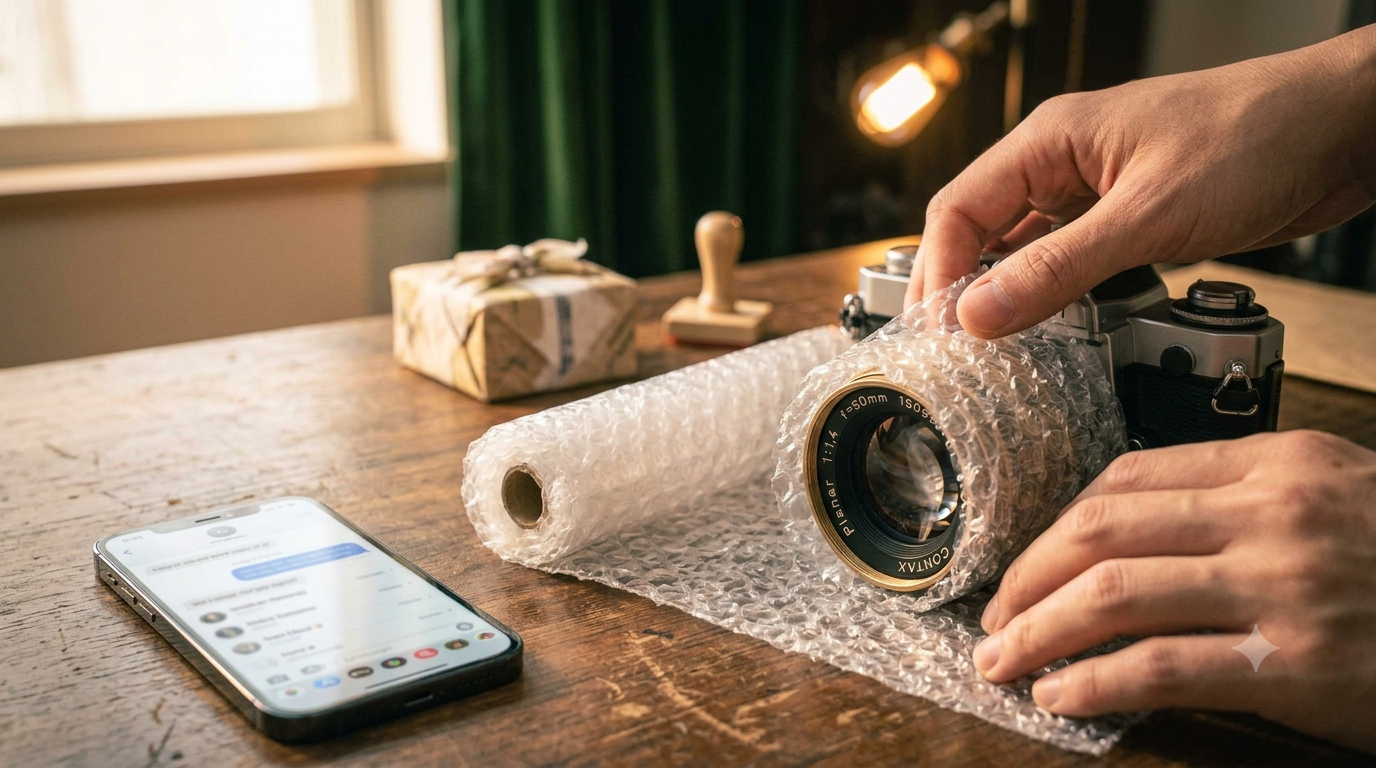
Last time, I explained how I actually grade cameras as a Japanese seller — what “Exc+++” and “Junk” really mean when I type them. That article got me thinking: there is a whole side of the transaction that buyers never see. What happens on the seller’s screen when your message arrives? What makes a deal go smoothly, and what makes it stall?
So today I want to open that door. Everything below comes from my own years of selling cameras from Japan on eBay — including one transaction that went badly wrong, which I will tell you about, because it taught me exactly what a buyer can do to get a problem solved fast.
What happens when your question arrives
Let me start with a confession. When a message notification appears, my honest first reaction is a small jolt: “Oh no, a question. What is it this time?”
Not because I dislike buyers. It is the language wall. For every message, my routine was the same: paste your English into a translation tool, read the Japanese, write my answer in Japanese, translate it to English, translate that English back to Japanese to check it still means what I intended, adjust, repeat. One short reply could take several round trips. Every message costs real effort on this side — which is exactly why a well-written question is such a gift.
How to ask questions a Japanese seller can actually answer
Here is what helps, from the seller’s chair:
- Be specific and short. “Does the aperture ring click at every stop?” is easy. “Hey, what’s the deal with this lens?” is a puzzle. The hardest messages I ever received were the ones where, even after translation, I could not tell what was being asked.
- One topic per message. A message with five mixed questions is five chances for a translation to go wrong. Short and single-topic gets you a faster, more accurate answer.
- Skip slang and abbreviations. “u,” “wanna,” “LMK,” “OBO” — translation tools regularly mangle these. Plain textbook English is not stiff or rude to us. It is kind.
- Mind the vocabulary gap. Camera part names and descriptions of behavior often differ between English and Japanese, and I sometimes spent a long time just figuring out which part a buyer meant. If you can, use the name printed on the camera itself, or describe the location (“the small lever on the front right, below the shutter button”).
- “Will this fit my camera?” — ask the internet first. This was the question I dreaded most, because back then I often simply did not know. Today, an AI assistant or a quick search answers most compatibility questions in seconds, in your own language. Save the seller messages for what only the seller can know: the condition of this exact item in their hands.
Negotiating, combining shipments, and the one request every seller refuses
Price offers: go ahead. In my case, I was selling my own gear, so haggling never bothered me — and honestly, a friendly negotiation is one way a buyer becomes a familiar face and then a repeat customer. Sellers who buy their inventory work on thinner margins, so a very low offer may simply get declined. But asking politely never hurt anyone.
Combined shipping: please ask. “Can you ship these together?” is a completely welcome request. On the seller’s side it only means recalculating the postage — mildly tedious, nothing more. If you are buying two or three lenses from the same seller, ask. You will usually save money and it costs the seller almost nothing.
“Can you declare a lower value?” — no, and please don’t ask. This request came to me constantly, even when my listings clearly said I could not do it. I always declined politely, and so will every other seller, because under-declaring the customs value is illegal. It is not a gray zone and it is not negotiable. A seller who says no is not being unfriendly — they are declining to commit a crime on your behalf.
When something goes wrong: my CONTAX RTS story
Now the part I most want you to read. In all my years of selling, I received exactly one negative feedback. It was on a CONTAX RTS, and it is still the transaction I think about most.
Here is what happened. I had sent that camera to an outside listing service, and it was listed based on their inspection, which said it worked. When it arrived overseas, it did not work. The buyer was furious — understandably — and wrote to me in very strong words. Meanwhile, the listing service shrugged: “It worked when we checked it. Must have broken in transit.” Caught between an angry buyer and an unhelpful middleman, I got frustrated — and I let that frustration leak into how I handled the buyer. The case ended with a refund, but by then the damage to trust was done, and the negative feedback was fair. Looking back, the buyer did nothing wrong. I failed to show them, quickly and clearly, that I was on their side.
Why do I tell you this? Because it shows what a return case looks like from the inside: a seller who cannot see the item, cannot see the box, and is reading angry sentences through a translation tool, trying to figure out what actually happened. Every other return I handled went smoothly — and the difference was almost always in what information reached me, and how fast.
What to send a Japanese seller when there’s a problem
- If the item arrived damaged: attach photos of the shipping box (all sides, especially any crushed corners) and the damaged part of the item to your return request. The box photos matter as much as the item photos — they tell the seller instantly whether this was a transit accident.
- If the item doesn’t work: attach a short video showing the problem. A video of a shutter not firing says in ten seconds what three rounds of translated messages cannot.
- State facts before feelings. Anger is human, and if you received a broken camera you have every right to it. But strong words have to survive machine translation, and what survives is often just noise. “Shutter does not fire. Video attached. I would like a refund.” — that message gets resolved fast.
Evidence is not about proving you are honest. It is about crossing the language wall in one step instead of five. In my experience, a return request with photos or a video attached gets solved in a fraction of the messages.
Why sellers get nervous about damage reports
One piece of background that explains a lot of seller behavior. You might assume that if the box arrives crushed, the carrier pays. In my experience, that almost never happens — DHL or FedEx compensating the seller for transit damage is rare in practice. And formal shipping insurance? The conditions I dealt with required something like 8 cm of cushioning material around the entire item, which balloons the package size, which balloons the shipping cost. So most sellers I know simply do not use it.
The result: when your camera breaks in transit, the seller usually eats the loss personally. That is why damage reports make sellers tense, and why clear evidence from you — box photos, item photos, a video — is met with relief, not suspicion. You are handing the seller exactly what they need to make a fast decision.
By the way, this is also why a seller may say “keep the item, here is a full refund” on a cheaper item instead of asking you to send it back: return shipping across the ocean can cost more than the item’s profit ever was. In my case, I asked for the item back only on expensive pieces. If a seller refunds you without a return, it is not carelessness — it is arithmetic.
The easiest way to make a seller’s day
Two small things, and I promise they are noticed.
First, a smooth transaction — paying promptly, confirming arrival — is quietly appreciated more than you would guess.
Second: leave feedback. In my experience, only about one in three buyers ever does. Every seller I know checks their feedback, and a short positive note from the other side of the world genuinely lands. If a Japanese seller packed your camera well and it arrived as described, thirty seconds of your time is the best thank-you there is.
Summary: the buyer’s cheat sheet
- Questions: specific, short, one topic per message, no slang or abbreviations.
- Compatibility questions: ask AI or search first; ask the seller about the item’s actual condition.
- Price offers and combined shipping: both fine to ask, politely.
- Lower customs declaration: never — it is illegal and every seller will refuse.
- Damaged arrival: photos of the shipping box + the damage, attached to the return request.
- Not working: a short video, attached to the return request.
- Facts first, feelings second — plain sentences survive translation; anger often doesn’t.
- Leave feedback. Only about a third of buyers do, and it matters more than you think.
Sellers are human beings on the other side of a language wall, refreshing the same order page you are. The buyers I remember most fondly were not the ones who never had problems — they were the ones whose messages made problems easy to solve.

コメント