
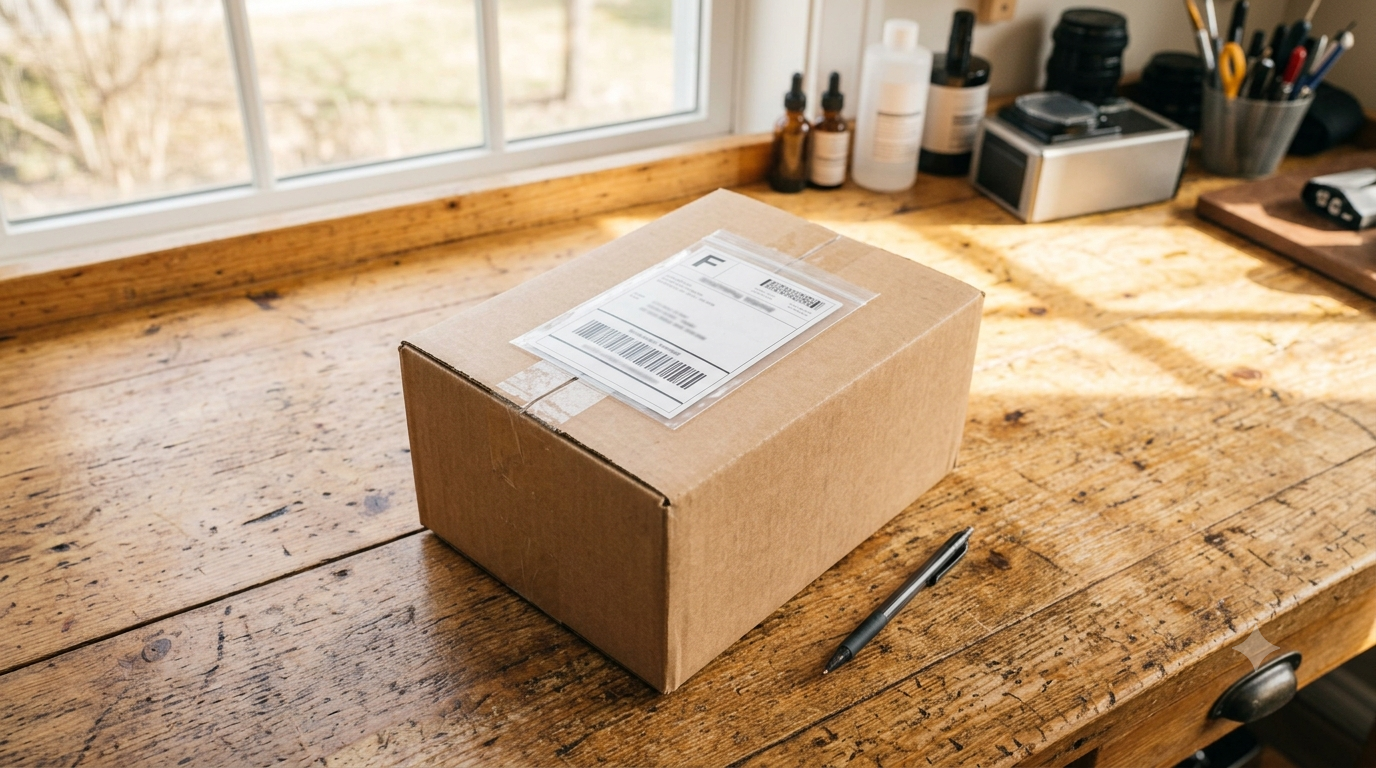
Last time I wrote about how I pack a camera, and I stopped at the moment the tape goes on. The box is silent, it passes the shake test, and it sits by the door.
But for you, that is not the end of anything. That is where the waiting starts. You refresh the tracking page. Nothing moves. You wonder whether something went wrong.
So today I want to keep going from where the last article stopped: what actually happens on shipping day, what paperwork travels with your camera, how long it really takes, and what it means when the tracking looks frozen.
One thing to set straight first. Everything below is my routine, and I used FedEx. Plenty of Japanese sellers use Japan Post, DHL, or something else entirely, and their day looks different from mine. Treat this as one seller’s version of the day, not the national standard.
Shipping day, step by step
It is less dramatic than you might think. With FedEx, my day goes like this:
- Create the shipping label on the FedEx website. Your address, my address, the weight, the service.
- Download the PDF and print it.
- Slide the label into a pouch. That is the clear plastic document sleeve couriers provide — the one you peel off your own package when it arrives. It goes on the outside of the box.
- Wait for the pickup. I do not drive the box to a counter; the courier comes to collect it.
That last point matters more than it sounds, and I will come back to it when we talk about weekends.
The customs paperwork
If your country requires a commercial invoice, that gets prepared too. FedEx supplies a template, so it is mostly a matter of filling in the blanks:
- My name, address and phone number, and yours
- The sale price
- The item name
- The weight
- A handwritten signature at the bottom
Because there is a template, this part is not difficult. It is just a form, and it is the same form every time.
Where it stops being a formality is the sale price line. That is the box a buyer occasionally asks a seller to fill in with a smaller number — and it is the same request I wrote about in my article on buying from Japanese sellers. Now you can see exactly what is being asked for: a signed customs declaration with a false figure on it, signed by name. That is why the answer is no, and why a seller who says no is protecting you as much as themselves.
One more piece of good news for readers in the US. Many countries now accept ETD — electronic trade documents, meaning the invoice travels as data instead of paper. The US is usually fine with it. When ETD is available I use it, and that removes one whole category of “the paperwork got separated from the box” problems.
How long it actually takes
For my shipments from Japan to the US by FedEx, the basic figure is two to three days.
People are often surprised by that. Japan feels far away on a map, but the courier lanes out of here are busy and well run, and a camera can genuinely be on your desk within the same week you paid for it.
Please read that number narrowly, though. It is the US, by FedEx, in my experience. Other destinations run on different schedules, and other shipping methods — economy post in particular — are in a completely different league, sometimes weeks. If speed matters to you, the service the seller chose matters far more than the country it left from.
Three reasons it can look slow
Here are the things that actually cause a delay in my experience. None of them are the thing buyers usually fear.
1. The weekend
Remember that the box waits for a pickup. No pickup runs on Saturdays, Sundays, or Japanese public holidays. So a camera that is packed and sealed on a Friday evening does not begin its journey until Monday — and if Monday happens to be a holiday here, Tuesday. Nothing is wrong. The box is simply sitting there, sealed, waiting for a truck. Japan also has a run of public holidays that foreign buyers rarely have on their calendar, so a quiet weekend can occasionally stretch a day longer than you expected.
2. A problem with my paperwork
This one is on the seller’s side, so I will say it plainly: if there is an error on the label or the invoice, the local depot can send the package back. It has happened. You fix the form, hand it over again, and a day or two is gone.
It is a frustrating way to lose time, and it is exactly why I do the label and the invoice unhurried rather than at the end of a long day. But from your side, the important thing to know is what it looks like: the tracking shows some movement, then stops, then starts again from the beginning. That pattern is usually a corrected document, not a lost camera.
3. Customs
Occasionally a package is held for inspection. This is rare in my experience, and it is not a sign that anything is wrong with the shipment — customs pulls packages as a matter of routine. It is the one stage neither of us can hurry, and it usually resolves on its own.
Notice what is not on this list: the camera being lost, or the seller quietly not shipping. In practice, “slow” almost always means Saturday, a form, or a queue.
About tracking
Here is a small fact I find genuinely interesting: in all my selling, I have never once had a buyer message me to say the tracking was not updating.
I do not think that is because nothing ever stalled. I think it is because buyers can see everything I can see. Your eBay order shows the tracking number, that number links straight to the courier’s own tracking page, and that page is the same page I look at. There is no seller-only dashboard with extra information. If you want more detail than the page shows, you can call the courier yourself — and for a package already in your country, their local office often knows more than I do sitting in Japan.
So my advice when the tracking worries you: look it up yourself first. Open the courier’s page directly, not just the summary line in the marketplace app, which sometimes lags behind. Nine times out of ten the answer is already there — a scan you had not seen, or a timestamp that explains the gap.
And then message the seller anyway if you are still uneasy. Truly. A buyer asking a calm question is not a nuisance; it is a normal part of the job, and most sellers would much rather answer it than have you sitting there worrying. Just know that the first thing we will do is open the same tracking page you already have.
Summary
- My shipping day: create the label on the courier’s site, print it, put it in the pouch on the box, wait for pickup. Other Japanese sellers use other couriers and other routines.
- The customs invoice lists both addresses, the sale price, the item, the weight, and a handwritten signature. The sale price is the line a seller cannot alter — it is a signed declaration.
- ETD (paperless customs documents) is accepted for most US shipments, which removes one source of trouble.
- Japan to the US by FedEx, in my case: about two to three days. Other countries and other services vary widely.
- Looks slow? Usually a weekend or a Japanese holiday, sometimes a document error that got the package returned to the depot, occasionally a customs check.
- You can see the same tracking page I can. Check the courier’s own site first — and ask anyway if you are still unsure.
If you want to know what happened before the box was packed, that part is in what I check before listing a camera. Between that, the packing, and today’s shipping day, you now have the whole path your camera takes from a shop shelf in Japan to your front door — including the two days when it looked like nothing was happening at all.


コメント