
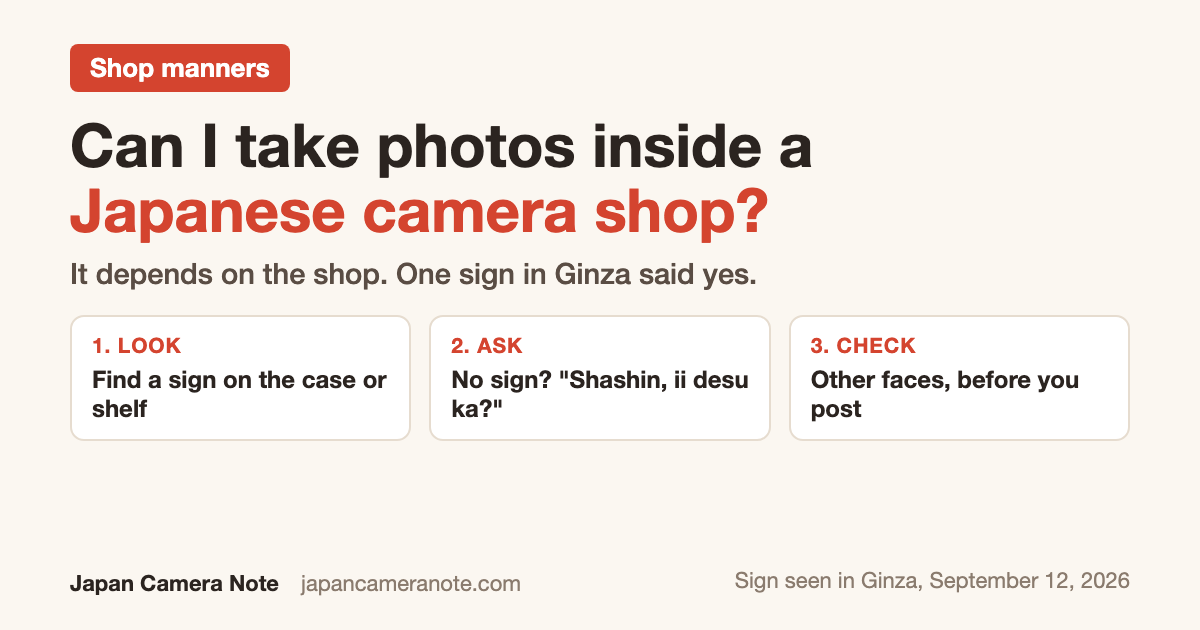
It depends on the shop. Look for a sign, and if there is no sign, ask before you take a photo.
On September 12, 2026, at Lemon Camera Ginza, a sign on a glass shelf said yes in two languages. The English line read: “OK! You can take photos at this store! You can use photos on social media.” It is the only camera shop on my Tokyo walks where I took photos of the shelves.
If you have read my camera shop etiquette guide, you may remember that I wrote I don’t photograph inside shops, and that you shouldn’t either unless you ask and get an OK. I wrote that in July, before Ginza. Both are true. The default is “don’t.” A sign like Lemon’s is the OK.
Can I take photos inside a Japanese camera shop?
Sometimes yes, sometimes no. There is no single rule for every shop. I can only tell you what one shop’s sign said, and what I did in the others.
Here is a simple order to follow:
- Look for a sign. Check the glass cases, the shelves and the counter.
- No sign? Ask. The staff are usually near the cases anyway, because most good cameras are behind glass.
- If the answer is no, put your phone away. That is a normal answer. It is not about you.
What did the sign in Ginza say?
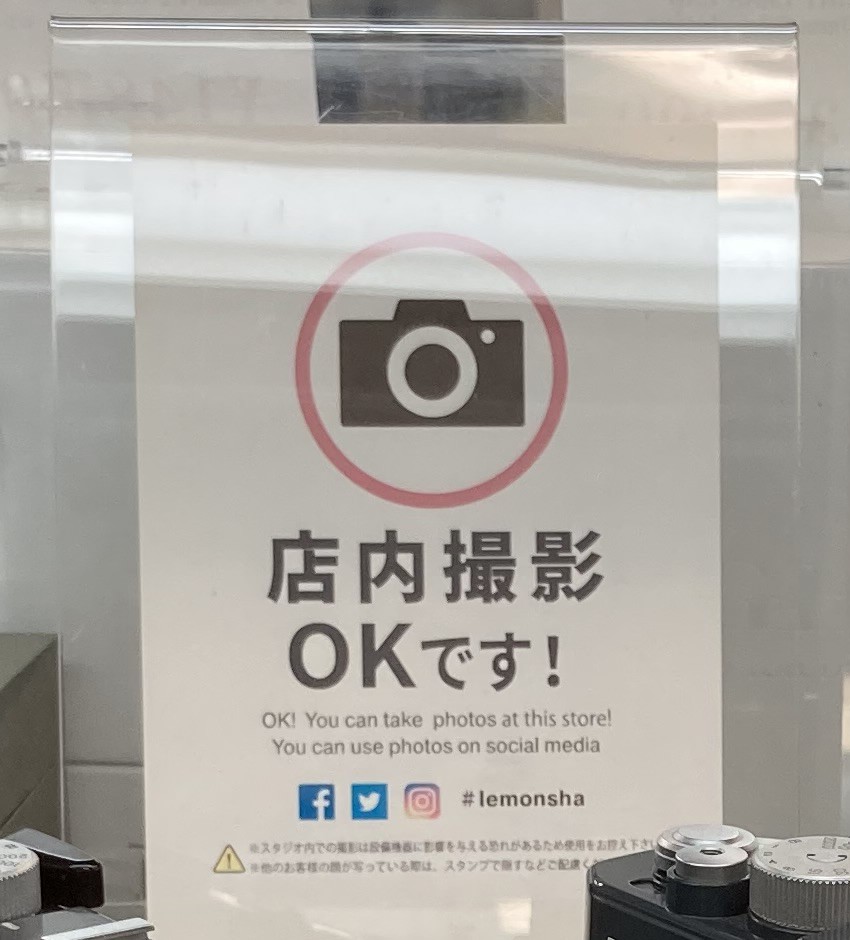
The big Japanese words say “Photos inside the shop are OK!” Under them are the two English lines, three social media icons and the hashtag #lemonsha.
At the bottom there is small print in Japanese, next to a warning triangle. I zoomed in on my photo to read it. The second line, as far as I can read it, asks you to hide other customers’ faces, for example with a stamp, when they are in your photo. The first line seems to be about the shop’s photo studio, and I could not read all of it.
I remember thinking a sign like this was unusual. With the sign there, I took photos of the shelves and the price tags. I did not ask the staff first. The sign had already said yes, so I took a lot of them. That is why my Lemon Camera Ginza guide and my used Leica guide can show you real tags.
One more thing: on October 19, 2026, I looked through Lemon’s website and did not find anything about taking photos in the shop. So the sign I saw on September 12 is my only source. If it is not there when you visit, ask.
What did I do in the other shops?
In July, when I walked Nakano and Shinjuku, I made a simple rule for this blog: no photos inside the shops, only the outside from the street. My Akihabara photos in August are shop fronts and signs, too. In Ginza in September, I took photos inside only at Lemon. At the other Ginza shops, I photographed from the sidewalk.
I do not know the photo rules of those other shops, because I did not ask. So I cannot tell you which ones say yes or no.
Even the outside can feel awkward. At Sankyo Camera, I was taking a photo of the shop from the sidewalk when I met the eyes of a staff member through the glass. I walked on and never went in. What I took away from it: at a small shop, take the outside photo after your visit, not before.
How do I ask?
Start with “excuse me,” then ask:
- “Ano… sumimasen. Shashin, ii desu ka?” (Excuse me. Is it OK to take a photo?)
Hold up your phone and point at the shelf you want to photograph. That makes the question clear, even if your Japanese is not. You can also show the Japanese on your phone screen: 写真、いいですか?
A nod or “Douzo” (go ahead) means yes. Hands crossed in an X, or a polite “sumimasen” with a small shake of the head, means no. More phrases are in asking in Japanese camera shops.
Can I photograph a price tag to compare later?
It is the same question as any other photo in the shop, so it gets the same answer: a sign, or ask. I understand why you want to. The tag holds most of what you need to know about a used camera, as I explain in how to read Japanese price tags.
If photos are not OK, write the details down instead: the model, the price, the condition rank and any warranty. A note on your phone works fine.
What about the window from the sidewalk?
All of my outside photos were taken from the street. Two things happen there that are easy to miss.
- People walk into your photo. After I published my Shimizu Camera guide, I noticed two men walking past at the edge of a window photo. I cropped them out and replaced the photo.
- Glass shows you more than you think. Window and door glass can show the staff inside, or reflect people on the street. Two of my shop door photos showed people inside, so I blurred them before I used the photos.
If I post it, what should I check first?
Before you post, zoom in on your own photo and check three things:
- Faces. Other customers, staff, and people in the glass. Lemon’s own sign asks you to hide other customers’ faces.
- The shop’s rule on that day. A sign I saw in September may not be there when you visit.
- What the shop said you can do. Lemon’s sign said photos and social media. Another shop might say yes to a photo but not say anything about posting it. If you plan to post, say so when you ask.
That is all. Look for the sign, ask if there is none, and check faces before you post. For everything else about behaving in the shop, see my camera shop etiquette guide. The full Ginza day is in my Ginza camera shop walk, and the whole site starts at the Japan camera shopping guide.
Official page
I read this on October 19, 2026. Hours and rules change, so please check before you go.
- Lemon Camera: shops and hours (Japanese). Lemon Camera Ginza is on the 8th floor of 4-2-1 Ginza, open 10:30–19:30.
コメント