
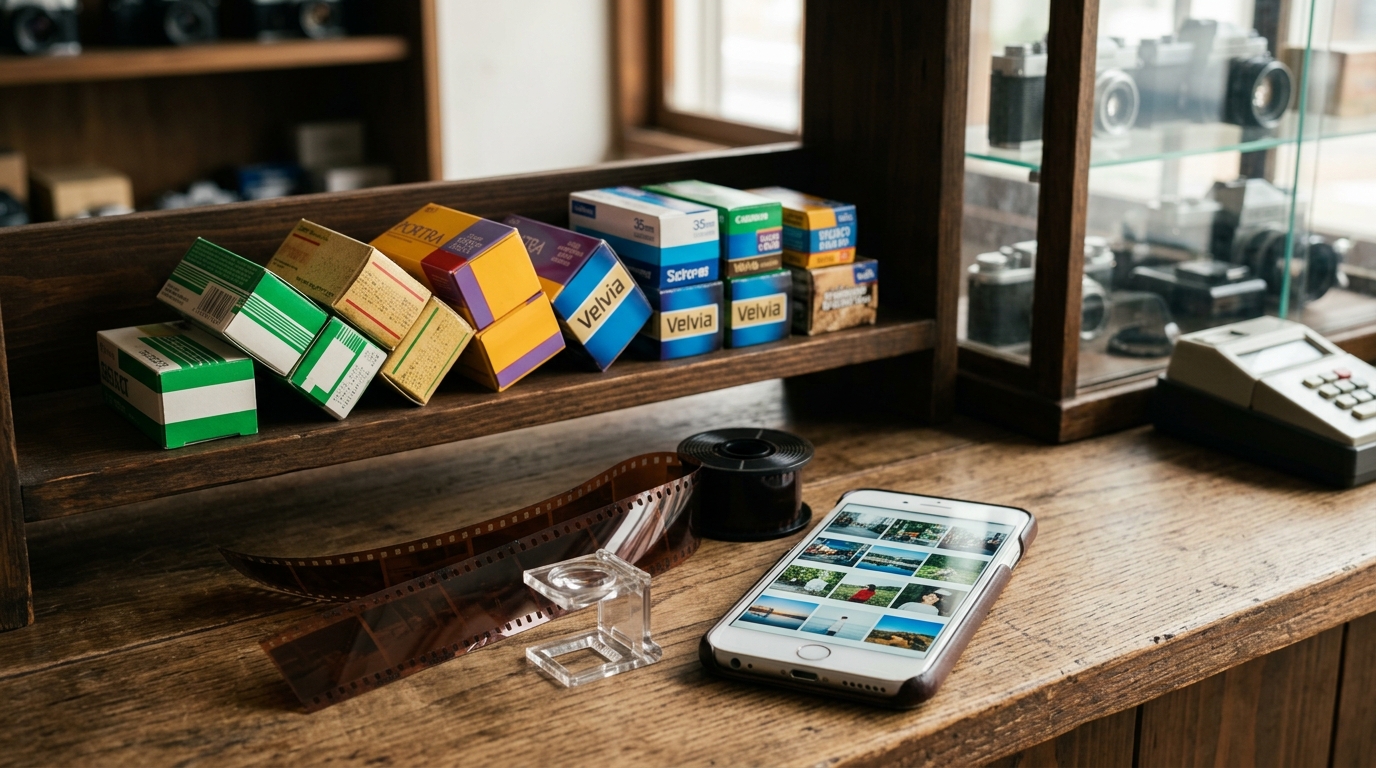
In my last article about film and airport scanners, one fact stood above everything else: the new CT scanners can fog undeveloped film, but developed film is safe. Kodak says it, Fujifilm says it, and it points to a simple move — if your shot rolls are developed before you board, the scanner problem mostly disappears for them.
Which raises two very practical questions: where do you buy film in Tokyo in the first place, and can you really get it developed before you fly home? This article answers both, with prices and turnaround times from the shops’ own websites, all checked on September 7, 2026. Prices for film move constantly these days, so treat every number here as a dated snapshot, not a promise.
One thing before we start, as always on this site: I sell cameras from Japan for a living, but I did not walk into these labs this week and time them with a stopwatch. What I saw with my own eyes, I’ll say so. Everything else comes from official pages, with links and dates so you can check for yourself.
Part 1: Buying film in Tokyo
Where the film is
The easy answer is the big electronics stores: Yodobashi Camera and Bic Camera. Both have film sections, both have stores at the major hubs (Shinjuku, Akihabara, Yurakucho, Shibuya and more), and Yodobashi’s website even shows how many of its stores currently stock each film — the Kodak Gold listing showed in-store stock at 18 locations on the day I checked. You will not have to hunt.
The more enjoyable answer is the camera shops themselves. On my Akihabara walk, 2nd BASE had one of the better film shelves I saw that day, with a sample booklet next to it showing how each film stock actually renders — you flip through real photos instead of guessing from box art. While I was in the shop, a visitor from overseas came in, bought film, and left. No cameras, no browsing. That is a normal thing to do there, and if you’re following my one-day Akihabara route, it’s an easy restock point. I didn’t memorize their shelf prices, so I can’t compare them with the big stores — I can only tell you the selection was wide.
What film costs right now
These are Yodobashi.com online prices as of September 7, 2026. Online and in-store prices are usually close at the big chains, but I can’t guarantee they match on any given day. Dollar figures are rough conversions at about 155 yen to the dollar, the rate in early September 2026 — it moves daily. I tried to check Bic Camera’s online store the same day for comparison, but the site wouldn’t load for me, so this table is Yodobashi only.
| Film | Price (Sept 7, 2026) | Stock note |
|---|---|---|
| Kodak Gold 200, 36 exp. | ¥2,260 (about $15) | In stock, listed at 18 stores |
| Kodak Portra 400, 36 exp. × 5-pack | ¥24,000 (about $155; ¥4,800 / $31 per roll) | Low stock warning |
| Ilford HP5 Plus, 36 exp. | ¥1,960 (about $13) | In stock, listed at 21 stores |
| Fujifilm QuickSnap (写ルンです), 27 exp., current model | ¥2,990 (about $19) | In stock, listed at 22 stores |
Three things worth noticing in that table:
- Portra 400 was listed only as a 5-pack at Yodobashi, and with a low-stock warning. If you want a single roll of Portra, a camera shop like 2nd BASE may be the more realistic place to find one — though I can’t quote their price.
- The QuickSnap is not the cheap toy it used to be. The current 27-exposure model is ¥2,990. People remember these costing pocket change; that era is over. It’s still a lovely thing to hand a friend, but budget for it like a real purchase — and remember from the scanner article that an undeveloped QuickSnap needs the same hand-check care as any film.
- Black and white is the bargain. HP5 Plus at ¥1,960 was the cheapest 36-exposure roll of the group.
Whether these prices beat your home prices, I’ll leave to you — you know what your local shop charges. What Japan reliably gives you is availability: the film exists, on a shelf, today, in a dozen stores you were probably visiting anyway on a camera shopping trip.
Part 2: Developing film before you fly
Here is the part that connects back to the scanner article. All three big chains below take walk-in film development at the counter. The differences are speed and options, and for a traveler the speed difference is enormous — from one hour to one week — so read the fine print.
Camera no Kitamura — the fast option
Kitamura’s official development page lists color negative development (35mm and APS) at ¥950 (about $6), with finished film ready in “as fast as 1 hour” — for in-store pickup only. Two caveats, straight from their own pages: not every store can do the 1-hour service, and busy days take longer. Their Shibuya store’s page, for example, quotes “as fast as 2 hours”. So the realistic promise is: same day at a store that develops in-house, exact speed depending on the store and the queue.
For data — which is what most travelers actually want — Kitamura’s QuickSnap page lists smartphone transfer at ¥880 per roll, a development-plus-transfer set at ¥1,830 (about $12), CD writing at ¥680, and a higher-resolution 13-megapixel option for an extra ¥1,100. Development plus scans to your phone for about twelve dollars a roll, potentially within hours, is the single best deal for a traveler that I found in this research.
One note: Kitamura also runs used-camera specialty stores — the Akihabara shop I wrote about is one of those. The development counter lives in their regular photo stores, so check the store type before you carry your rolls across town. Black and white and 120 film: their page says these are accepted but tells you to ask the individual store.
Bic Camera — good speed, one trap to avoid
Bic’s official price list has color negative development from ¥720–930 depending on which lab handles it, and — unusually for a walk-in chain — black and white and slide (reversal) development on the same menu. All of it is counter service at the store; the price page doesn’t state turnaround times.
The time information is on their smartphone transfer page, and this is where travelers need to read carefully. Bic offers two ways to get your film onto your phone, both ¥1,600 (about $10) at standard resolution:
- Direct transfer at the counter: about 2 hours — but only at stores that process film in-house. At other stores the same service takes about two weeks.
- Download type (QR code): about 2 weeks — and here is the trap: with this plan, your negatives are not returned unless you pay an extra ¥814 per roll and come back to the store later to collect them.
Two weeks and a return visit is useless to someone flying out on Friday. If you use Bic, the traveler’s version is the direct transfer at an in-store processing location — and their published store list for that service includes the big central ones: Bic AKIBA (yes, on the Akihabara route), Shinjuku West, Ikebukuro, Yurakucho, Shibuya East. Confirm at the counter that your store processes in-house before you hand anything over.
The slide film note deserves repeating, in the other direction: Bic lists E-6 development (from ¥1,050 for a 24-exposure roll at the cheaper lab), which is genuinely useful — but no turnaround is published, and lab work like this typically isn’t a same-day affair. If you shoot slide film on a short trip, don’t build your plan around developing it here; ask first, and be ready to carry it home undeveloped with a hand check.
Yodobashi — fine for buying, slow for developing
This one surprised me. Yodobashi’s official development page lists development-only at ¥930 with a turnaround of about one week, and its smartphone data plans (¥1,600 standard / ¥2,900 large) at 3–5 days, with negative return as a ¥682 option on the data plan. Perfectly good prices — but on a one-week trip, a one-week turnaround means your film flies home without you. Buy your film at Yodobashi if it’s convenient; develop it at Kitamura or Bic if time is short. If you’re in Japan for a month, ignore this paragraph.
The plan: a timeline that beats the scanner
Put the two halves together and the trip looks like this:
- Day 1–2: Buy your film. Big stores for stock and predictable prices, camera shops like 2nd BASE for the fun of choosing from a sample book.
- During the trip: Shoot. Keep finished rolls together in one pouch so nothing gets lost or double-loaded.
- Two or three days before you fly — not the last day: Drop your shot rolls at a Kitamura photo store or an in-house-processing Bic. Order development plus smartphone transfer. “As fast as” times are best-case; queues, store differences, and B&W/slide film can all add days. The buffer costs you nothing. The missed pickup costs you every photo from the trip.
- Departure day: Your developed negatives can ride in any bag — every maker agrees developed film doesn’t care about scanners — and the images are already on your phone as backup. Any unshot rolls you’re taking home still need the old routine: clear plastic bag, carry-on, hand inspection requested.
What I could not confirm
- English support at the counters. None of the official pages I checked say anything about English service at the film counters, so I won’t claim it either way. The order is simple enough that a few words carry you: hand over the film and say 「現像お願いします」 (genzō onegai shimasu — “development, please”), then 「スマホ転送もお願いします」 (sumaho tensō mo onegai shimasu — “smartphone transfer too, please”). To ask when it’s ready: 「いつできますか?」 (itsu dekimasu ka?). If speaking up feels daunting, the same short-phrase approach I use in camera shops works at a print counter.
- In-store prices. The film prices above are Yodobashi’s online listings for one day. I did not verify shelf tags in stores that day, and Bic’s online store wouldn’t load for me at all, so I have no Bic film prices to give you.
- Which exact stores develop in-house. Both Kitamura and Bic say speeds vary by store. Ask before you commit your rolls, especially if your flight is close.
Summary
- Film is easy to find in Tokyo: Yodobashi and Bic at every hub, plus camera shops like 2nd BASE in Akihabara with a wide shelf and a sample book.
- Sample prices on September 7, 2026 (Yodobashi online): Gold 200 ¥2,260, HP5 Plus ¥1,960, Portra 400 ¥4,800/roll in a 5-pack, current QuickSnap ¥2,990. Snapshot, not promise.
- Developing before you fly is realistic: Kitamura from ¥950 with same-day service at in-house stores (“as fast as 1–2 hours” per their pages); Bic direct smartphone transfer about 2 hours at in-house stores including AKIBA.
- Avoid the slow paths: Bic’s download plan (about 2 weeks, negatives not returned by default) and Yodobashi development (about a week) don’t fit a short trip.
- Drop your rolls off with days to spare, not hours. Then fly home with developed negatives, scans on your phone, and only your unshot film left to hand-check.
Sources
- Yodobashi.com product listings — film prices and stock notes (checked September 7, 2026)
- Camera no Kitamura — Negative Film Development (checked September 7, 2026)
- Camera no Kitamura — QuickSnap Development & Data Services (checked September 7, 2026)
- Camera no Kitamura Shibuya — Film Development Service (checked September 7, 2026)
- Bic Camera — Film Development & Print Price List (checked September 7, 2026)
- Bic Camera — Film-to-Smartphone Transfer Service (checked September 7, 2026)
- Yodobashi Camera e-Photo — Film Development Plans (checked September 7, 2026)


コメント