
Let me start with something you should know about the person writing this: I have never been on an airplane. Not once. I live in Japan, I sell cameras to people overseas, and the flying is always done by someone else — a cargo plane, or you.
So why is a person who doesn’t fly writing about airport scanners? Because if you buy film in Japan — and many of you do, next to the junk cameras and the beautiful used bodies — the trip home is the one part of the purchase I can’t help you with from experience. And it happens to be the part people worry about most. “Will the airport scanner ruin my film?” is a real question with real money attached.
What I can do is read. So I spent a day going through what the film makers and the authorities actually publish about this, in Japanese and English, and collected it here with sources and dates. Nothing in this article is a travel story of mine, because I don’t have one. Everything is “Kodak says”, “Fujifilm says”, “the airport’s own website says” — checked as of September 2026, with links so you can verify it yourself.
What changed: X-ray vs. CT scanners
For decades, the standard advice was that airport X-ray machines for carry-on bags were fairly gentle on film. That era is ending. Airports around the world have been replacing the old machines with CT scanners — the newer type that builds a 3D image of your bag, using stronger energy to do it.
The film makers are unusually blunt about what this means. Kodak’s motion picture division states on its official site that the new CT scanners “have been proven to fog all unprocessed film”, and that high-intensity scanners “will fog and ruin unprocessed film of any speed, whether exposed or not” (kodak.com, checked September 2026).
Kodak Alaris — the company behind the still films like Portra and Gold — says on its site that it “strongly advises against putting any unexposed or exposed but unprocessed film through a CT Scanner” (kodakprofessional.com, checked September 2026).
Fujifilm published an official notice saying the newer scanners are more damaging to film than the previous generation, that fogging can occur from a single pass, and that this covers all photographic film — exposed or not — plus motion picture film, instax film, and the QuickSnap single-use camera (Fujifilm official notice, PDF, dated February 2020, checked September 2026).
One more thing all of them agree on, and it matters: developed film and prints are not affected. Fujifilm’s notice says developed film and photographic images are normally not affected by X-ray or CT scanners. The problem is only film that hasn’t been developed yet — which is exactly what a fresh brick of Portra from a Tokyo shop is.
“Is my ISO 400 film safe, then?”
You may have seen an old rule of thumb: film under ISO 800 is fine in the carry-on X-ray. I went looking for that number on the official pages, and here is what I found — and didn’t find — as of September 2026:
- The TSA’s film page does not mention any ISO threshold. It simply recommends hand inspection (more below).
- Kodak’s pages don’t give a safe ISO for CT scanners — the opposite, they say all speeds are affected.
- Fujifilm’s Japanese FAQ for the QuickSnap does single out the ISO 1600 version as a case where hand inspection is the safest option even for domestic flights, and recommends hand inspection for any film on international trips (Fujifilm FAQ, checked September 2026).
So the short version, staying strictly inside what the makers publish: with CT scanners there is no “safe ISO” anymore. Whether one pass will visibly hurt your ISO 200 negatives, I can’t tell you — I have no way to test it, and I won’t pretend. But the companies that make the film tell you not to find out, and that’s the advice I’d follow with film I’d just paid for.
The two rules everyone agrees on
Rule 1: Never put undeveloped film in checked baggage. This is the loudest, clearest point in every source. Kodak Alaris: “Do not check your film; Checked bags are also CT scanned.” Kodak’s motion picture page: “Never pack unprocessed film in baggage that will be checked.” Fujifilm says the same — carry it into the cabin, and specifically warns against putting instax film (or an instax camera or printer with film inside) into checked baggage. A small consolation from that same notice: an instax camera without film in it is fine anywhere.
Rule 2: Keep it in your carry-on and ask for a hand inspection. The TSA’s official page says: “We recommend that you put undeveloped film and cameras containing undeveloped film in your carry-on bags or take undeveloped film with you to the checkpoint and ask for a hand inspection” (tsa.gov, checked September 2026). Fujifilm goes further: ask for the hand check every time, regardless of the film’s speed.
How to actually ask — the phrases
A hand inspection (also called a hand check) means the officer looks at your film directly instead of sending it through the machine. Here is how to ask for one, in both directions of your trip.
At a Japanese airport:
- フィルムが入っています。手検査でお願いできますか?
Firumu ga haitte imasu. Tekensa de onegai dekimasu ka?
(“There is film in here. Could I have a hand inspection?”) - The key word is 手検査 (tekensa) — hand inspection. Staff also understand ハンドチェック (hando chekku), the katakana version of “hand check”. If words fail entirely, holding up the clear bag of film and saying “firumu” while gesturing away from the machine communicates a lot. If speaking up in Japan makes you nervous, I’ve written before about how far a few simple words go here — the same applies at the airport.
In English, for the US and elsewhere:
- “I have photographic film. Could you hand-check it, please?”
- If asked why: “It’s undeveloped film — the CT scanner can fog it.”
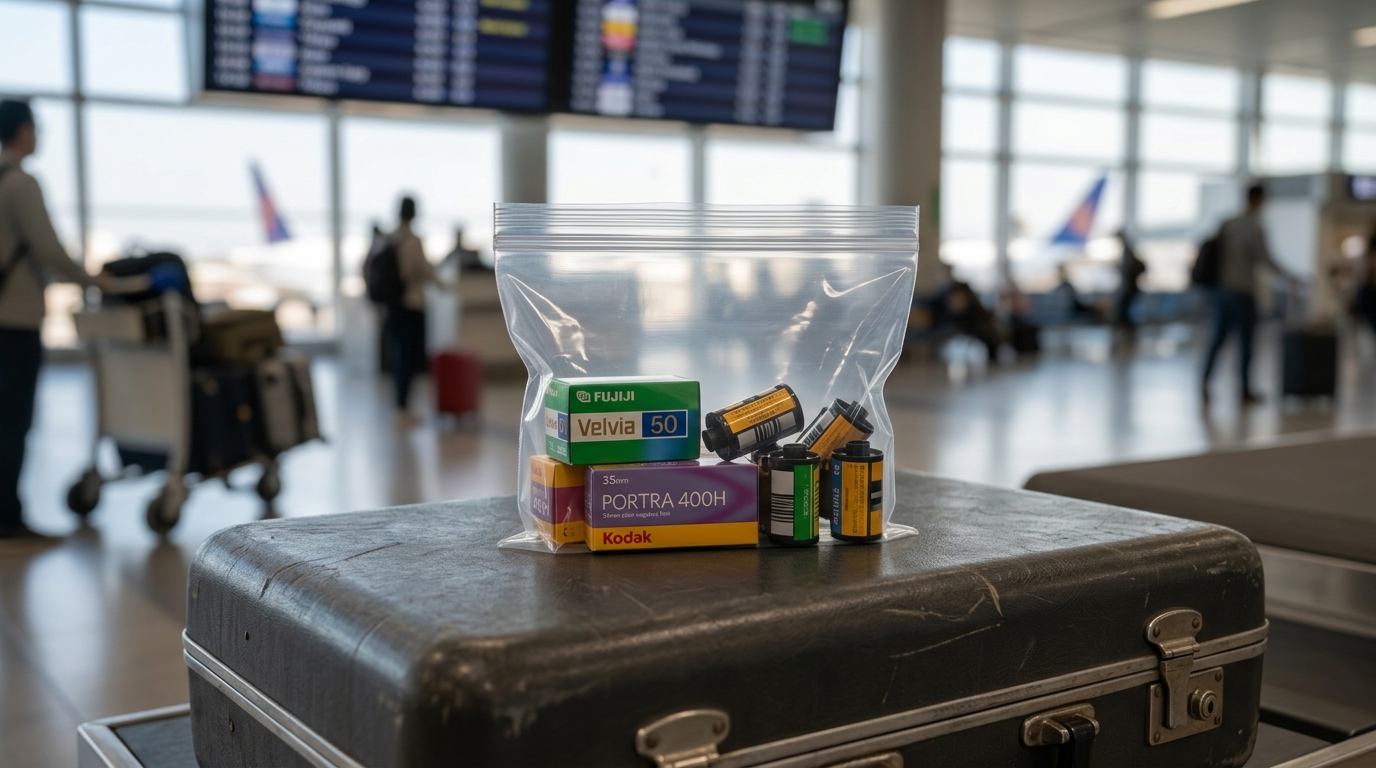
And the preparation that makes the request easy to say yes to, straight from the makers’ pages: Kodak and Fujifilm both recommend packing all your film in a clear, resealable plastic bag so you can pull it out of your carry-on at the checkpoint and hand it over in one motion. Take it out of the boxes and canisters ahead of time if you can — the less there is to open, the faster the check goes. Fujifilm also advises that if you’re carrying a large quantity, you should contact the airline before your flight.
One caution the makers themselves give, so I’ll pass it on: a hand inspection is a request, not a right, everywhere in the world. Kodak’s page notes that “there is no guarantee that your request will be granted by local inspectors”, and Kodak Alaris says hand inspections “may not be guaranteed at all airports” and that contacting the airport in advance is strongly advised. Polite, early, and organized is your best strategy; a guarantee is not on offer.
What Japan’s airports say — and don’t say
This is the part I most wanted to pin down for you, since Japan is where your film journey starts. I checked the airports’ own websites, and here is the state of things as of September 3, 2026:
- Narita (NRT): an official yes. Narita’s security FAQ states, in Japanese: 「カメラのフィルムにつきましては、X線検査でなく、検査員による手検査も可能です。」 — “As for camera film, a hand inspection by staff is possible instead of the X-ray inspection.” The English version of the same FAQ says the same thing and asks travelers with sensitive film, or anyone who prefers to skip the X-ray, to tell the staff. So at Narita, you are not asking for a strange favor — you are using a published option.
- Haneda (HND): I could not find an official statement. I went through the FAQ and the departure-procedure pages on Haneda’s official site and found no mention of film or hand inspections. That is not the same as “Haneda refuses hand checks” — it only means I couldn’t confirm it in writing, and I won’t claim what I can’t confirm. If you fly out of Haneda, ask at the checkpoint with the phrase above; the worst case is a polite no.
If anyone reading this asks at Haneda and gets an answer either way, I would genuinely love to hear about it — that’s a blank spot on my map.
The quiet alternative: don’t fly with undeveloped film at all
Remember the one thing every source agreed on: developed film is not the problem. That opens a few doors worth considering before you’re standing in the security line negotiating:
- Develop it before you fly. If your trip is long enough, getting your shot rolls developed in Japan turns them from “fragile undeveloped film” into “perfectly safe negatives”. Many camera shops in Tokyo take in development — the big-name stores you’ll already be visiting on a Japan camera shopping trip often have a lab counter. Turnaround and English support vary by shop, so ask when you drop in early in your trip, not on the last day.
- Think about how much unshot film you carry home. Unshot film has to fly undeveloped by definition — that’s the cargo to protect hardest, in the clear bag, in the carry-on, hand check requested. It may also be a reason to buy an amount you’ll be comfortable advocating for at a checkpoint, rather than a suitcase-level supply.
- Shipping is a maybe, not a promise. Fujifilm’s notice suggests considering a parcel or cargo service that guarantees no X-ray inspection for sending film ahead. I used to ship camera gear out of Japan every week, but film was never my cargo and I don’t know which carriers, if any, currently offer that guarantee — so I’ll flag the option and stop there rather than guess.
And whatever you do with the film, your camera itself doesn’t care about scanners at all — its dangers are mechanical. For that side of the trip home, I wrote a separate guide on packing your camera in your luggage, and that one is from experience.
Summary
- Airports are switching to CT scanners, and the film makers say plainly that these can fog undeveloped film of any speed — Kodak and Fujifilm both warn that one pass can be enough. (Sources linked above, checked September 2026.)
- There is no official “safe ISO” for CT scanners. The old ISO 800 rule doesn’t appear on the current official pages I checked.
- Never put undeveloped film — including instax and QuickSnaps — in checked baggage. Every source agrees on this one.
- Carry film in a clear resealable bag in your carry-on and ask for a hand inspection: “Firumu ga haitte imasu. Tekensa de onegai dekimasu ka?” in Japan, “Could you hand-check it, please?” elsewhere.
- Narita’s official FAQ confirms hand inspection is available for film. For Haneda I found no official statement either way — ask at the checkpoint.
- Developed film is safe, so developing your shot rolls in Japan before you fly removes most of the problem.
I’ll say it once more so there’s no confusion: none of this is my personal airport experience, because I have none. It’s the makers’ and authorities’ own published guidance, gathered in one place and dated, for the people who do the flying. Buy the film, enjoy the trip — and let the officer look inside the bag.
Sources
- Kodak — Transporting & Storing Film (checked September 3, 2026)
- Kodak Alaris — CT Scanning X-Ray Technology and Film (checked September 3, 2026)
- TSA — Film (What Can I Bring?) (checked September 3, 2026)
- Fujifilm — Protecting Film from X-ray/CT Scans at Airport Baggage Inspection (official notice, PDF, February 2020) (checked September 3, 2026)
- Fujifilm — QuickSnap X-ray FAQ (Japanese) (checked September 3, 2026)
- Narita International Airport — Security FAQ (checked September 3, 2026)


コメント