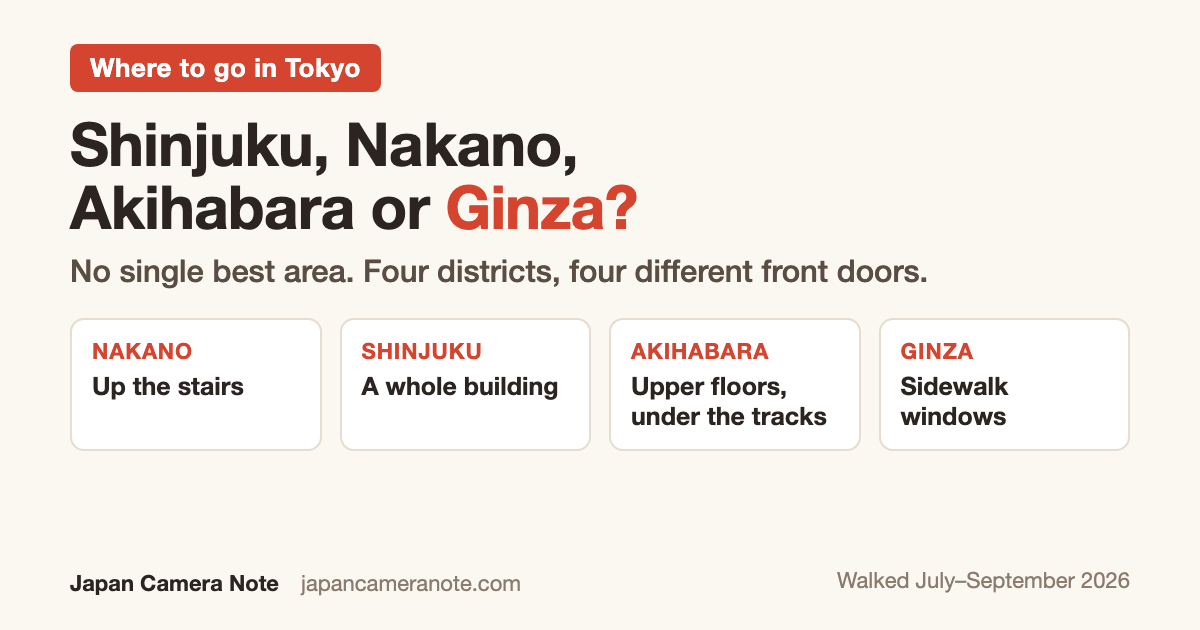
There is no single best area in Tokyo for used cameras. The four I have walked do different jobs, and the shop doors are in different places: a staircase in Nakano, a whole building in Shinjuku, upper floors and a spot under the train tracks in Akihabara, sidewalk windows in Ginza.
I visited each area once: Nakano and Shinjuku on July 12, 2026, Akihabara on August 1, and Ginza on September 12. Things may be different now. I do not rank the areas or the shops. The table is for choosing, in the order I visited.
| Area | Where the shop door is | Junk | English I saw |
|---|---|---|---|
| Nakano | Two floors with separate entrances; the 2nd is up a staircase | A small annex in its own building | Floor maps at the stairs; a notice on the annex door |
| Shinjuku | A passage beside a whole building; a 3rd floor up a staircase | Open shelves you can pick from | Signs at both shops |
| Akihabara | 3rd and 4th floors of office buildings; one under the train tracks | A junk floor and a self-service junk garage | A floor guide at the door; a guide to the tags; ranks on tags |
| Ginza | Sidewalk windows with price tags; an 8th floor in a church building | For sale in four of five shops | Little. Tag notes were in Japanese |
- Which area of Tokyo is best for used cameras?
- I only have half a day. Where do I go?
- Where do I go for junk and cheap lenses?
- Where do I go for Leica and the high end?
- Which area is easiest on a first visit, with no Japanese?
- Can I do two areas in one day?
- What about prices and tax-free?
- What I could not confirm
- Official pages
Which area of Tokyo is best for used cameras?
None of them is best. Each one fits a different kind of trip.
Nakano is one shop in more than one building. Fujiya Camera is about 5 minutes on foot from Nakano Station’s North Exit. Almost everything is in glass showcases, and the customers I saw were mostly Japanese men.
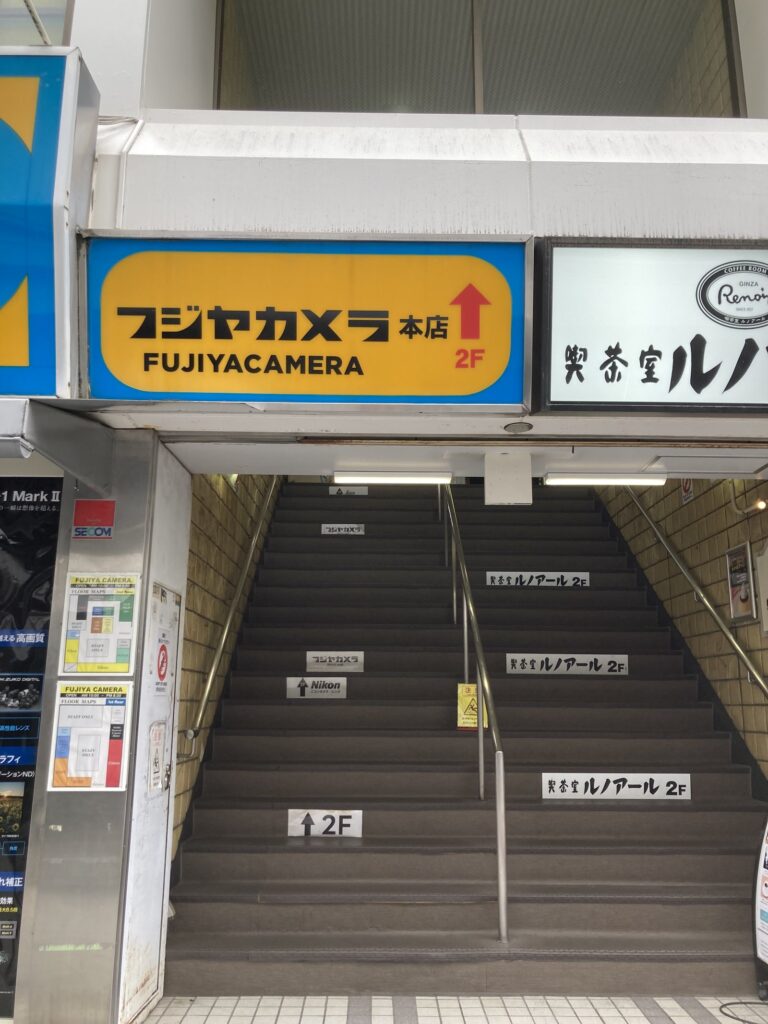
Shinjuku is scale. Map Camera fills a building, sorted by brand, floor by floor. Lemon Company is one compact room on a 3rd floor. Both are about 5 minutes from Shinjuku Station.
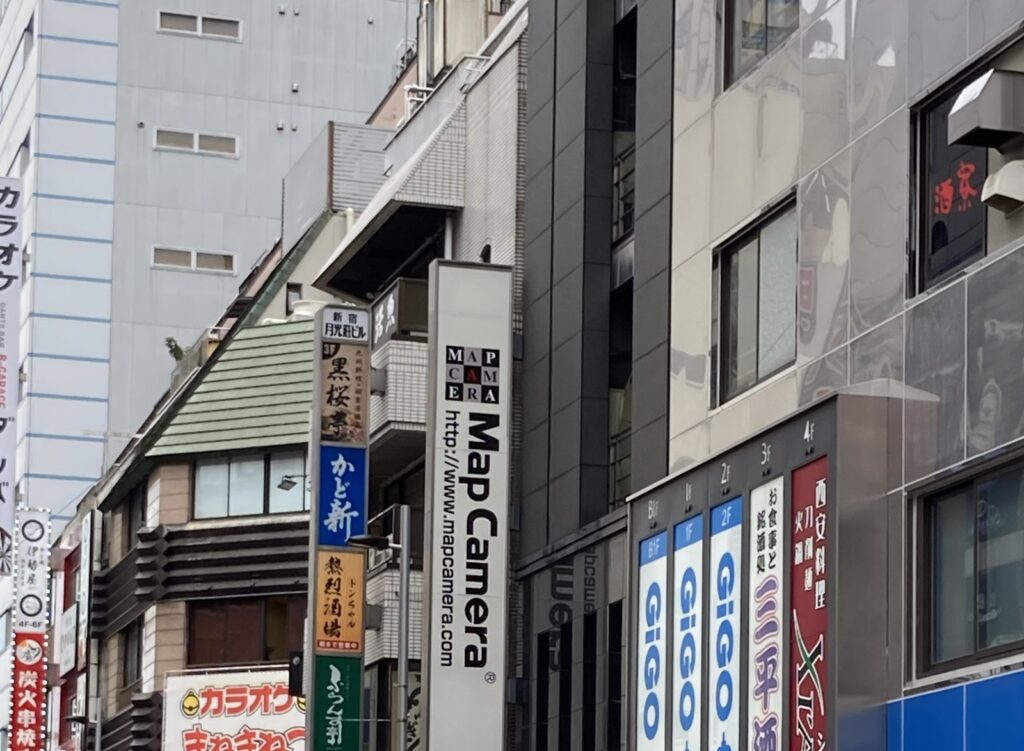
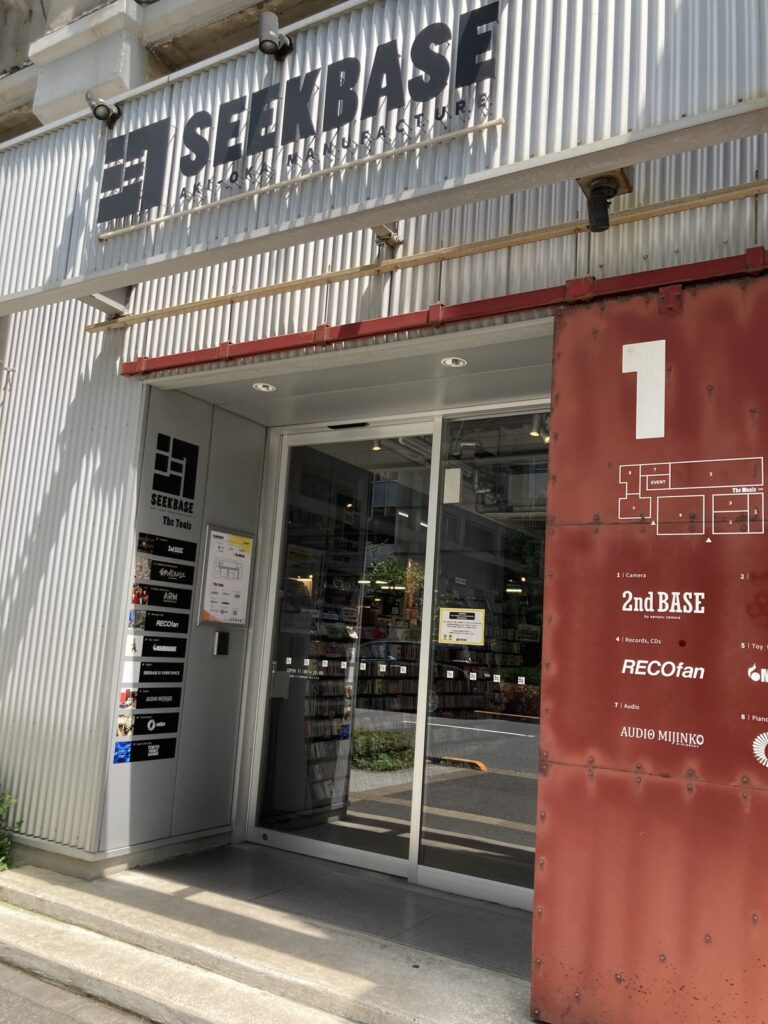
Akihabara is variety on foot. I walked five camera shops, all within about a ten-minute walk of the station, from a clean shop where you can pick cameras up to a garage with no staff inside.
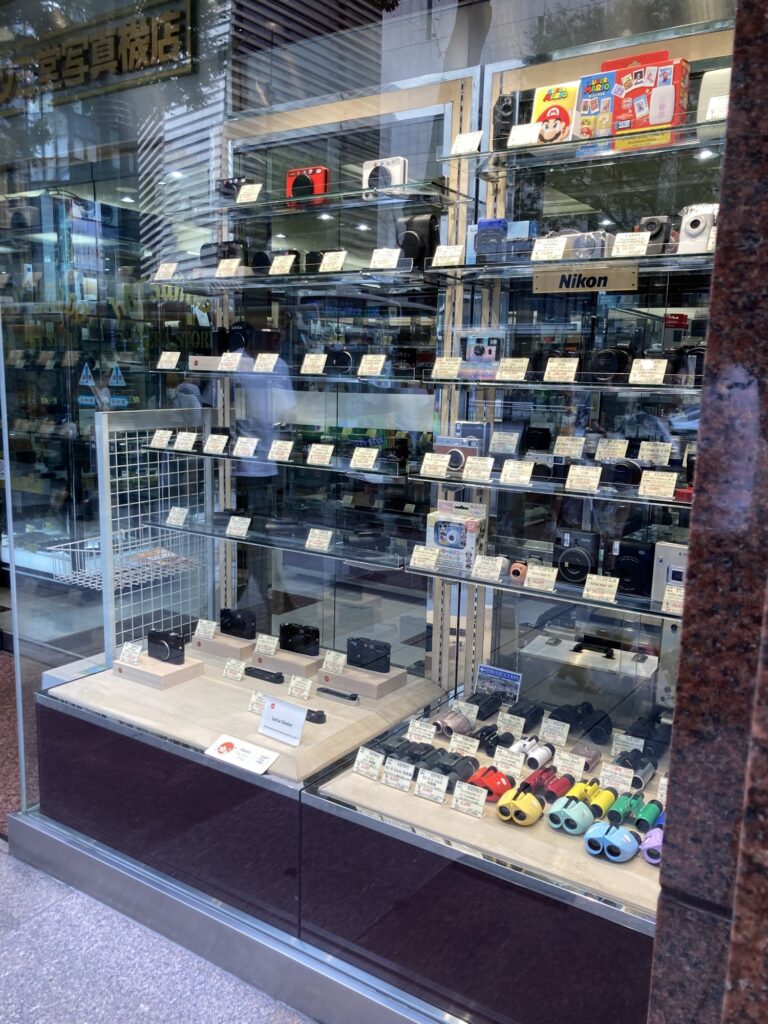
Ginza is windows. Five shops are close enough to walk between in one day, and three of them put cameras with price tags in a window facing the street.
I only have half a day. Where do I go?
In my shop guide I called Nakano plus Shinjuku a half-day walk. For Akihabara I have a two-shop short version.
On my Nakano and Shinjuku day I started at Fujiya around 11:30 and took the train around 13:00. The two Shinjuku shops filled the afternoon.
My full Akihabara day ran from 11:00 to a beer at 17:30, with five camera stops and breaks. The short version I suggested there is 2nd BASE plus the Junk Garage at Tokyo CAMERA.
I gave Ginza a day. Three of its five shops are close together near Ginza Station.
Check the day of the week first. In Ginza, Sankyo Camera is closed on Sundays and national holidays (official website, checked September 24, 2026), and Sukiya Camera on Mondays (a card I photographed on September 12). In Akihabara, three shops on my route were listed as closed on Wednesdays when I checked before my August visit. Hours change, so confirm on each shop’s own page. More in Japanese camera shop hours.
Where do I go for junk and cheap lenses?
Every area had junk. What changes is how you shop it.
- Akihabara: Kitamura‘s 4th floor is mostly junk grade, with colored stickers for the month each item arrived. Next to Tokyo CAMERA, the Junk Garage has no staff inside and no condition labels. A sign, in English too, says you may mount lenses and put in batteries.
- Shinjuku: At Lemon Company the junk sits on open shelves, and you can pick items up yourself. Condition varied a lot.
- Nakano: Fujiya’s junk annex is narrow, and large bags go on a rack. What stood out to me were genuine Nikon and Canon accessories: straps, caps, hoods, cases.
- Ginza: Four of the five shops had junk for sale. The fifth had a box out front marked “Free.”
“Junk” means nobody promises that it works. Read my junk guide first.
Where do I go for Leica and the high end?
Ginza and Shinjuku. That is where I wrote the most about Leica.
- Ginza: Katsumido Camera has a “Leica Dealer” plate in its window, and that window ran from a ¥3,080 disposable camera to a ¥1,012,000 Leica M11. The sign at Sukiya Camera says, in Japanese, “half a century with Leica.” Lemon Camera Ginza had a case of M-mount lenses and a shelf of M bodies. The window at Shimizu Camera is sorted under maker plates: Leica, Linhof, Hasselblad and more.
- Shinjuku: At Map Camera, the 1st floor and the basement are Leica. In the basement I saw two Leicas at roughly 3 million yen each.
- Nakano: Fujiya keeps Leica on its 2nd floor, up the stairs.
- Akihabara: My Akihabara shop articles do not mention Leica. That says what I noted, not what the shops stock.
Which area is easiest on a first visit, with no Japanese?
Shinjuku and Akihabara had English at the entrance. Ginza had windows instead.
- Shinjuku: Map Camera had English signs and a floor guide at the entrance. Lemon Company’s street signboard reads “Camera Buy & Sell” and “TAX FREE 3F.”
- Akihabara: The arcade door at 2nd BASE has an English floor guide, and one staff member spoke English. Kitamura posts an English guide to reading its price tags. Lemon Camera Akiba prints English condition ranks on its price cards.
- Nakano: English floor maps at the stairs to Fujiya’s 2nd floor, and an English notice on the junk annex door. Inside the main shop I saw no English signs.
- Ginza: English was thin: a Tax-free sticker, “WE BUY CAMERAS” on a glass door, the word “Free.” But a camera behind glass with a number next to it needs no translation. At Lemon Camera Ginza, every customer I saw was from overseas.
Where I noted the language of the price tags, the condition notes were in Japanese, except for the English ranks at Lemon Camera Akiba. My guides to reading Japanese price tags and asking in Japanese camera shops cover the words you need.
If I had to name one area for a first visit, I would say Ginza. There were many visitors from overseas on the streets when I walked them, so you will not be the only one, and Lemon Camera Ginza is the shop I would send a first-time visitor to first. That is my answer for a first visit, not a ranking.
Can I do two areas in one day?
Nakano and Shinjuku, yes. I have not done any other pair in one day, so for those I can give you train lines, not walking times.
- Nakano and Shinjuku: one stop, 4 minutes on the JR Chuo Line rapid. From the Nakano Station entrance to Map Camera’s sign, my photos span about 18 minutes. See Nakano to Shinjuku.
- Nakano or Shinjuku to Akihabara: the JR Chuo-Sobu Line local goes there with no change. In JR East’s Saturday and holiday timetable, one local train leaves Nakano at 13:04, Shinjuku at 13:11 and Akihabara at 13:29.
- Akihabara to Ginza: Akihabara (H16), Higashi-ginza (H10) and Ginza (H09) are all on the Tokyo Metro Hibiya Line.
- Shinjuku to Ginza: Shinjuku (M08) and Ginza (M16) are both on the Tokyo Metro Marunouchi Line.
I read those JR East and Tokyo Metro pages on October 13, 2026. I did not find ride times on Tokyo Metro’s station lists, so use a route app. And station to station is not shop to shop, as the 4 minutes and the 18 minutes above show.
What about prices and tax-free?
I do not compare areas by price. One model name can carry very different tags. The tags I saw are in How much does a used film camera cost in Tokyo?.
Japan’s tax-free system changes on November 1, 2026, and Kitamura moved to a refund method on October 6. What I saw at each shop, and what each shop’s website says, is in tax-free at Tokyo camera shops. The airport steps are in Japan’s tax-free rules from November 1, 2026. Please confirm the details at the shop.
What I could not confirm
- Other camera areas in Tokyo. These four are the ones I have walked, not the only ones.
- Whether anything has changed since each visit.
- A weekday. July 12 was a Sunday, and August 1 and September 12 were Saturdays.
- The inside of Sankyo Camera in Ginza. I did not go in.
- Ride times on the two Tokyo Metro lines, and walking times for any pair except Nakano and Shinjuku.
Official pages
- JR East: Nakano Station timetables (Japanese)
- JR East: Akihabara Station timetables (Japanese)
- Tokyo Metro: Hibiya Line stations (English)
- Tokyo Metro: Marunouchi Line stations (English)
If you already know the model you want, start with how to find a specific camera in Tokyo. For the whole trip, start with the Japan camera shopping guide.
コメント