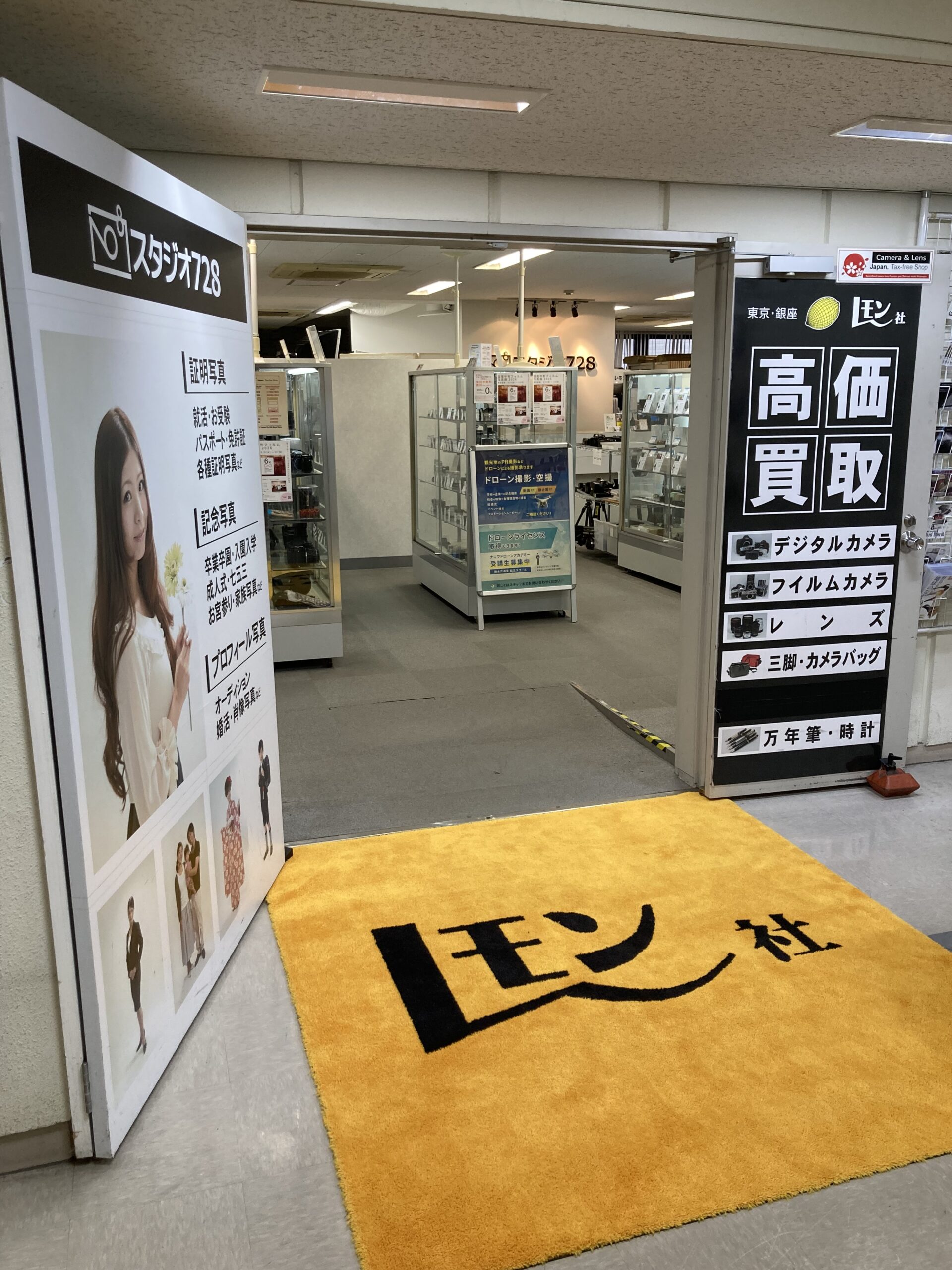
This is my third Lemon shop. I visited Lemon Company in Shinjuku in July, Lemon Camera Akiba in August, and on September 12, 2026, I finally went to the Ginza branch. As far as I know, nobody else has written up all three in English — so this article is both a shop guide and the final piece of a little three-part puzzle.
And the Ginza branch has the strangest address of the three. It is on the 8th floor of a church building.
This was also the first stop of a day spent walking around the used camera shops of Ginza — more articles from that day are coming.
- Finding it: follow the word “church”
- Then the doors open on the 8th floor
- You can take photos inside (which is why this article has photos)
- What is on the shelves
- Prices I saw that day
- Reading the tags: ranks yes, English no
- Tax-free — and a rule I had never seen explained before
- Three Lemons, compared
- The elevator, on the way out
- Practical notes
Finding it: follow the word “church”
Let me start with my mistake, so you can skip it.
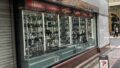
The shop is in the Ginza Kyokaido Building (Ginza 4-2-1), on Matsuya-dori street, a short walk from Ginza Station. From the pavement you can see Lemon’s yellow sign on the side of the building. What I did was walk confidently into the building next door and take its elevator. The doors opened on a beauty clinic. I did not get off. Back on the street, I looked at the building beside it and saw the word 教会 — “church” — on the signage, and that was the clue: Lemon Camera Ginza is officially called the “Ginza Kyokai (Church) Store,” so the church is the landmark. If you can see the word church, you are in the right place.
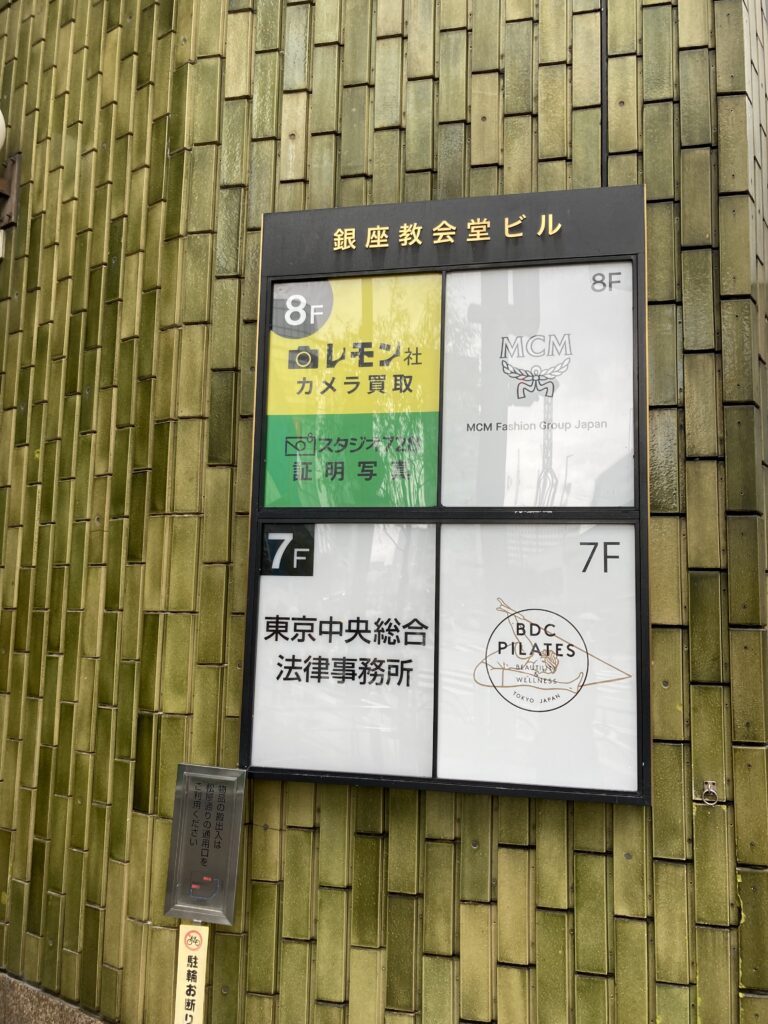
The building works like this: floors 1 to 6 belong to the church, including the chapel. The 7th floor is offices. The 8th floor is the camera shop. So you walk into a quiet church-building entrance, past a display case on the ground floor with a religious figure in it — which gave me a little start, only because I do not spend much time in churches and was not expecting to meet anyone in a glass case — and you take the elevator up past six floors of chapel to reach the used Leicas.
I will say plainly: as a Japanese person, this entrance felt hard to walk into. It does not look like a shop. It looks like a church, because it is one. I stood there wondering whether I was allowed in. (You are. The floor guide at the entrance lists the shop, and the elevator takes you straight up.)
Then the doors open on the 8th floor
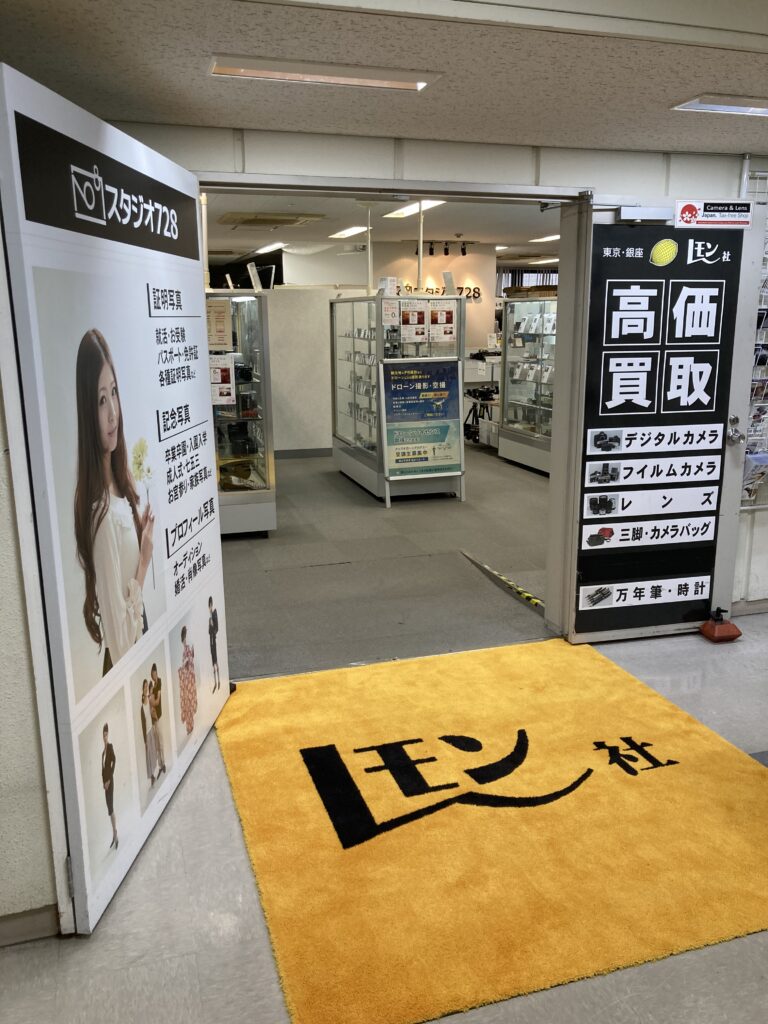
And here is the reversal that made my day. The entrance downstairs intimidated me, a local. Upstairs, the shop was full of customers — and during my visit, every customer I saw was from overseas. Not “some foreign visitors.” All of them, including a family browsing together. People were having showcases opened for them, holding cameras, asking questions, listening to explanations. It was the busiest, warmest shop floor I saw in Ginza that day.
So the shop that looks hardest to enter from the street turns out to be the one where visitors from abroad are completely at home. If the church entrance makes you hesitate, know that the hesitation is the local reaction — the world has already found the 8th floor.
You can take photos inside (which is why this article has photos)
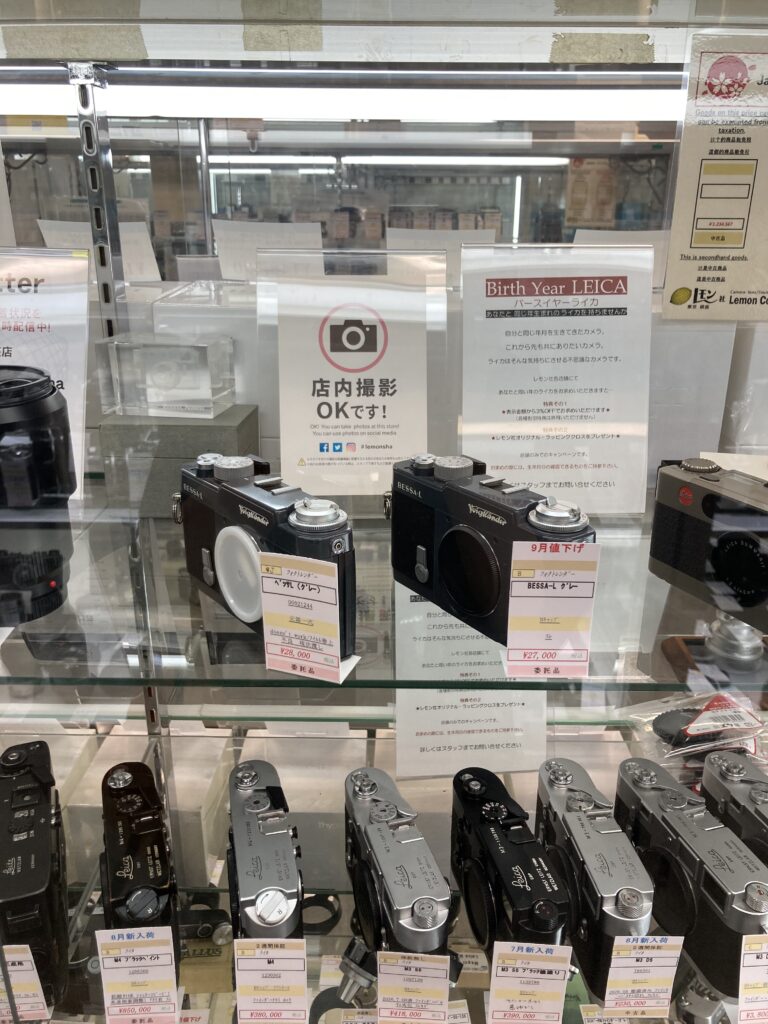
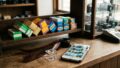
There is a sign on the shelf that says photography inside the shop is welcome. That is not common — in most Japanese camera shops I keep my phone in my pocket. It is why this article can show you the shelves instead of only describing them, and it tells you something about how this branch feels about visitors and their cameras.
What is on the shelves
For a single floor of a church building, the range is wide:
- Leica, properly. A case of M-mount lenses (Summiluxes and Summicrons), and a shelf of M bodies — M3s, M4s, including some serious collector pieces.
- Japanese film SLRs. A Nikon case with FE2, FE, FG and accessories, and a whole Canon AE-1 corner with several AE-1s and an AE-1 PROGRAM lined up together.
- Film. A well-stocked shelf: Kodak Gold, UltraMax, Portra 800, Ektar, CineStill, Ilford and more.
- Fountain pens and watches. They sit in a big showcase of their own, displayed exactly the same way as the cameras. The shop’s buying-counter sign lists pens and watches alongside cameras and lenses — it is one culture of “good old things behind glass,” not a camera shop with a gift corner.
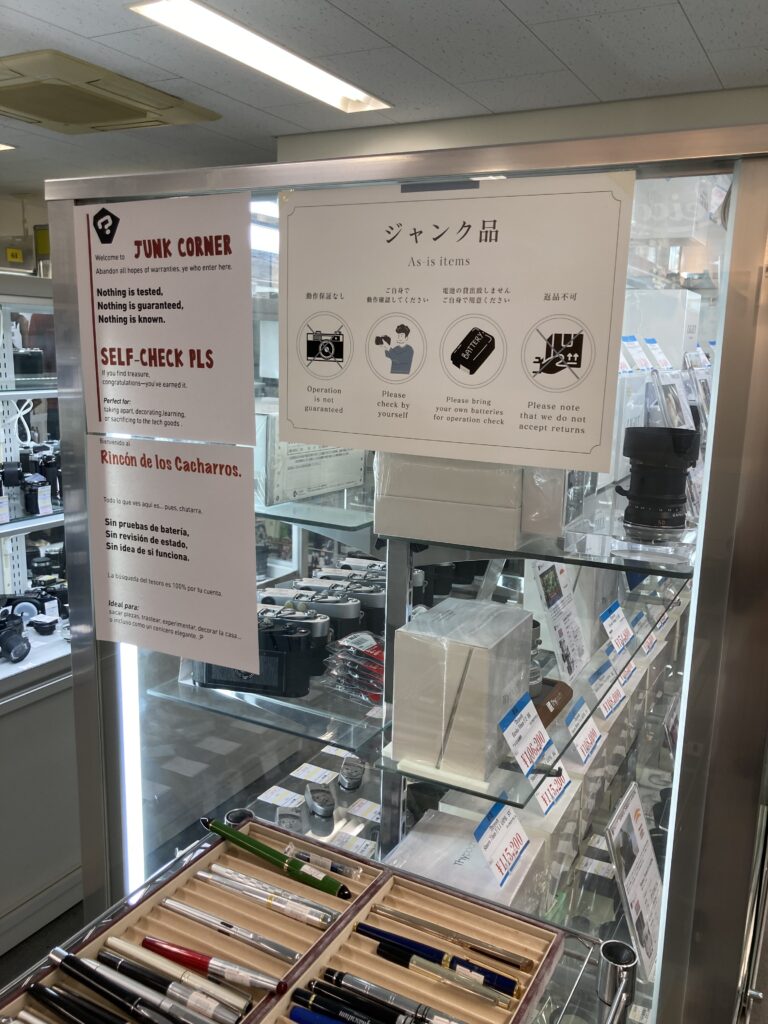
- A junk corner. Yes, even in Ginza. Open shelves with strobes, tripods and binoculars, and a sign in three languages — English (“Nothing is tested, Nothing is guaranteed”), Spanish, and Japanese. As-is means as-is, in any language.
Prices I saw that day
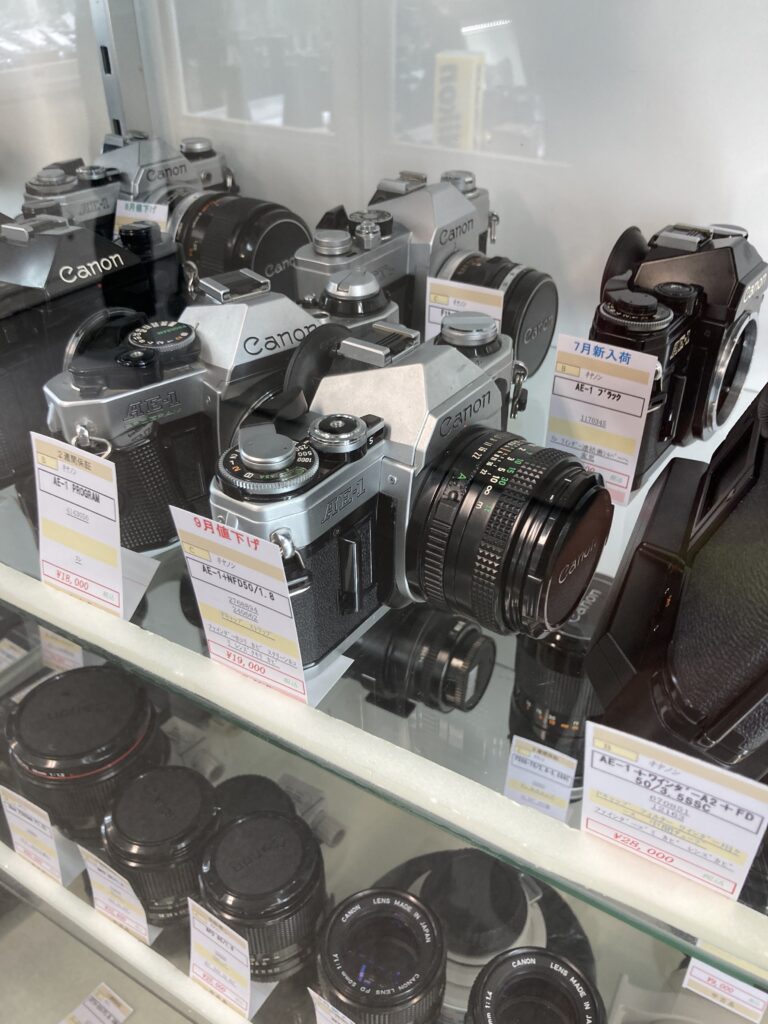
These are prices from the actual tags, as of September 12, 2026, the day I visited — not market rates, just what was on the shelf that afternoon:
- Canon AE-1 + New FD 50mm f/1.8: ¥19,000 (rank C, haze and fungus noted on the tag, marked down in September)
- Canon AE-1 + Winder A2 + FD 50mm f/3.5: ¥28,000 (rank B)
- Canon AE-1 PROGRAM: ¥18,000 (rank B, with a 2-week warranty)
- Nikon FE2 body: ¥39,000 (marked down in August)
- Leica M3 double-stroke: ¥230,000 (serviced August 2026, 2-week warranty noted)
Two things the tags tell you beyond the numbers. First, the shop marks price cuts with the month (“marked down in September”), so you can see which items have been sitting. Second, warranties come in exactly two flavors here: “2-week warranty” or “no warranty” — and the tag says which.
Reading the tags: ranks yes, English no
One difference from the Akihabara branch matters for visitors. In Akihabara, the price cards included English translations of the condition ranks. At the Ginza shop, on the day I visited, I did not see English on the price tags: you get a rank letter (A/B/C) plus detailed condition notes — haze, fungus, scratches, “as-is” — written in Japanese. The rank letter alone will carry you a long way, and if you want to decode the rest, my guide to Japanese condition grades covers the vocabulary. And with the customers around me all speaking English to the staff over open showcases, the tags are clearly not the only way to get your questions answered here.
Tax-free — and a rule I had never seen explained before
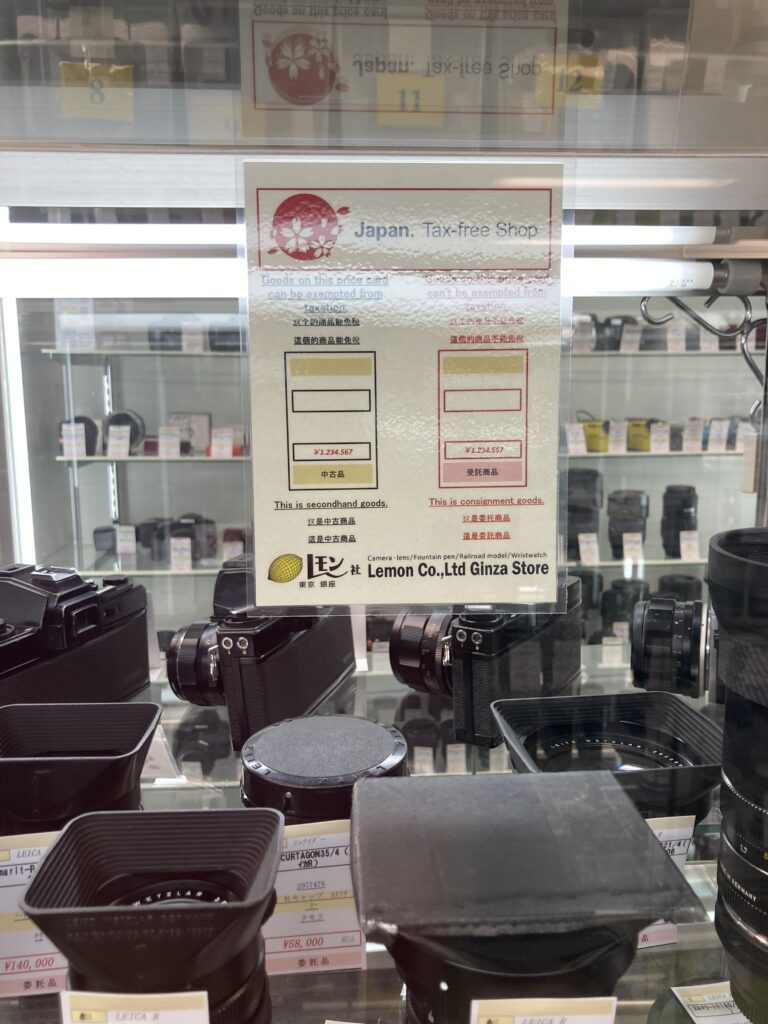
There is a Tax-free Shop sticker at the shop entrance, and inside I found something I have not seen spelled out anywhere else: a printed card explaining that the shop’s own used items (yellow tags) qualify for tax-free purchase, but consignment items (pink tags) do not. Consignment items are gear the shop sells on behalf of the owner, and those are outside the tax-free system.
This is genuinely useful. It means that at this shop, the color of the price tag tells you whether your passport will save you the tax. Check the tag before you fall in love with something. For how tax-free camera shopping works in general, see my tax-free shopping guide.
One more small thing for readers outside Japan: the shop hands out a card explaining how to buy from their group’s online store from overseas through a proxy service. So if you find the shop after your trip, or the item you wanted sells before you arrive, the door is not completely closed.
Three Lemons, compared
The shop’s card lists seven branches nationwide. I have now been to three, so here is the comparison I can actually make — from my own visits, each on a single day (Shinjuku in July, Akihabara in August, Ginza in September 2026):
| Branch | The building | What stood out on my visit |
|---|---|---|
| Shinjuku | 3rd floor, up a staircase | The biggest of the three; the most relaxed browsing, staff at the back |
| Akihabara | 3rd floor of an office building | Compact; English condition ranks on the tags; junk limited to 3 per person |
| Ginza | 8th floor of a church building | The most international crowd; photos welcome inside; tag color shows tax-free eligibility |
The family resemblance is real: all three make you push through an entrance that does not look like a shop, and all three reward you once you are inside. But they are not interchangeable. Shinjuku is where I would send you for a long, quiet browse. Akihabara is a good half-hour stop on a junk-hunting day. Ginza is the one with a story — and, on my visit, the one where the rest of the world already was.
The elevator, on the way out
Here is how the visit ended. I was standing at the elevators, waiting on the left side. A staff member came out, pressed the button for the right-hand elevator, and showed me to it with a small “this way, please.” That is all. A shop on the 8th floor of a church building, where I had hesitated at the door an hour earlier, walking me to the elevator on my way out.
A day that starts with taking the wrong elevator and ends with someone calling the right one for you — that is about as neat a summary of this shop as I can write.
Practical notes
- Where: Ginza Kyokaido Building 8F, 4-2-1 Ginza — on Matsuya-dori, a short walk from Ginza Station. Look for the word “church” and the yellow Lemon sign; floors 1–6 are the church, the shop is on 8.
- Photos: allowed inside (there was a sign on my visit — if the sign is gone when you go, ask first).
- Tax-free: yes, for the shop’s own used items (yellow tags); consignment items (pink tags) are not eligible.
- Tags: rank letters A/B/C; condition notes in Japanese; “2-week warranty” or “no warranty” marked per item.
- The building is a working church. You share the entrance and the elevator with it — normal quiet-visitor manners are all it takes.
Everything above is what I saw on September 12, 2026. Stock, prices and shop details change, so please check the official information before you go. This was the first stop on a day around Ginza’s camera shops — the rest of the street is coming in the next articles, and if you are still planning the Japan side of your trip, start with my Japan camera shopping guide.
コメント