
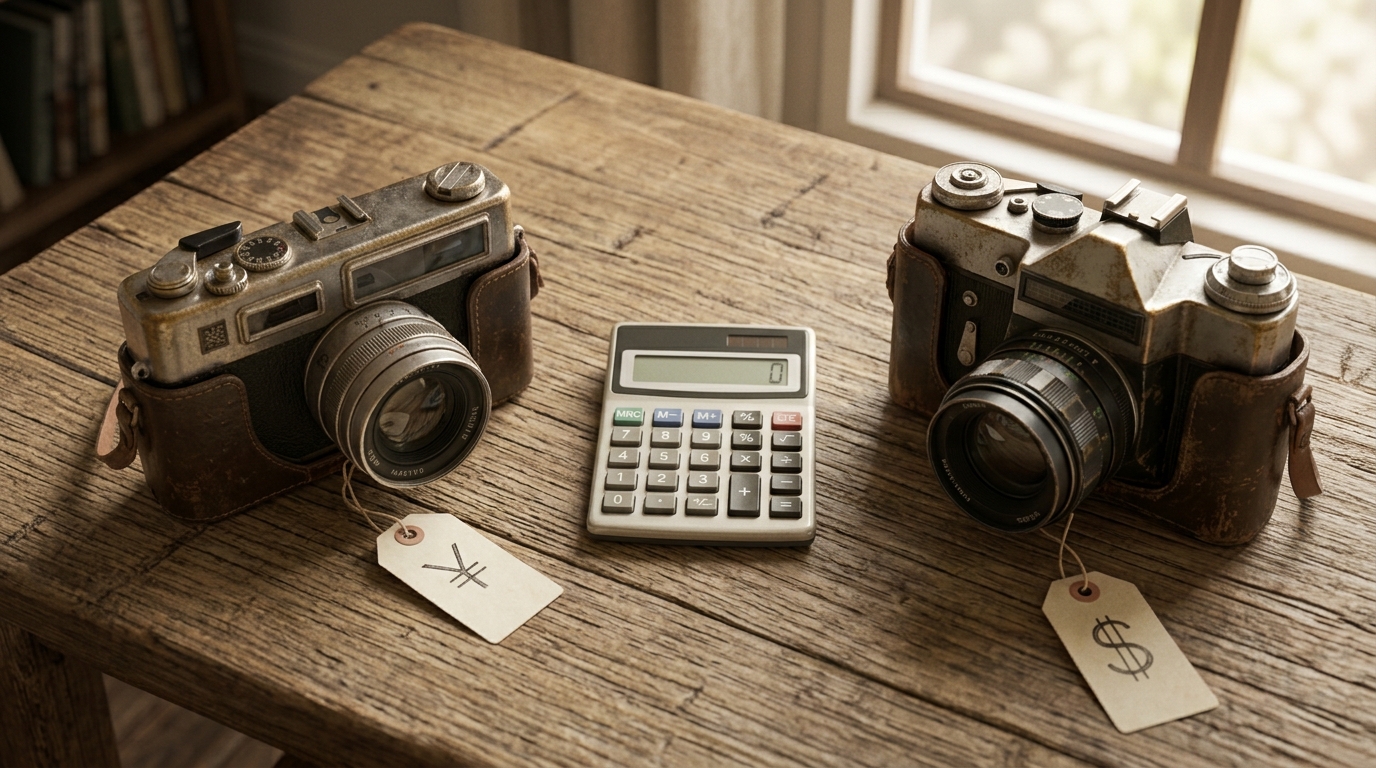
People ask this question a lot: “Are cameras really cheaper in Japan?” You will find strong opinions on both sides. Some people say everything is half price here. Some people say the good days are over.
I wanted to answer with numbers instead of opinions. For years I sold used Japanese cameras on eBay and shipped them to buyers overseas, so I have looked at both sides of this price tag many times. In this article I picked three famous film cameras — the Nikon FM2, the Canon AE-1, and the Nikon F3 — and checked what they actually cost in Tokyo shops and on eBay on the same day.
The short answer: sometimes Japan is cheaper, sometimes it is not. The long answer is more useful, so let’s look at the numbers.
How I checked these prices
All prices in this article were checked on September 1, 2026. Here is exactly what I looked at:
- Tokyo shop prices: the online used-camera listings of two big chains — Kitamura’s used store (shop.kitamura.jp) and Fujiya Camera (fujiya-camera.co.jp). These are the same graded, checked items you would see in their shops. Map Camera also has a large used stock, but I did not include it in this comparison.
- eBay prices: active listings on eBay’s category pages for each model. One important note: I could not view eBay’s sold-listing data that day, so the eBay numbers below are asking prices, not final sale prices. Sold prices are usually somewhat lower than the highest asking prices, so keep that in mind.
- Exchange rate: eBay’s own currency display that day worked out to roughly 160 yen = 1 US dollar (one listing showed US $450 and ¥72,041 for the same camera). All dollar figures below are approximate conversions at that rate. The rate moves every day, so check it before you plan a purchase.
Japanese shops label used items with condition grades like A, AB, B, and C. If you have not seen this system before, my guide to Japanese camera condition grades explains what each grade means.
Nikon FM2 (New FM2)
Tokyo shop prices (as of September 1, 2026)
| Shop | Item | Grade | Price |
|---|---|---|---|
| Kitamura | New FM2 body, black (23 in stock) | B | ¥81,500–¥96,600 (about $510–$605) |
| Kitamura | New FM2 body, black | AB | ¥90,000–¥103,400 (about $565–$645) |
| Kitamura | New FM2 body, black | A | ¥107,000 (about $670) |
| Kitamura | New FM2, chrome (10 in stock) | — | from ¥79,980 (about $500) |
| Fujiya Camera | New FM2, black | AB- | ¥78,100 (about $490) |
| Fujiya Camera | New FM2, silver (2 in stock) | AB- | ¥74,800–¥78,100 (about $470–$490) |
eBay asking prices (as of September 1, 2026)
- Most clean used bodies from Japan-based sellers were asking about $300–$500, plus shipping that was typically $50–$110 (a few listings had free shipping).
- A few discounted or “read the description” bodies sat lower, from around $250.
- One US-based seller had a working black body at $450 with free shipping.
- Unused, boxed examples were asking $880–$1,290.
Verdict: Tokyo was not the cheaper option for this one
This surprised me a little. On this day, a B-grade FM2 body in Tokyo cost about $510 — roughly the same as, or more than, many eBay asking prices for similar user-grade bodies. The FM2 is very popular with visitors, and Tokyo prices reflect that.
What Tokyo gives you instead is depth and certainty: Kitamura alone had 23 black bodies, each one graded and checked, and you can hold each one and fire the shutter before you pay. On eBay you are choosing from photos.
Canon AE-1
Tokyo shop prices (as of September 1, 2026)
| Shop | Item | Grade | Price |
|---|---|---|---|
| Kitamura | AE-1 body, black | C | ¥11,000–¥12,040 (about $70–$75) |
| Kitamura | AE-1 body, black | B | ¥13,700 (about $86) |
| Kitamura | AE-1 body, silver | B | ¥41,800 (about $260) |
| Fujiya Camera | AE-1, black | AB- | ¥33,000 (about $205) |
Note the stock: only five bodies between the two chains that day. AE-1 stock in the big graded shops is thin, and prices jump around depending on color and condition.
eBay asking prices (as of September 1, 2026)
- Working bodies from Japan-based sellers were asking from about $120 (body only, near mint) up to about $240 for a boxed top-condition example, plus shipping of roughly $25–$90.
- Body-plus-50mm-lens kits from Japan sellers were asking about $100–$205 plus shipping.
- US-based refurbished kits with a 50mm f/1.8 were asking $267–$290 with free shipping.
- As-is and “read the description” bodies started around $50.
Verdict: Tokyo wins — if you accept worn cosmetics
A working, shop-checked AE-1 body for about $70–$86 is hard to beat. The C-grade bodies will show real wear, but the shop has tested them and graded them, and you can inspect everything yourself before paying. On eBay, a similar working body typically starts higher, and shipping is on top.
The one caution is stock. With so few bodies on the shelves in the big chains, you may need to check several shops or look at the smaller shops too. My guide on how to find a specific camera in Tokyo covers how to do that hunt efficiently.
Nikon F3
Tokyo shop prices (as of September 1, 2026)
| Shop | Item | Grade | Price |
|---|---|---|---|
| Kitamura | F3 body (over 30 listed) | B | ¥69,800–¥92,300 (about $435–$575) |
| Kitamura | F3 body | AB | ¥100,200–¥101,800 (about $625–$635) |
| Kitamura | F3 body | A | ¥112,400 (about $700, already marked sold) |
| Fujiya Camera | F3 eye-level body | AB- | ¥85,800 (about $535) |
| Fujiya Camera | F3 HP body (2 in stock) | AB- | ¥94,050 (about $590) |
| Fujiya Camera | F3/T, silver | AB- | ¥114,950 (about $720) |
eBay asking prices (as of September 1, 2026)
- F3 eye-level bodies from Japan-based sellers, described as excellent to near mint, were asking about $280–$530, plus shipping of roughly $40–$120.
- F3 HP bodies in top condition were asking about $450–$730.
- As-is bodies and bodies with issues started around $180.
Verdict: roughly even, with a small edge to eBay on price
For the F3, the two markets overlap almost completely. Many eBay asking prices for eye-level bodies were a little below Tokyo’s B-grade shelf prices, but once you add international shipping the gap gets small. Tokyo’s AB and A grades cost more than typical eBay asks — that premium buys you the shop’s grading, its checks, and your own hands on the camera before you decide.
What is inside an eBay price
Here is something I learned from the selling side. When I sold cameras on eBay, the listed price had to cover much more than the camera itself: international shipping (even on “free shipping” listings — the cost simply moved inside the price), eBay’s selling fees, packing materials, and the risk of returns. A camera sitting on a Tokyo shelf carries none of that international load in its price tag.
So when the same model looks more expensive on eBay than in a Tokyo shop, nobody is doing anything strange. The two prices are covering different jobs. That is also why the gap is bigger on heavy, low-priced cameras (shipping eats a large share) and smaller on expensive ones.
If you want to understand the eBay side better before buying from overseas, I wrote about it in what to know when buying from Japanese sellers.
The costs each side adds
- Buying on eBay: add shipping, and possibly import charges when the parcel enters your country. Import rules and thresholds are different in every country and they change — check your country’s rules before you buy. You also cannot inspect the camera first, and you wait for delivery.
- Buying in Tokyo: the flight and hotel are the obvious costs, but if you are visiting Japan anyway, the camera shopping rides along for free. Visitors can sometimes buy tax-free — I explain the conditions in my guide to tax-free camera shopping in Tokyo. And you can inspect the actual camera: fire the shutter, check the meter, look through the finder. The price tag itself tells you a lot too — here is how to read Japanese price tags.
So, is Japan really cheaper?
Based on what I found on September 1, 2026, for these three cameras:
- Canon AE-1: yes, clearly cheaper in Tokyo — if you accept worn cosmetics and can find one in stock.
- Nikon FM2: no, not on this day. Tokyo shelf prices matched or exceeded eBay asking prices.
- Nikon F3: about even, with eBay slightly ahead on raw price and Tokyo ahead on everything else.
Prices move, stock changes daily, and the exchange rate alone can swing a $500 camera by $50 in a few months. So treat these numbers as a snapshot, not a law.
But here is the part that does not change: the real advantage of buying in Japan was never a magic discount. It is the depth of stock (23 graded FM2 bodies in one chain, on a random Monday), a grading system the shops actually stand behind, and the chance to check the exact camera with your own eyes and hands before you pay. For a 40-year-old mechanical camera, that last part is worth real money.
If you are planning a camera-shopping trip, my Japan camera shopping guide pulls all the practical pieces together.


コメント