
So you did it. Somewhere in Tokyo — maybe at the end of a long camera day in Akihabara — you found the one, paid, and walked out with the shop’s bag in your hand. A wonderful feeling — and the start of your camera’s most dangerous journey: the trip home, in your luggage, with no professional packer in sight.
A while back I wrote about how Japanese sellers pack a camera before it crosses the ocean. This is the sister article: this time the box is your suitcase or backpack, and the packer is you. The good news — the thinking is exactly the same, and you can do a solid version of it on a hotel-room bed with things you already have.
The usual caveat: this comes from my own experience. I have spent years packing cameras for overseas buyers, and that work teaches you two things fast: what breaks, and what stops it from breaking.
What actually breaks in transit
Here is something that surprised me in that work: most people would guess the weak point is the lens mount, but mount dents were fairly rare. The damage that showed up again and again came in two flavors:
- A dented pentaprism — the pointed “head” above the viewfinder. On an SLR, that hump is the tallest point of the camera — whatever the camera bumps into, the head gets there first, so that is where the dents live.
- A lens damaged because the hood was left attached. A mounted hood looks like armor, but in transit it works like a lever: it sticks out, catches the impact, and passes the force straight into the lens it was supposed to protect.
In other words, transit damage is predictable — and anything predictable can be defended against. That is the idea behind the three rules below.
My three packing rules
Packing a camera for shipping is mostly routine, but for me these three points are non-negotiable. They translate directly to your suitcase.
- Give the camera’s head extra padding. Wrap the whole body, then put an extra, thicker pad of bubble wrap over the pentaprism hump. It is the most common victim, so if you only have a little bubble wrap, this is where it goes.
- Body and lens travel separately. Take the lens off the camera, put the caps on both, and wrap them as two separate packages. Two small, round, well-wrapped objects are far harder to hurt than one long, heavy, T-shaped one.
- Take the hood off the lens. Never leave it mounted for the trip. If you store it reversed over the barrel, put bubble wrap or soft thin paper between hood and lens so they never grind against each other; otherwise, wrap the hood on its own.
The hotel-room version of a shipping box
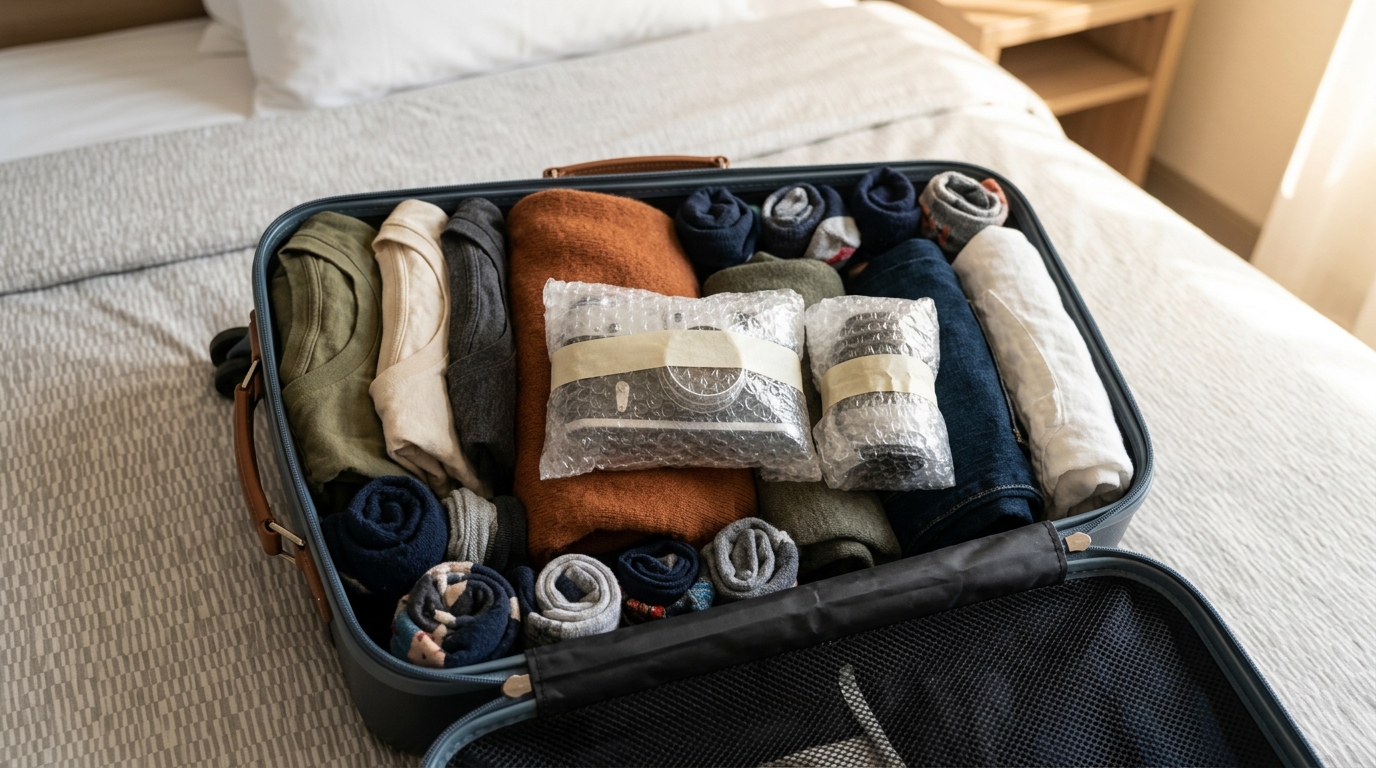
In the packing article I described the full routine: three to four layers of bubble wrap, then a nest of soft crumpled paper below, around, and above, so the item sits snug in the middle and touches nothing hard. You can rebuild that whole system in a hotel room, because you are already carrying the materials. They are called clothes.
- Bubble wrap plays itself, if you have some (more on getting it in a moment). Three or four layers around the body, extra on the head; same for the lens.
- Your T-shirts are the nest. A folded shirt below the wrapped camera, shirts or a sweater around it, something soft on top.
- Socks are the gap-fillers, doing the job of the crumpled paper: filling the small empty spaces so nothing can shift. A rolled-up pair also makes a fine extra pad for the camera’s head.
- Position matters. Middle of the suitcase, cushioned on every side — never against the shell, an edge, or a corner. Same idea in a backpack: clothes between the camera and every outer wall.
Whether it rides in a suitcase or a backpack, the physics inside the bag are the same: a camera that cannot move cannot be hurt by a bump it never feels.
Ask the shop — and learn one word
About that bubble wrap. Japanese camera shops generally wrap a purchase with care, and asking for a little extra is a normal thing to do here. I cannot promise every shop will say yes — but asking costs nothing, and the everyday Japanese word for bubble wrap is easy to remember: puchi-puchi (プチプチ), named after the popping sound. Point at your camera, say “puchi-puchi?”, and you will be understood. If speaking up in a Japanese shop feels intimidating, I wrote about how little talking a camera shop here actually requires — and this is about as easy as asking gets.
The shake test works on a suitcase too
The final step of my shipping routine is the shake test: lift the sealed box, shake it gently, and if you hear anything — the faintest knock or slide — open it and repack until it is silent. Your luggage deserves the same exam. Close the packed bag, lift it, tilt it slowly each way. A sound means something has room to move — the one thing you must not grant. Add a shirt, reposition a sock, test again. The bag is ready when it is boring.
When you get home, check it the same day
One last habit from the selling side. When the camera is finally on your own table, do not just put it on the shelf — give it the 10-minute check I used to run before listing a camera: exterior under a light, a flashlight through the glass, shutter and rings and blades. Not because you distrust the shop, but because you were the shipper this time, and a good shipper confirms the delivery. Ten quiet minutes, and the trip is truly, completely over.
Summary
- Transit damage is predictable: the pentaprism “head” dents first, and hoods left attached break their own lenses.
- Three rules from the shipping desk: extra padding on the camera’s head, body and lens wrapped separately, hood off the lens (with soft paper between if they nest together).
- Rebuild the shipping box in your hotel room: bubble wrap as armor, T-shirts as the nest, socks as gap-fillers, camera in the middle of the bag away from every wall.
- Ask the shop for extra wrapping — the magic word is puchi-puchi.
- Shake test your packed bag: if you can hear the camera, repack until you cannot.
- Back home, run the 10-minute arrival check the same day.
Somewhere between Tokyo and your front door, your bag will get bumped, tipped, and stacked under something heavier. That is fine. If you packed it tonight on the hotel bed — head padded, lens separate, hood off, everything silent — then your camera will feel none of it. It will simply wake up on your table at home, as if it never left the shelf in Tokyo.

コメント