
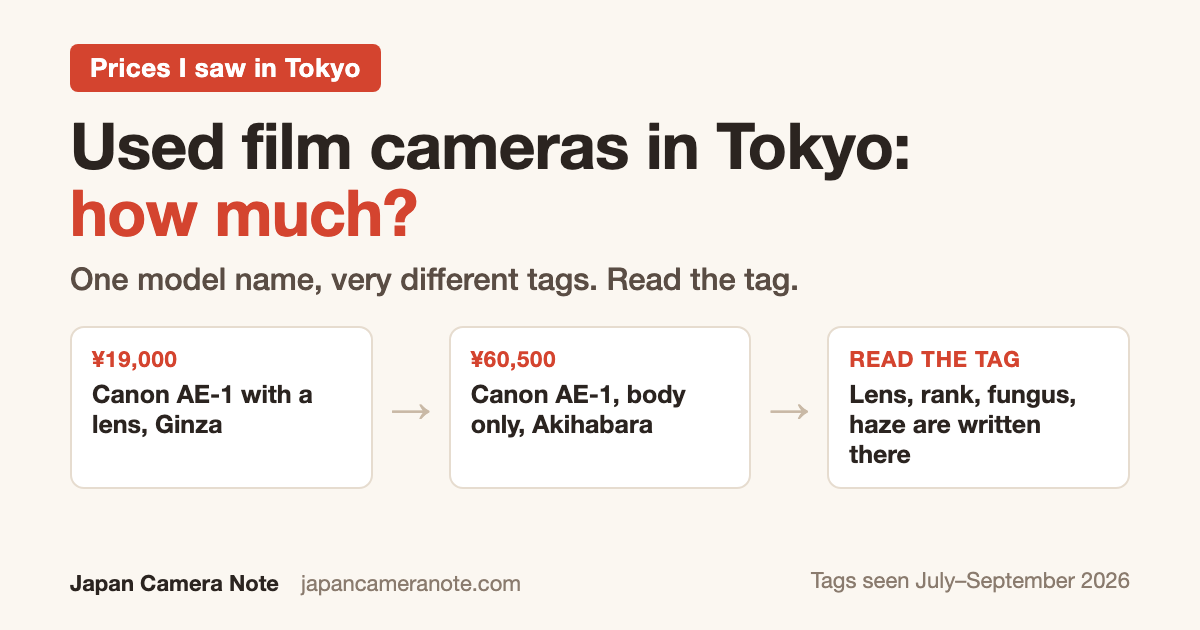
On the price tags I saw in Tokyo between July and September 2026, a Canon AE-1 with a lens was ¥19,000. A Canon AE-1 body with no lens was ¥60,500. Same model name, more than three times the price.
So there is no single price. This page lists the tags I photographed or wrote down on three days: July 12 (Nakano and Shinjuku), August 1 (Akihabara) and September 12 (Ginza). That is fewer than 30 tags, not a market survey, and those shelves have changed since. All prices are in yen. For scale: the U.S. Federal Reserve’s rate for October 2, 2026 was 157.81 yen to the dollar, so ¥10,000 is about $63 and ¥60,500 is about $383.
| Price on the tag | What it was | Town |
|---|---|---|
| ¥500–¥2,000 | Junk items on open shelves | Shinjuku |
| ¥3,000–¥10,000 | Lenses | Akihabara, Ginza, Shinjuku |
| ¥17,000–¥19,000 | Film SLRs with notes on the tag | Ginza |
| ¥26,000–¥39,000 | Film SLRs, some with a lens or a motor drive | Akihabara, Ginza |
| ¥60,500 | One Canon AE-1, body only | Akihabara |
| ¥121,000–¥230,000 | Nikon F2 and F3, Leica M3 | Ginza |
How much does a used film camera cost in Tokyo?
For a Japanese film SLR, the tags in my records ran from ¥17,000 to ¥60,500. I have nine such tags: Canon AE-1, AE-1 Program, Nikon FE, FE2 and FG. Eight of them were between ¥17,000 and ¥39,000.
Lenses started lower, from ¥3,500 in a showcase. The top of a Ginza window was far higher.
One more reference point. On September 1, 2026, I checked the online used stock of two big chains, and AE-1 bodies ran from ¥11,000 to ¥41,800. Those numbers are in Is Japan really cheaper for cameras?. This page is the other half: tags on physical shelves.
Why was the same camera ¥19,000 in one shop and ¥60,500 in another?
For the ¥19,000 camera, the tag listed its faults. For the ¥60,500 camera, I do not know the reason.
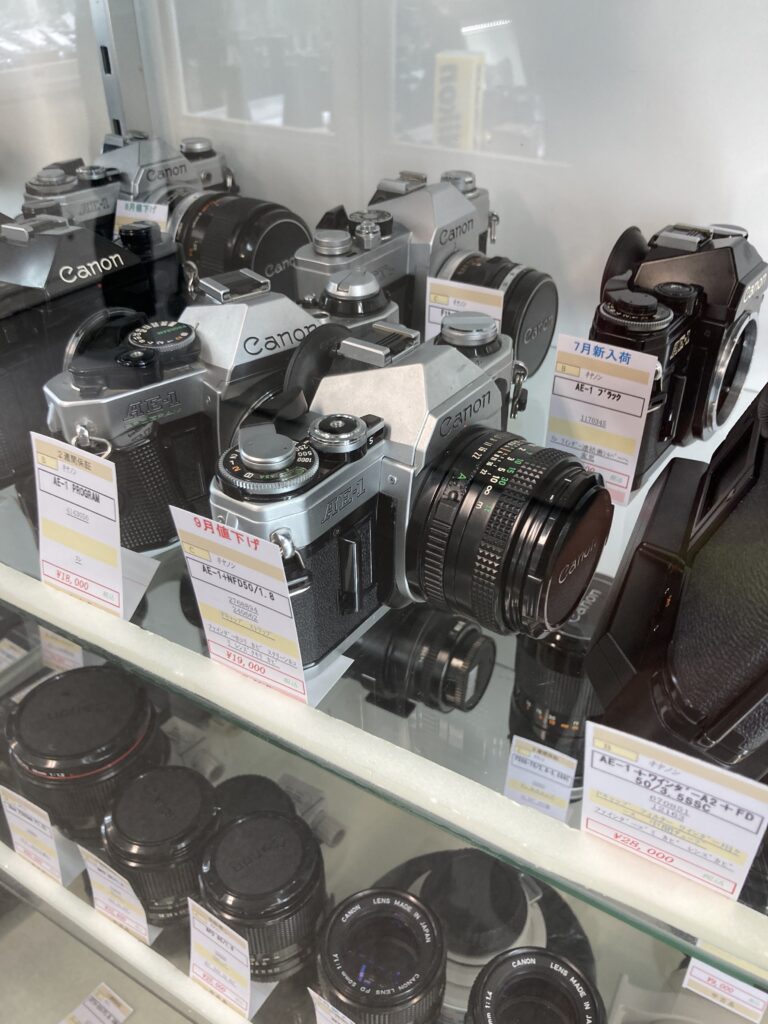
The ¥19,000 AE-1 was at Lemon Camera Ginza on September 12. The tag said: with a New FD 50mm f/1.8 lens, rank C, marked down in September. Then, in Japanese: viewfinder dust, fungus, screen dust, lens haze, fungus.
The ¥60,500 AE-1 was in an Akihabara shop on August 1. My note says “body only, no lens” and the price. I did not record the condition, the color, or anything else on the tag, and I have no photo of it. The reason is not in my records.
Three more AE-1 tags sat between those two:
- ¥28,000 at Lemon Camera Ginza: with a Winder A2 and an FD 50mm f/3.5 lens, rank B. The tag also listed fungus.
- ¥33,000 and ¥36,000 in another Akihabara shop. My notes have the two prices and nothing else, not even whether a lens was attached.
Five tags, one model name. Where I can see what differed, it was written on the tag: a lens or no lens, the rank, the faults, the month of a markdown. So do not set your budget from the model name alone. Read the tag.
The two words to learn first are カビ (fungus) and クモリ (haze). My guide to reading Japanese price tags has the rest. A shop’s rank B or C is also a different vocabulary from the “Exc+++” you see on eBay, which I cover in Japanese condition grades.
What can I get for under ¥10,000?
Lenses and junk. The lowest film SLR tag in my records was ¥17,000.
- ¥500 to ¥2,000: junk items on open shelves at Lemon Company in Shinjuku, July 12. They are in my Nakano and Shinjuku guide.
- From about ¥3,000: junk lenses in Akihabara, August 1. The price was stuck straight onto each lens, with no condition note.
- ¥3,500: a Canon FD 35-70mm f/2.8-3.5 zoom at Lemon Camera Ginza. Rank C, “heavy haze” on the tag, 2-week warranty.
- ¥6,000: a Takumar 55mm f/1.8 in Shinjuku.
- ¥6,600: a Minolta Rokkor lens in Akihabara. My note has no focal length.
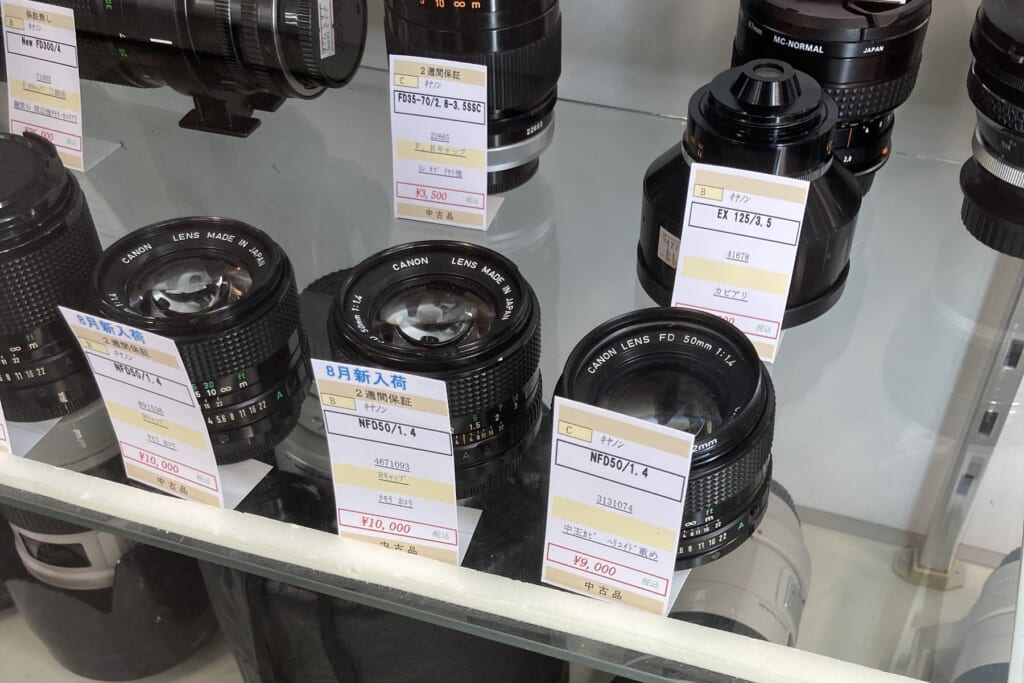
- ¥9,000 and ¥10,000: three Canon New FD 50mm f/1.4 lenses on one shelf at Lemon Camera Ginza.
Look at those three 50mm lenses. Two were rank B at ¥10,000 each, with haze and dust on the tag and a 2-week warranty. The third was rank C at ¥9,000: fungus on an inner element, and a focus ring on the heavy side. The gap was ¥1,000. A fault on the tag is information. Here it did not mean a big discount.
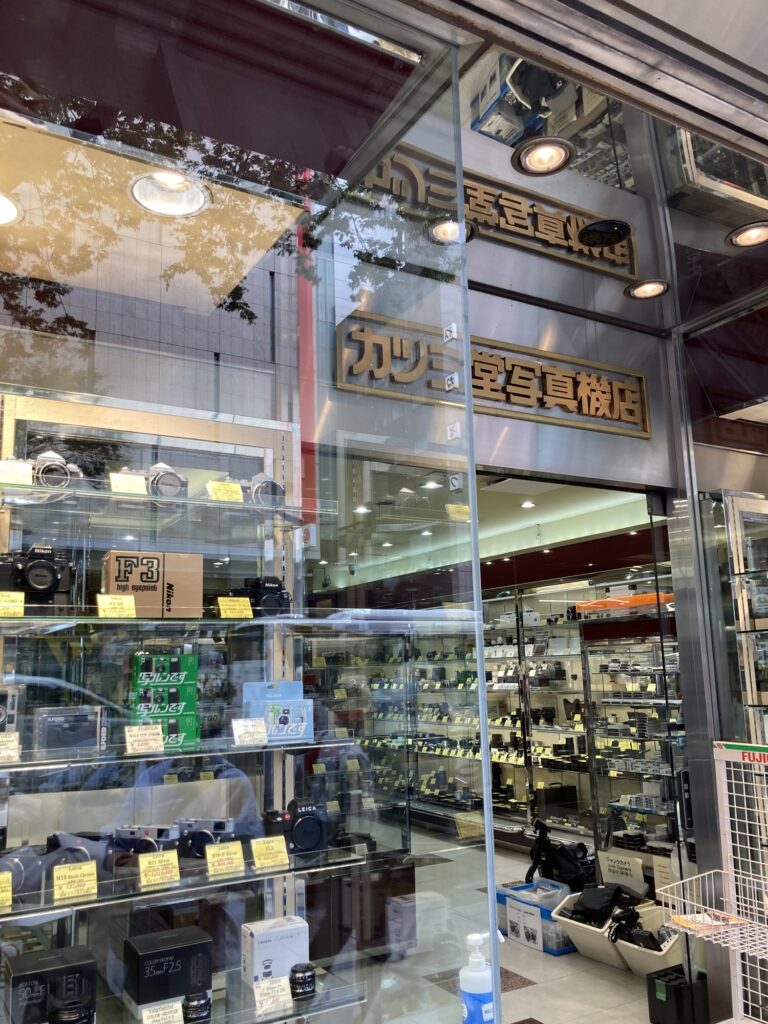
Before you buy at the bottom of this range, read what “junk” means in Japan. And one new camera belongs in this band: a 27-exposure Fujifilm disposable was ¥3,080 in the window of Katsumido Camera in Ginza.
What does ¥20,000 to ¥40,000 buy?
A film SLR, sometimes with a lens, a winder or a motor drive, and usually with a note to read.
- ¥26,000: a Nikon FE with an MD-12 motor drive, Lemon Camera Ginza. Rank B. The tag listed scuffs, worn light seals, viewfinder dust and fungus.
- ¥28,000: the AE-1 with winder and lens, above.
- ¥33,000 and ¥36,000: the two AE-1s in Akihabara.
- ¥39,000: a Nikon FE2 body, Lemon Camera Ginza, marked down in August. In my photo the tag shows rank C and the note 露出計不良, “light meter faulty.”
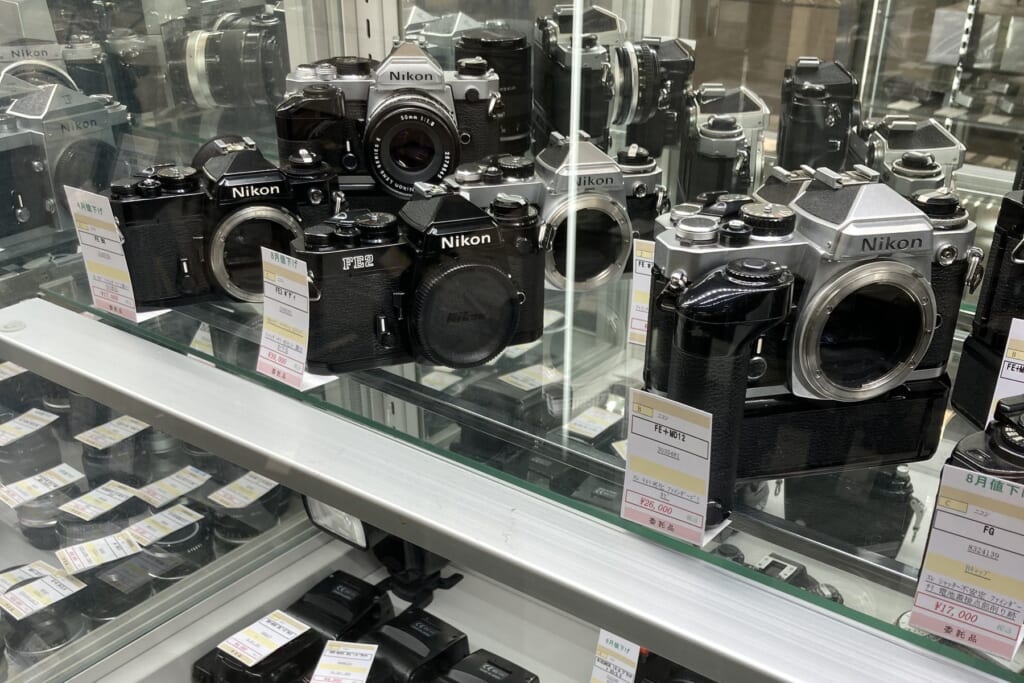
Just under this band were a Nikon FG at ¥17,000 (rank C, “shutter unstable” on the tag) and a Canon AE-1 Program at ¥18,000, both at Lemon Camera Ginza (rank B, scuffs, 2-week warranty).
A fast 50mm lens can cost as much as a body. An Ai-S Nikkor 50mm f/1.4 was ¥30,000 in Akihabara. In July I saw three more Nikkor 50mm f/1.4 lenses in Nakano and Shinjuku, from ¥16,500 to ¥35,800. I did not check which generation each lens was, so I cannot compare them.
What does the top of the window cost?
Six figures. For a digital Leica, seven.
These four were in Ginza on September 12:
- Nikon F2 Photomic AS, black: ¥121,000, at Katsumido Camera.
- Nikon F3 HP, displayed with its original box: ¥220,000, in Katsumido’s street window.
- Leica M3 double-stroke: ¥230,000, at Lemon Camera Ginza. The tag noted an August 2026 service and a 2-week warranty.
- Leica M11, a digital camera: ¥1,012,000, in the same Katsumido window.
In Shinjuku in July, Map Camera had two Leicas at roughly 3 million yen each. Looking costs nothing.
Is the number on the tag the number I pay?
On the tags I saw, yes: the price already includes tax. Every tag I can read in my two shelf photos from Lemon Camera Ginza has 税込 (tax included) printed beside the price, and every tag I saw in Akihabara was tax-included too. For Nakano and Shinjuku, I did not write that detail down. If a tag says 税抜, tax is added at the register.
Tax-free shopping for visitors is a separate step, and I do not calculate it here. From November 1, 2026, you pay the price on the tag, with tax, and the tax comes back after a customs check at the airport. Purchases through October 31 follow the older system. The steps are in my guides to Japan’s tax-free rules from November 1, 2026 and tax-free shopping at Tokyo camera shops. Please confirm the details at the shop.
One more thing to read on a tag: the three Nikon bodies in my photo are marked 委託品 (consignment). The card I photographed inside Lemon Camera Ginza says goods with that mark cannot be exempted from tax.
What I could not confirm
- Why the AE-1 body in Akihabara was ¥60,500. I recorded no condition, and I have no photo.
- Whether the ¥33,000 and ¥36,000 AE-1s came with lenses.
- Which generation the Nikkor and Takumar lenses were.
- What rank B and rank C mean in each shop’s own rules.
- Whether the tags in Nakano and Shinjuku were tax-included.
- Whether any of these items is still for sale, and what the tags say today.
- A typical price. Fewer than 30 tags on three days is too few for that.
The exchange rate is from the Federal Reserve’s H.10 release of October 5, 2026.
If you already know the model you want, start with how to find a specific camera in Tokyo. For the whole trip, start with the Japan camera shopping guide.
コメント