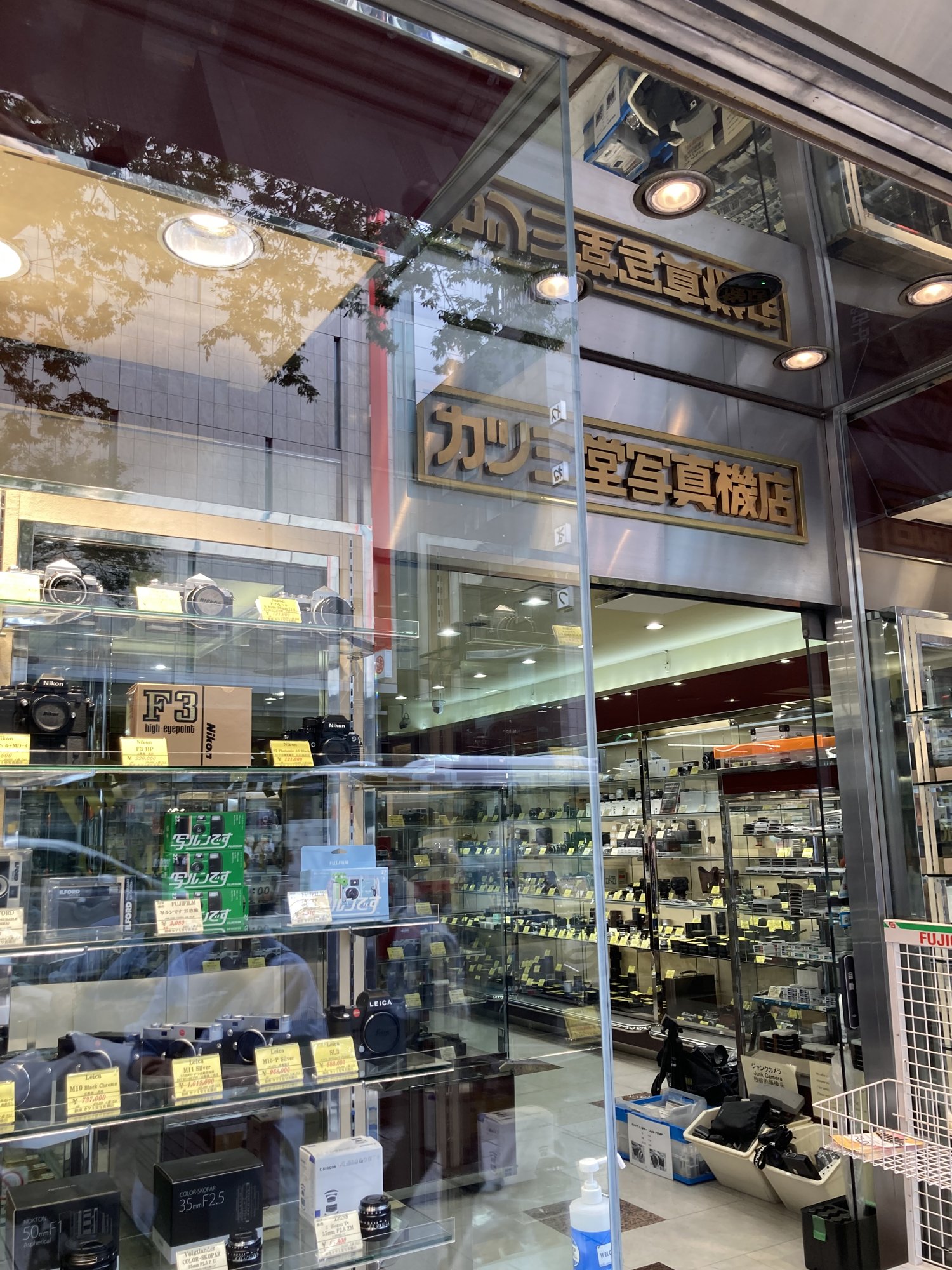
Stand on the pavement in front of Katsumido Camera in Ginza and read the window from left to right. A Fujifilm disposable camera for ¥3,080. Kenko binoculars in candy colors — yellow, mint, pink, sky blue. A Super Mario instax box. A boxed Nikon F3 High-Eyepoint for ¥220,000. And a Leica M11 with a tag that reads ¥1,012,000.
That is almost the whole price range of photography, in one piece of glass, and you have not opened a door yet.
I visited on September 12, 2026, as the fourth stop of a day walking Ginza’s camera shops. The earlier articles in this series are Lemon Camera on the 8th floor of a church building and Shimizu Camera, the shop with no website.
Finding it: look up for the tall black sign
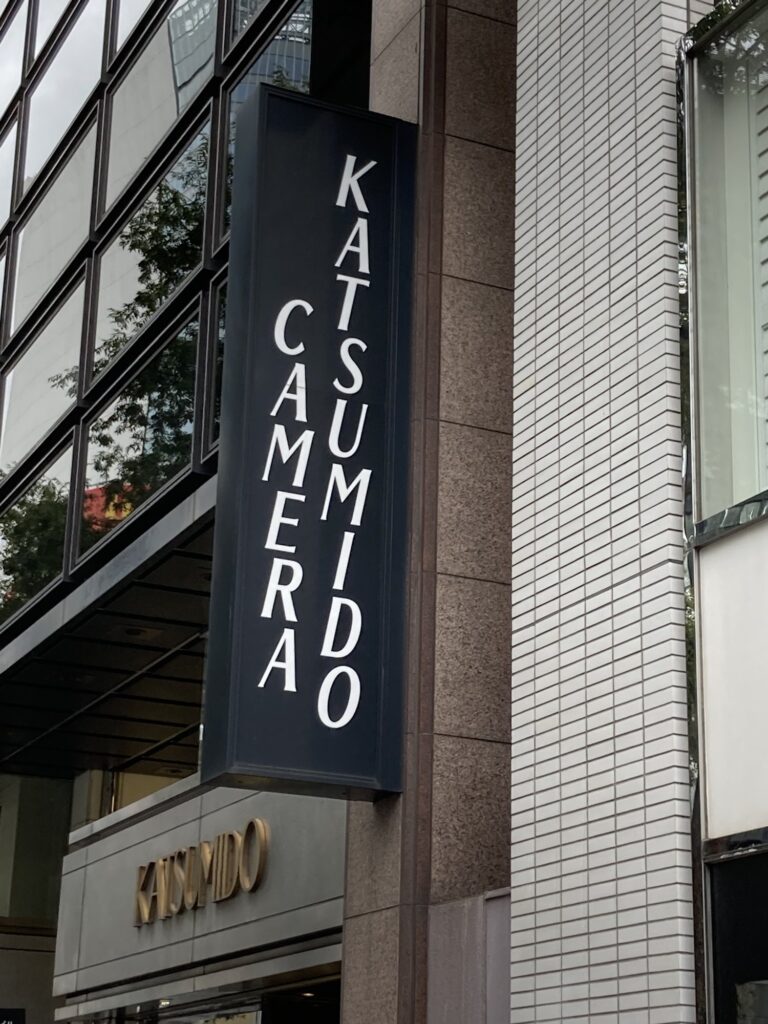
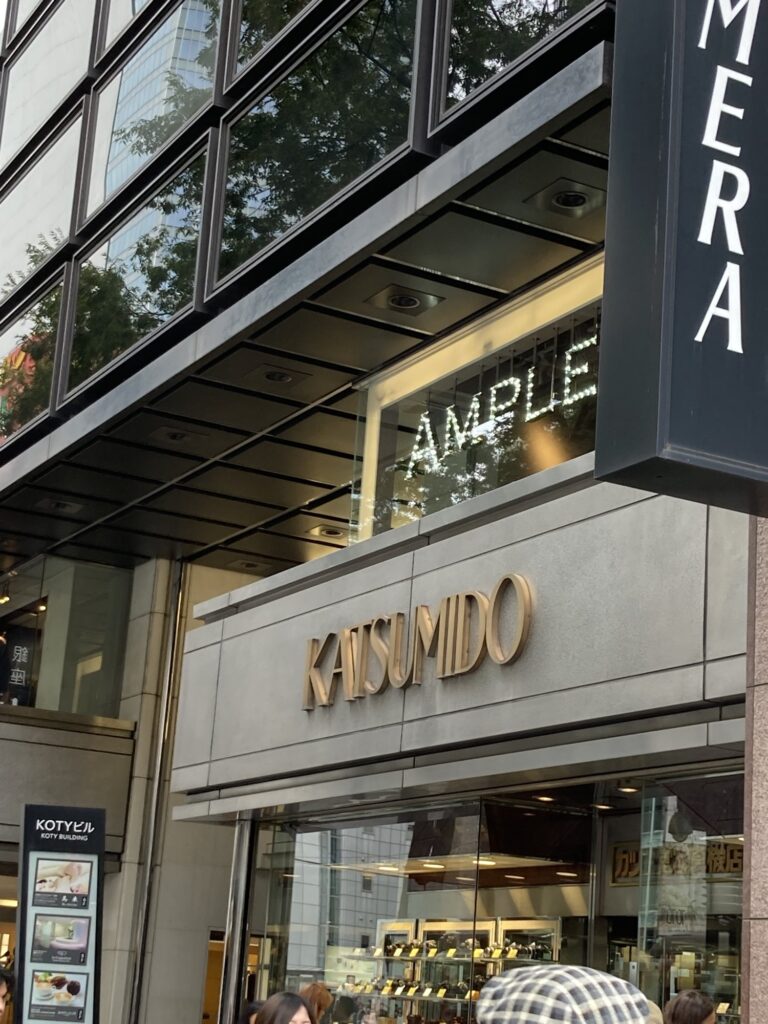
Katsumido’s address is 5-9-1 Ginza, a short walk from the big Ginza 4-chome crossing. The easiest landmark is a tall black vertical sign with “KATSUMIDO CAMERA” in white letters. You can read it from across the street. Below it, the name is spelled out again in gold letters over the entrance, and inside the glass there is a second gold sign in Japanese: カツミ堂写真機店, “Katsumido Camera Shop.”
The shop is on the ground floor, facing the street. No elevator, no staircase, no guessing which building. After a church building and a shop with no website, this was the easiest shop of the day to find.
Two windows, one on each side of the door
In my Shimizu Camera article I wrote that Ginza shops like to put their stock in the front window, with prices showing. Katsumido does this on both sides of the entrance. The shop feels old and established, but the windows make it easy: you can browse and compare prices from the street before you decide to go in.
What surprised me was the mix. This is not only a classic-camera window. On the day I visited, I saw:
- New everyday cameras. Instax cameras, a Canon PowerShot V10 (¥59,950), a Nikon Z30 lens kit (¥113,300), a Nikon Z50II lens kit (¥199,100). These tags were white and marked “NEW.”
- Binoculars. A whole shelf of new Kenko binoculars, several of them in the ¥3,000s.
- Film. Fujifilm disposable cameras (the 27-exposure one at ¥3,080) and Ilford boxes.
- Classic Nikon film SLRs. A Nikon F, an F2, a boxed F3 HP and more, on yellow tags.
- Leica. A shelf of M bodies and an SL3, plus a white plate that says “Leica Dealer — Authorized by Leica Camera Japan Co., Ltd.”
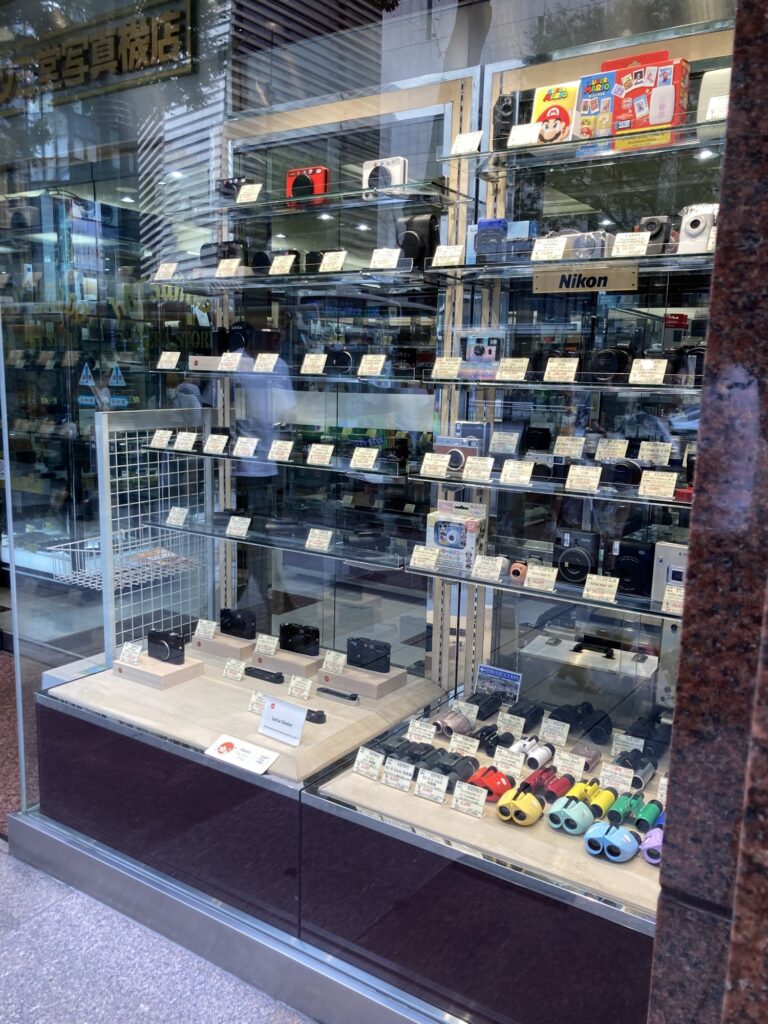
So if you are traveling with someone who does not care about old cameras, this window has something for them too. Colorful binoculars and a Mario instax are an easier conversation than a Leica.
Prices I read through the glass that day
These are from the window tags on September 12, 2026. They are not market rates. They are what was on display that afternoon, and I only list tags I could read clearly in my photos:
- Nikon F3 HP (High-Eyepoint), displayed with its original box: ¥220,000
- Nikon F2 Photomic AS, black: ¥121,000
- Nikon F eye-level with Nikkor-S Auto 50mm f/1.4: ¥121,000
- Leica M10 Black Chrome: ¥737,000
- Leica M10-P Silver: ¥968,000
- Leica SL3: ¥880,000
- Leica M11 Silver: ¥1,012,000
- Fujifilm disposable camera, 27 exposures (new): ¥3,080
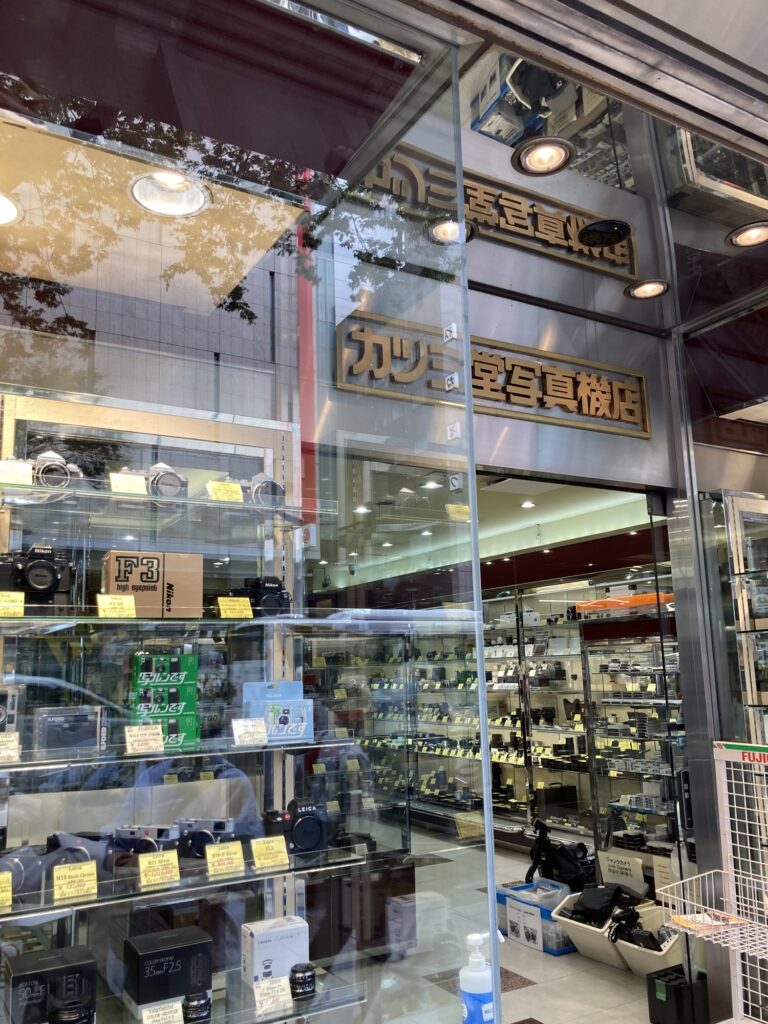
The F3 HP is the tag I kept looking at. The big “F3 high-eyepoint” box stands in the window with the tag in front of it, which says a lot before you read any Japanese: this one comes complete. If you are wondering whether that kind of price is “cheap for Japan,” that is a separate question, and I tried to answer it in Is Japan really cheaper for cameras?
How the tags work, from what I could see in my photos: the camera name is written in English letters (“Leica M11 Silver,” “Nikon F3 HP”), the large number is the price including tax, and a smaller line shows the price before tax. Short notes under the name are in Japanese. New items have white tags with “NEW”; the used Nikon film cameras have yellow tags. I could not tell from the tags alone whether each Leica on the shelf was new or used, so ask if that matters to you.
“Jōmono”: a word I did not expect on a camera tag
Inside the shop, the words on the tags were my favorite part. Two came up again and again. This part is from memory — I did not take photos inside, and my window photos are too small to show these words.
- 上物 (jōmono) — “top-quality goods.” It is an old word for a fine piece of something. To me it sounds like a word from a fish market, not a camera shop. At Katsumido it describes cameras.
- 清掃済み (seisō-zumi) — “cleaned.” The item has been cleaned before being put out for sale.
Both are in Japanese only. “Jōmono” is the shop telling you, in its own voice, that this one is good. It is not a standard grade you can compare between shops, so treat it as a compliment, not a measurement, and look at the camera yourself. If you want the more common tag words (scratches, haze, fungus, “as-is”), my guide to reading Japanese price tags covers them. You can add 上物 and 清掃済み to that list.
Inside: glass cases, and junk bins by the door
Again from memory for most of this. The more expensive Leicas sit in glass cases that look like a jewelry store. The room is bright, with long rows of shelves and yellow tags.
And right inside the entrance, in plastic bins on the floor, there is junk. My photo through the door shows a sign standing in the bins, in three languages: ジャンクカメラ, “Junk Camera,” and a line in Chinese. There is a second sign beside it that starts in English, but in my photo it is too blurry to read. So yes, even at a Leica dealer in Ginza, there is a place to dig. If you have never bought junk before, read my guide to buying junk cameras in Japan first — “junk” means no guarantee that it works.
There were two staff members on my visit, both older men. I saw them helping customers from overseas, and there were visitors from abroad both inside the shop and outside at the windows. I did not ask the staff any questions myself, so I cannot tell you how much English they speak.
Tax-free sticker in the window
In one of the windows, next to the Leica Dealer plate, there is a “Japan. Tax-free Shop” sticker. That is a good sign for visitors with a passport. I did not check the details at the counter, so I cannot tell you which items qualify. At Lemon Camera Ginza, consignment items were not tax-free, so it is worth asking before you decide. My guide to Japan’s tax-free rules explains how the system works in general and what changes on November 1, 2026. What I saw at each shop is on my shop-by-shop tax-free page.
Who this shop is for
Katsumido is a shop for more than one kind of visitor. If you want a boxed classic Nikon, it is in the window. If you want a Leica, there is an authorized dealer plate. If you like to dig, there are bins by the door. And if the person next to you just wants binoculars or an instax, they are covered too.
And if you are not sure you want to go in, you do not have to decide yet. Read the window first. At Katsumido, the window tells you a lot about the shop before you step inside.
Practical notes
- Where: 5-9-1 Ginza, ground floor, facing the street. Look for the tall black “KATSUMIDO CAMERA” sign.
- Hours: the shop’s official website shows 10:00–19:00, open year-round (checked September 17, 2026). I visited on a Saturday afternoon and it was open. Please check the website before you go.
- Before you enter: windows on both sides of the door, with price tags. You can browse from the street.
- Stock: new and used. Classic Nikon film SLRs, Leica (authorized Leica dealer plate in the window), new digital cameras, instax, binoculars, film, and junk bins inside the entrance.
- Tags: camera names in English letters; the large number includes tax; notes in Japanese. Look for 上物 (top quality) and 清掃済み (cleaned).
- Tax-free: “Japan. Tax-free Shop” sticker in the window. Ask which items qualify.
- Photos: I photographed only the outside and the windows. If you want to take photos inside, ask first.
Everything above is what I saw on September 12, 2026. Stock and prices in a window like this change quickly, so the exact cameras will be different when you go. This was the fourth shop of my Ginza camera day; the rest of the street is in my Ginza round-up. If you are planning your whole trip, start with my Japan camera shopping guide.
コメント