
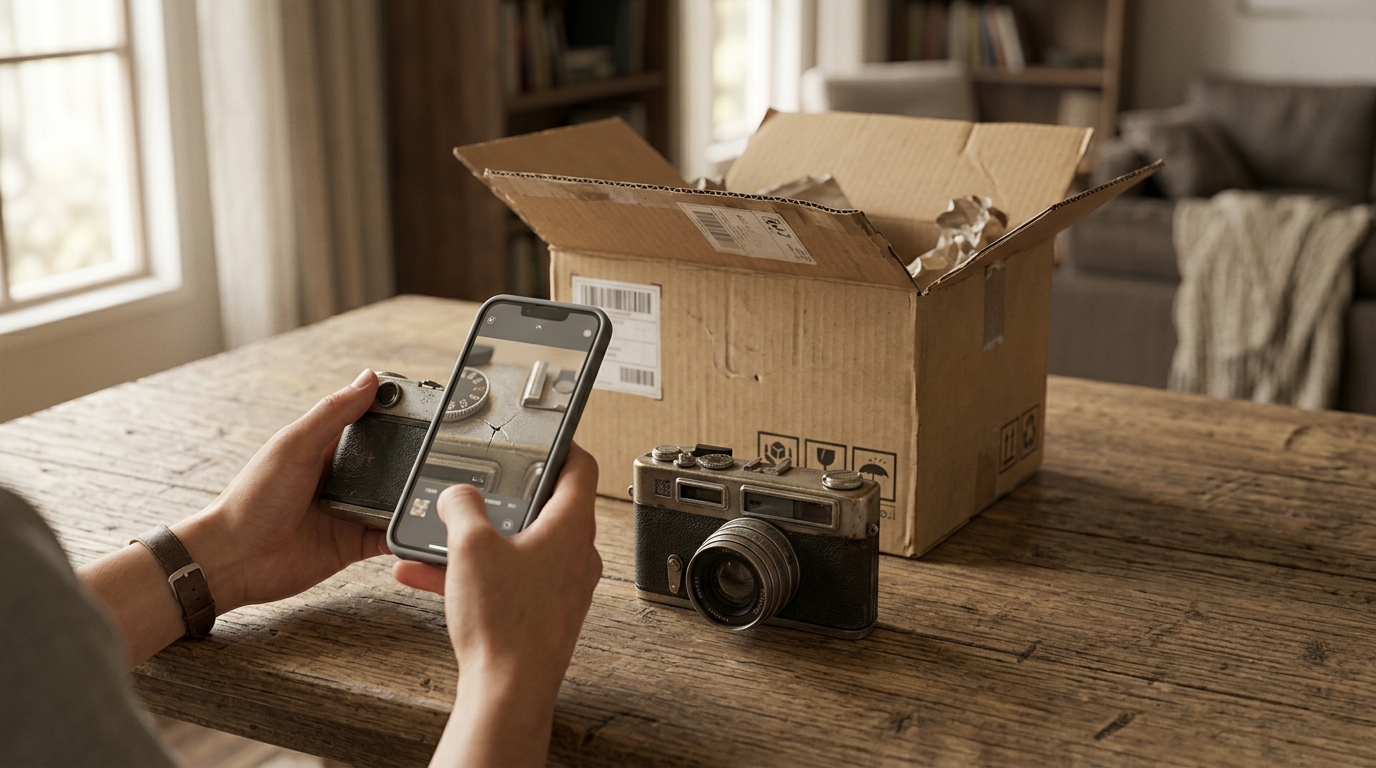
You open the box, lift out the camera, and something is wrong. The viewfinder is cracked. Or the lens rattles. Or the shutter that was “working perfectly” does not fire.
It is a terrible moment. But I have spent years on the other side of it — packing and shipping cameras to buyers overseas, and before that working at a parcel counter — and I can tell you something that may help right away: with the right first moves, this is almost always a solvable problem. A refund or a return is the normal outcome, not a lucky one. What decides how fast you get there is mostly what you do in the first hour.
First: take three photos
Before you write the message, before you “test it a bit more,” take these three photos:
- The outer shipping box — the whole box, showing its condition: crushed corners, holes, dents, or none at all.
- The item as a whole — the full camera or lens in one frame.
- A close-up of the damage — as near and as sharp as your phone can manage.
Add a short written description of what is wrong, and you have everything a seller needs.
Why these three? Because together they answer the two questions a seller must settle before doing anything: what exactly is broken, and did it break in transit or was it shipped that way. When those three arrived together with a clear description, the decision on my side — refund or return — could usually be made on the spot, in one reading. Without them, the same case became a long chain of “could you also send…” messages across a language barrier and a time difference.
And one reassurance: it is completely fine that you already unpacked everything. Nobody discovers damage before opening the box. A photo of the empty, already-opened shipping box is exactly what a seller expects.
Second: do not sit on it
If I could put only one sentence from the seller’s side into this article, it is this: the hardest thing a buyer can do to a seller is wait.
A message sent the day the package arrives is easy to act on: tracking shows delivery this morning, your photos show the damage this afternoon, and the refund moves. The longer the gap grows, the harder every part of the case gets — not because anyone assumes bad faith, but because time makes everything blurrier, for everyone involved.
The same goes for the carrier. If the damage clearly happened in transit, the delivery company may need to be told too, and carriers tend to have time limits for reporting damage. Those limits depend on your country and carrier, so check with the local office of whichever company delivered your box. The safe rule is simple: the day you notice is the day you report. Seller first, carrier soon after if the box took the hit.
The fastest route happens at your door
Here is something most buyers never think of, because the moment goes by so quickly. If the box that shows up is visibly wrecked — crushed flat, punctured, rattling — you have options before you ever sign for it. You can point the damage out to the delivery driver right at the door. And in some cases, you can contact your local carrier and refuse the delivery, so the package goes back through the carrier’s own hands instead of yours.
From the seller’s side, this route was remarkably clean when it happened: the carrier contacted the shipper directly, the damage was documented in the carrier’s own system, and the case usually ended in a straightforward refund — with the return leg handled in the carrier’s process, not by the buyer arranging an international shipment home.
Whether refusal is possible, and what it triggers, differs by country, carrier, and how the shipment was sent — I am describing how it looked from the shipping side in Japan, not promising how it works at your door. But the option is worth knowing, because the window for it is exactly as long as the driver is standing in front of you.
And if you do accept a beaten-up box — also a reasonable choice — this is the one situation where filming the opening genuinely helps, as I wrote in the packing article: photograph the box from all sides, then record yourself opening it.
Your first message to the seller
Keep it short, factual, and calm. It needs four things: the three photos, when the package arrived, what is wrong in plain words, and what you are asking for. Here is a version you can adapt:
Hello, the camera arrived today. Thank you for the careful packing. Unfortunately, the viewfinder is cracked and the shutter does not fire. I have attached photos of the shipping box, the camera, and the damaged area. Could you let me know how you would like to handle this? Thank you.
Notice what is not in there: no accusation, no guessing whose fault it is, no anger. Not because your frustration is wrong — it is not — but because, as I wrote in how to buy from Japanese sellers, your message will likely pass through machine translation on the other end, and facts survive translation far better than feelings do.
One thing to know about the person reading it: when a camera breaks in transit, the seller usually absorbs the loss personally, so a damage report always lands with a small knot in the stomach. A calm message with the three photos attached untangles it immediately — you are handing over exactly what the seller needs to say yes quickly.
Three things not to do
- Do not open up or repair the camera yourself. Not even “just to take a look.” Once a screwdriver touches it, nobody can tell transit damage from repair damage, and options that were open — return, claim, replacement — start closing. Report first, in the state it arrived.
- Do not wait a week. Even if you are busy, send the three photos and a one-line “more details to follow” today. You can add information later; you cannot add earliness later.
- Do not lead with anger. You may be entirely in the right and still slow your own case down. The fastest-resolved damage reports I handled read like weather reports: this arrived, this is broken, here are pictures, what next?
Summary
- Three photos before anything else: the outer box, the whole item, a close-up of the damage — plus a short description. This set lets a seller decide in one reading.
- The box photo after unpacking is fine. Nobody finds damage before opening.
- Report the day you notice: seller first, then the carrier if the box took the hit. Carrier deadlines vary, so check locally.
- A visibly wrecked box at the door: flag it to the driver, or ask your carrier about refusing delivery. Rules differ — an option to know, not a guarantee.
- First message: photos, arrival date, plain facts, and “how would you like to handle this?” No blame, no heat.
- Never open the camera yourself, never wait, never let the anger write the message.
This closes the loop I have been writing for a while: the inspection before listing, the packing, the shipping day — all of it aimed at making sure this article never applies to you. Most of the time, it never does. But cardboard boxes cross an ocean, and sometimes the ocean wins.
When it does, remember that a good seller wants this solved as much as you do. Your three photos are the fastest road back to the moment this was all supposed to be: you, opening a box from Japan, smiling.


コメント