
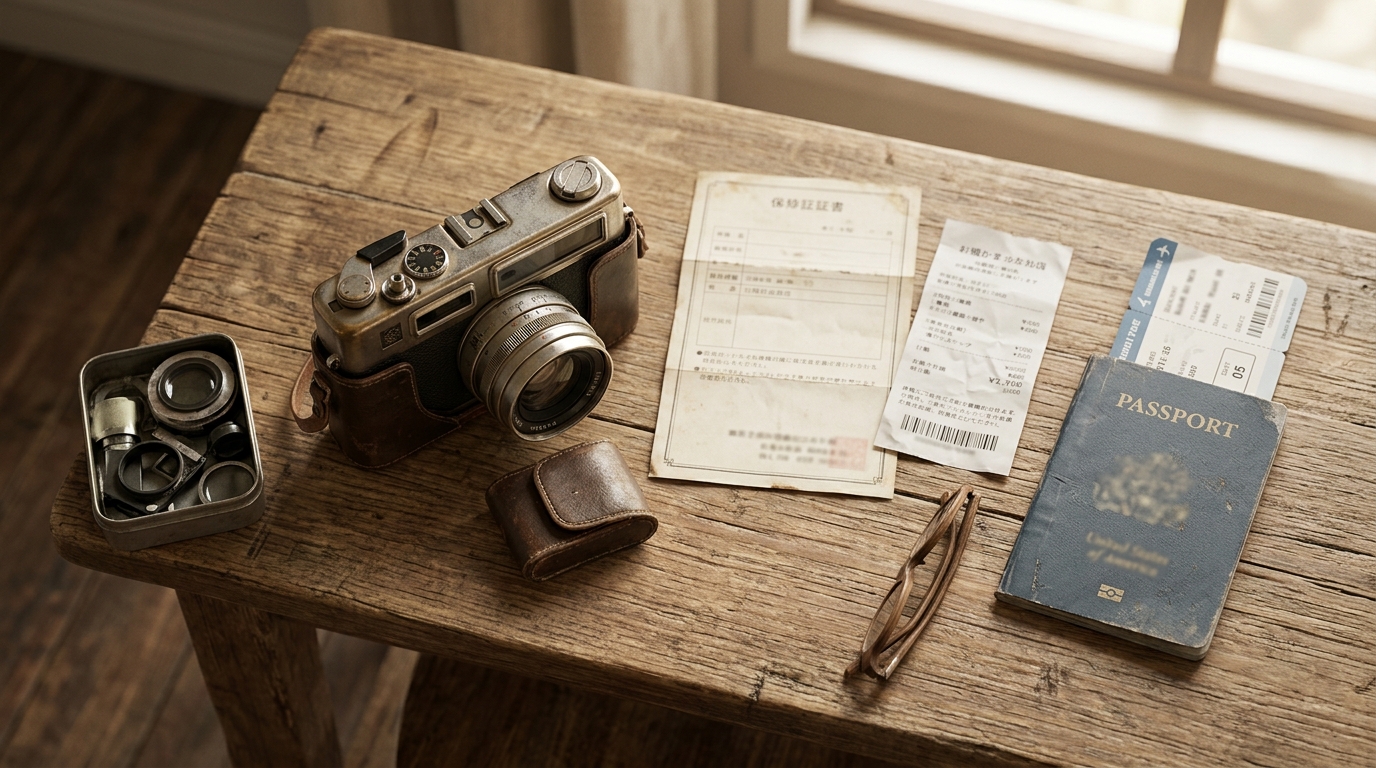
Picture the moment at the register. You have just bought a clean used lens in Tokyo, and the staff hands you a slip of paper: a six-month warranty. Nice — except your flight home leaves in four days, and home is Berlin, or Chicago, or Sydney. So what exactly did you just receive?
I have not had to use one of these warranties myself, so this is not a war story. Instead, I did the next best thing: on August 25, 2026, I opened the official websites of the three big shops I keep writing about — Map Camera, Fujiya Camera, and Kitamura — and read their used-warranty pages as they stand today. Policies change, so treat this as a snapshot, and confirm the current terms when you buy.
What the big shops’ used warranties say
First, the good news: real warranties on used gear do exist here, and they are not marketing fluff. All three shops publish written rules.
Map Camera
Map Camera’s shopping guide describes its own warranty on used camera bodies and lenses priced ¥10,000 and up (with some exceptions): up to one year from the purchase date. It covers functional failures that happen naturally — not drops, not fungus you grew yourself — and the shop pays for the repair, up to the price you paid for the item. To claim it, the guide says you bring the item in, or send it in, together with the shop’s warranty card. There are also separate initial-defect return windows: two weeks for used digital gear, one month for used film cameras.
Fujiya Camera
Fujiya’s guide gives used items priced ¥11,000 and up a six-month warranty (some categories excluded). Same shape: normal use, natural failure, free repair up to the purchase amount, and the product must come back to the company with its warranty card.
Kitamura
Kitamura attaches a “used camera 6-month warranty card” to used cameras and lenses of ¥10,000 and up (before tax). If a natural failure gets in the way of shooting within six months, they repair it at their cost — and if the item cannot be repaired, they refund the purchase price. The card is valid at Kitamura stores nationwide (as long as the store handles used goods), it works once, and the page warns that a lost card or lost receipt will not be reissued.
Now the fine print that matters to you
Read those three summaries again as a resident of another country, and a pattern appears.
Kitamura’s warranty page settles the question in a single line, written in English on an otherwise Japanese page: “This warranty is valid only in Japan.” Fujiya’s exclusion list includes use of the product outside Japan. And Map Camera’s claim procedure — bring the item in, or send it in, with the warranty card — assumes you can physically get the camera back to them; the same shopping guide also states that the shop does not ship overseas, and that purchases made through Buyee or eBay are outside the warranty entirely.
I want to be fair to the shops here: none of this is a trick. These warranties were designed for domestic customers, decades before anyone imagined a tourist carrying an FM2 back to Berlin. The terms are published openly, and by Japanese domestic standards they are generous — a year of coverage on a used lens is a serious commitment. But the practical picture for a visitor is clear enough. Once you and the camera leave Japan, the paperwork in your bag has, at best, an unclear status — and in two of the three cases, an explicitly stated one.
One small silver lining: if you return to Japan while the period is still running, that paper may still be worth something at the counter. Keep the card and the receipt with your travel documents, not in the camera box you throw away. And if the terms matter to you, ask at the register before you pay — staff at these shops answer this kind of question every day.
Junk was never covered — and that is by design
If you bought your treasure on a junk shelf, none of the above applies, and no shop pretends otherwise. Fujiya’s grading table marks its bottom two ranks — “as-is” and “collection” — as outside the used warranty. Kitamura’s rules exclude items sold as-is. Map Camera’s guide states that junk items and used accessories cannot be returned or exchanged at all.
This is consistent with everything I have written about the junk system in Japan: junk prices are low precisely because the shop makes no promises. The warranty question and the junk question are the same question, answered at opposite ends of the price tag.
The warranty you can actually use
So if the paper warranty fades at the border, what protects you? Mostly things that happen before and just after the purchase — and they are all in your control.
At the counter, ask to check the item. Japanese shops expect this; dry-firing a shutter or looking through a lens with permission is normal behavior, and my shop etiquette guide covers how to do it comfortably. That evening in your hotel, run the ten-minute check I use on every camera that crosses my desk — shutter, aperture, focus, light seals, a test shot if you can. Four days in Tokyo with a problem camera is a fixable situation. Discovering the problem in Berlin is not.
And if you are buying through Kitamura’s network, the system I described in my article on hunting down a specific camera is worth repeating here: you can have an item transferred to a branch, inspect the actual camera at the counter, and decline it if it disappoints. An inspection before money changes hands is worth more to a traveler than any promise after.
How I would think about it
Here is the frame I would carry into the shop: choose the camera as if the warranty did not exist, and if it turns out you can use it someday, treat that as a gift. That mindset pushes you toward the right habits anyway — checking before you buy, testing the day you get back to the hotel, favoring shops that let you see the actual item. The six-month slip is real, and it means something in Japan. Your eyes and ten minutes of your time mean something everywhere.
Everything above is what the official pages said on August 25, 2026, read from Japanese with translation tools where needed. Warranty terms change and individual items can carry special conditions, so please confirm the details for your specific purchase at the register.

コメント