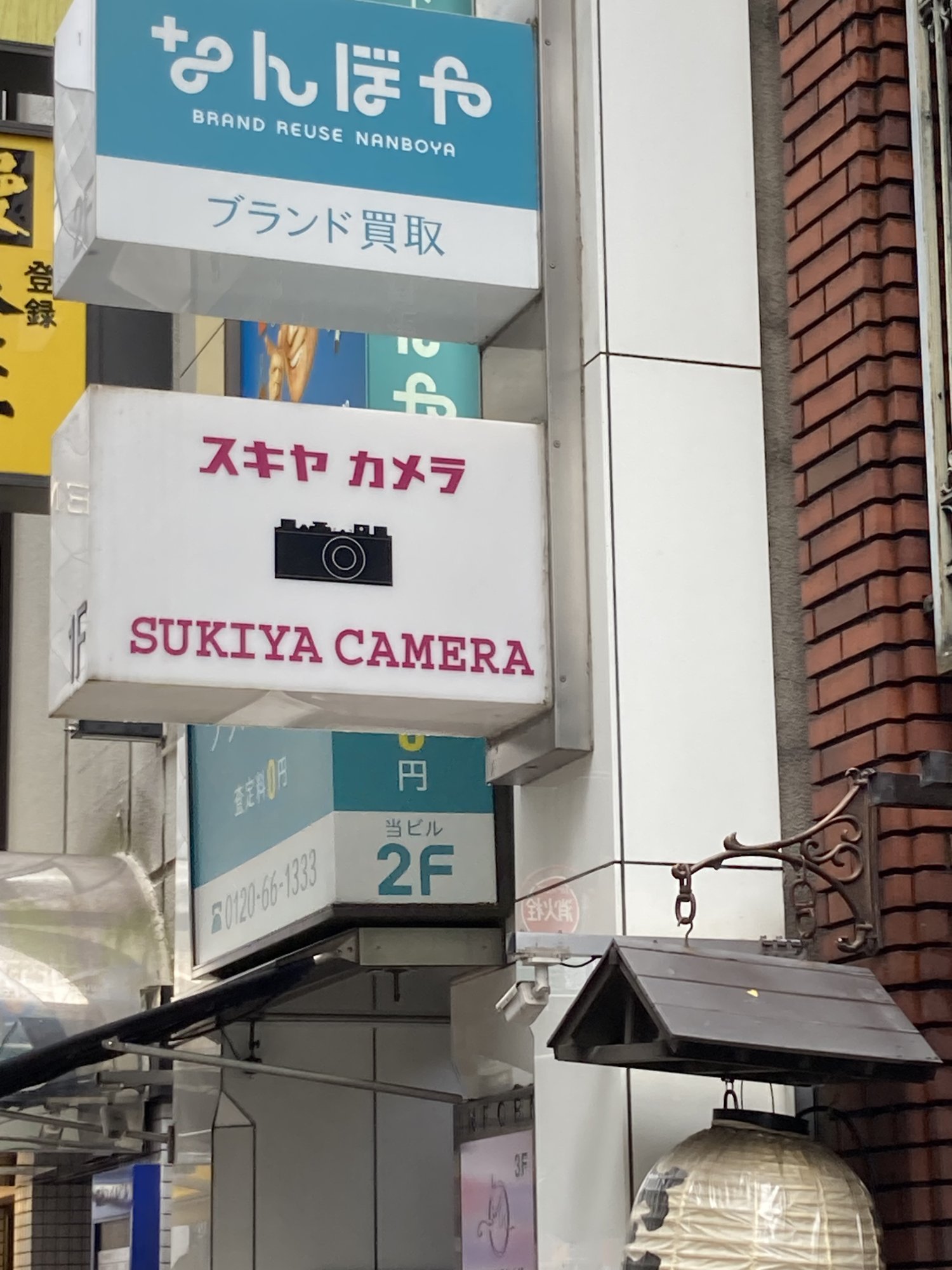
Above the door of Sukiya Camera in Ginza there is a small white sign. On the left is one word in red cursive script: Leica. Next to it, four Japanese words — と共に半世紀, to tomo ni han-seiki. “Half a century together.”
Then you look down, and the shop under that sign is one narrow room. A glass case along the left wall, a glass case along the right wall, a walkway between them, a counter at the back. That is the whole shop.
I liked that contrast so much that I am leading with it. This was the third stop of a day walking Ginza’s camera shops on September 12, 2026. The other shops from that day that I have already written up are Lemon Camera on the 8th floor of a church building, Shimizu Camera, the shop with no website, and Katsumido Camera, where one window holds everything from ¥3,080 to over ¥1,000,000.
Finding it: look at the ground floor, not up
Sukiya Camera is at 4-3-7 Ginza, on the ground floor, on the same block as Shimizu Camera. It is a short walk from Ginza station.
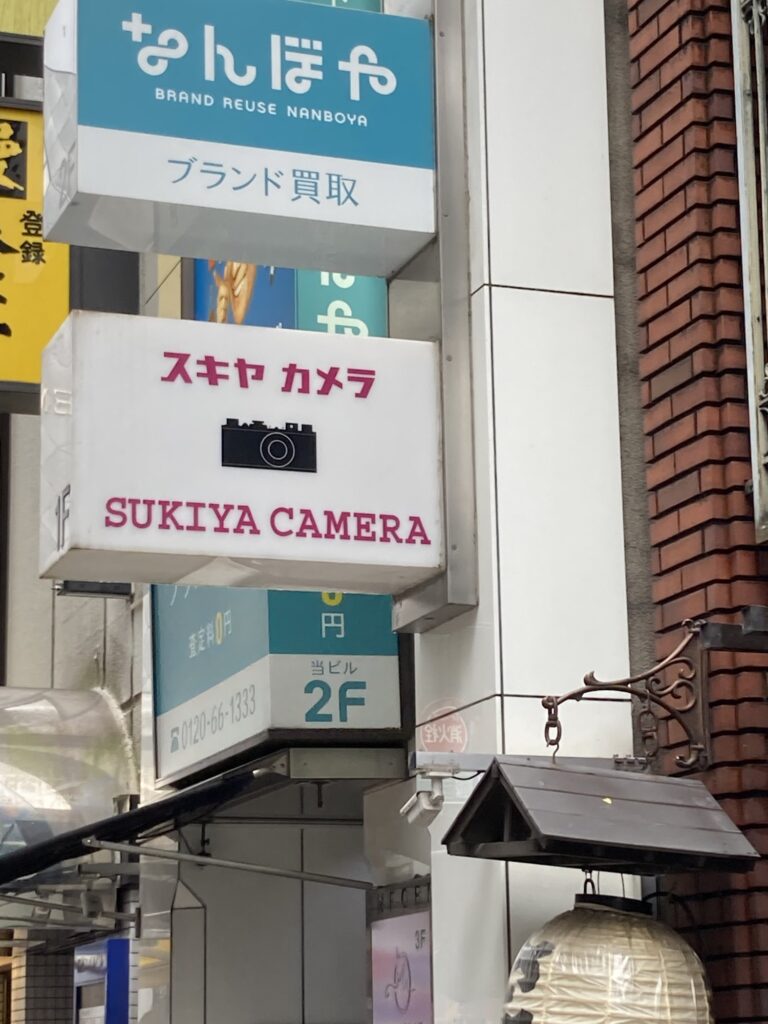
The sign you are looking for is a white box sign with a little black camera drawn on it, and the name twice: スキヤ カメラ in red above the camera, SUKIYA CAMERA in red below it. It is easy to read. The problem is that it is not the loudest sign on the building.
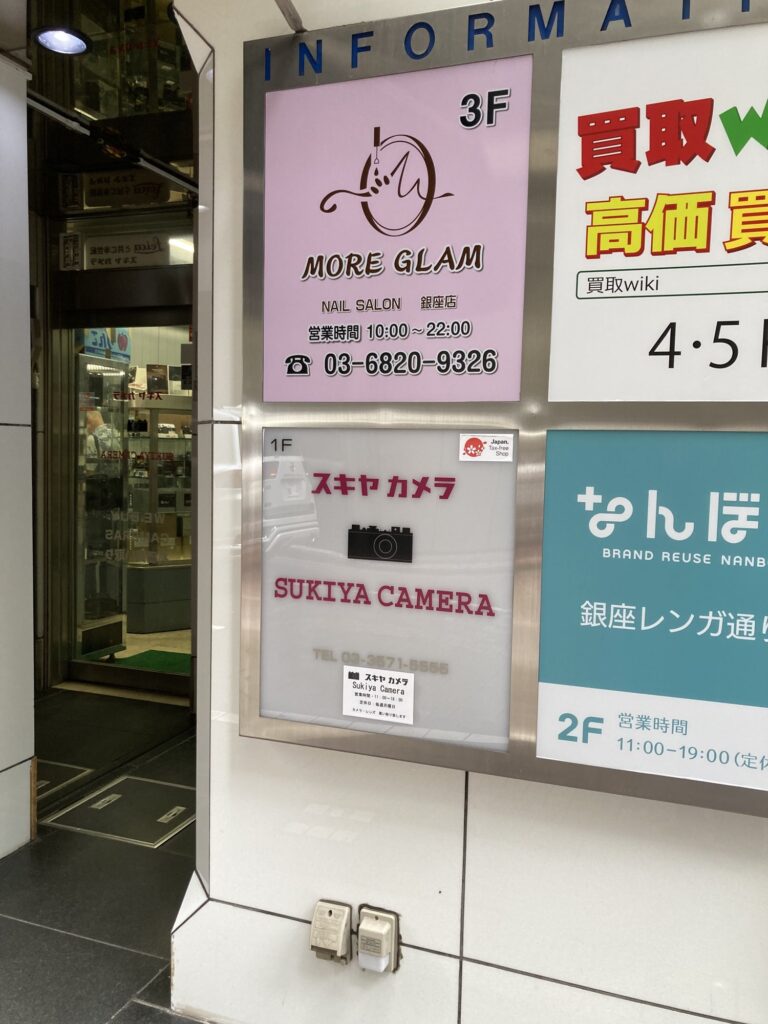
This is a small building with several tenants, and most of them buy things rather than sell them: the tenant board lists a brand-reuse buying counter on the 2nd floor, a nail salon on the 3rd, and another buying service on the 4th and 5th. Their signs are bigger and brighter. So do not look up for the camera shop. It is the glass door at street level, and the white sign hangs just above it.
A door you can read before you open it
The front of Sukiya Camera is glass from top to bottom. Standing outside, I could see the entire shop through the door: both glass cases, the floor, the counter at the back, plastic crates stacked on the floor beside it, and the staff member standing there.
In this series I have written a lot about Ginza shops putting their stock in the front window. Sukiya does something different. There is no display window with price tags to study from the pavement. What the glass shows you is not the goods — it is the size of the room and how many people are in it.
On the glass itself, in white letters, it says “SUKIYA CAMERA” and, lower down, “WE BUY CAMERAS” above the Japanese 高価買い取り (“we pay well”). There is a notice that security cameras are recording. And on the door frame, a column of payment stickers: UnionPay, JCB, Visa, Mastercard, and the Japanese card brands MUFG Card, DC, UFJ and NICOS.
That column of stickers is worth a second look. A small, old-style shop with no window display still takes a foreign card — including UnionPay. It matches what I found when I looked into paying at Japanese camera shops: the idea that Japan is a cash-only country is out of date in the camera world. I did not buy anything, so I cannot tell you how it goes at the register. But the stickers are on the door.
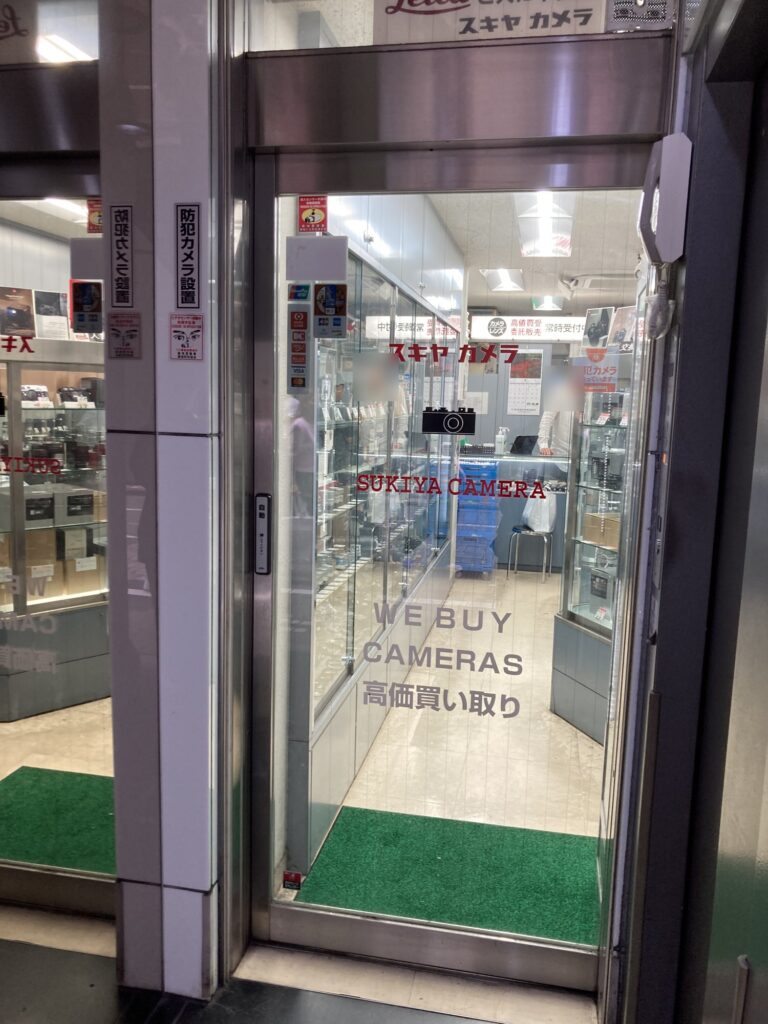
The hard part was going in
Here is my report on my own courage, which is becoming a regular feature of these articles.
A room this narrow is intimidating. In a big shop you can walk in, drift around and leave again, and nobody notices. In a room where two people make a crowd, the staff know you are there the moment the door opens.
What got me through the door was the customer who was already inside. That sounds like a small thing. It is not. In a tiny shop, an existing customer changes the arithmetic: the staff are busy, the room already has someone in it, and you are simply the second person, not an event.
So if you find a shop like this and you hesitate at the door — wait a moment and look through the glass. If a customer is in there, that is your cue. And if you want to know what is expected of you once you are inside, I wrote about that in camera shop etiquette in Japan.
Inside: Japanese only, and a customer who knew what he wanted
I did not ask permission to photograph inside, so from here I am describing what I remember, plus what my one photo through the door shows.
The cases are full and tightly packed. The other customer was an older Japanese man who looked like he had been doing this for decades — he had asked for a case to be opened and was examining a camera properly. There were no other overseas visitors in the shop or at the door, which was different from the other Ginza shops I saw that day.
The thing you should know before you go in: the condition notes on the tags are in Japanese, with no English version. No English grade letters, no English condition line. If you have read my guides to Japanese condition grades and reading Japanese price tags, you will manage — the vocabulary on used camera tags is small and repetitive once you know it. If you have not, put your phone camera’s translate function on before you walk in, and be ready to ask.
I did not talk to the staff, so I cannot tell you how much English they speak. The shop was quiet and the staff were with the other customer, and I did not want to take up the room.
A tax-free sticker the website did not mention
On the building’s tenant board, in the panel for the 1st floor, next to the shop’s name and phone number, there is a red-and-white “Japan. Tax-free Shop” sticker.
I did not know that before I went. It was not on the shop’s own website when I was planning the day — I only saw it because I was standing in front of the board. For a shop this size, that sticker is a genuinely useful discovery: it means that with your passport, tax-free is at least on the table here.
One thing to ask about, though. Inside the shop there is a sign advertising 委託販売 — consignment sales — meaning some of the stock belongs to other people and the shop is selling it for them. At Lemon Camera in Ginza, consignment items were specifically not eligible for tax-free. I do not know how Sukiya handles it, and I did not ask. So if the tax-free price is what makes the difference for you, ask about that specific camera before you commit. My guide to Japan’s tax-free rules explains how the system works in general and what changes on November 1, 2026. What I saw at each shop is on my shop-by-shop tax-free page.
No prices from me this time
In the other Ginza articles I could give you real numbers, because those shops put tagged cameras in a street-facing window and I could photograph them.
Not here. I have no readable price tags from Sukiya Camera: no display window, small tags, no photos indoors. Rather than describe a price range from memory and get it wrong, I will leave it blank. You will have to read the tags yourself, standing in the room — which, given what this shop is, feels about right anyway.
Who this shop is for
Not everyone. If you are browsing, wandering, still deciding what you like — Ginza has easier shops for that, and three of them are linked at the top of this article.
But if you already know what you are hunting for, and it is a Leica or something near one, Sukiya is worth the door. A shop does not put Leica, half a century together above its entrance unless that is the thing it has been doing. (That is the shop’s own wording on its own sign. I have not checked the founding year, so I am passing the claim on, not confirming it.) Small specialist rooms like this often hold stock the chain shops do not have.
Go in with one clear question. That is the way to use a shop this size.
Practical notes
- Where: 4-3-7 Ginza, ground floor, same block as Shimizu Camera. Look for the white “SUKIYA CAMERA” box sign with a black camera on it, low down — not the bigger signs above it.
- Hours: the card posted on the building’s tenant board on the day I visited said 11:00–18:00, closed every Monday (photographed September 12, 2026). Before my trip I saw other listings giving 10:00–19:00, so the two do not agree. I would trust the card on the door and go in the afternoon. More on this in my guide to opening hours and closing days.
- Phone: 03-3571-5555 (listed on the tenant board).
- Before you enter: no display window. The door is glass, so you can see the whole shop and how busy it is before you open it.
- Size: one narrow room, a glass case along each wall. Expect to be noticed.
- Tags: Japanese only, no English grades. Bring a translation app.
- Payment: card stickers on the door frame — UnionPay, JCB, Visa, Mastercard, MUFG Card, DC, UFJ, NICOS. I did not test them at the register.
- Tax-free: “Japan. Tax-free Shop” sticker on the tenant board. Ask whether your item qualifies — the shop also sells consignment stock.
- Photos: I photographed only the outside and one frame through the door. If you want to photograph inside, ask first.
Everything above is what I saw on September 12, 2026, and a shop with two glass cases turns its stock over, so the cameras will be different when you go. This was the third shop of my Ginza camera day, and the whole day is in my Ginza round-up. If you are planning your whole trip, start with my Japan camera shopping guide.
コメント