
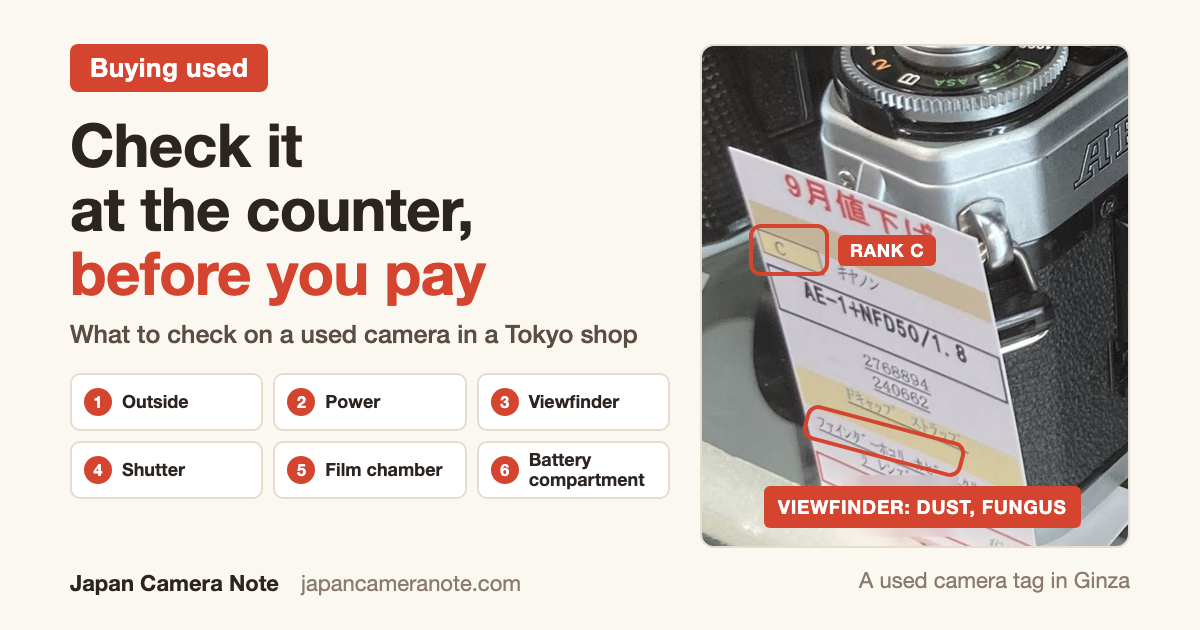
Check the camera at the counter, before you pay. Ask first, then go in this order: the outside, the power, the viewfinder, the shutter, the film chamber, and the battery compartment. For a body, it takes a few minutes.
I sell used cameras in Japan. Before anything goes up for sale, it gets this same check on my desk, in this same order. I have not run it in a shop as a customer. What I can give you is the order I use, and what changes when you are standing at a counter instead of sitting at a desk.
If you already have the camera at home, my arrival check is the article for you. This one is about the minutes before the money.
Why check in the shop, and not at home?
Because after you pay, getting it fixed can be hard, and from abroad it can be close to impossible.
- Junk is sold as-is. No returns. Fujiya Camera’s junk annex in Nakano says so in English on its glass door. More in my guide to buying junk cameras in Japan.
- Tax-free returns. When I visited Map Camera in Shinjuku, posters around the shop said that items bought tax-free could not be returned or exchanged. That was under the old tax-free system. Japan’s system changed on November 1, 2026, and I have not confirmed how shops handle returns of tax-free items now. The new system is in my tax-free refund guide.
- Warranties are written for Japan. Kitamura’s warranty page says, in English, that its warranty is valid only in Japan. The other big shops expect you to bring or send the camera back with the warranty card. Details are in my article on used camera warranties.
If you live in Japan, the last point works in your favor: within the warranty period, you can take the camera back. Keep the warranty card and the receipt together. If you are flying home, the counter is the easiest place to find a problem.
Whatever the situation, ask before you pay:
- 返品できますか? (Henpin dekimasu ka?) “Can I return it?”
What should I read before I ask to see it?
The price tag. On a used camera, it often lists the faults the shop found. Use that list as your checklist.
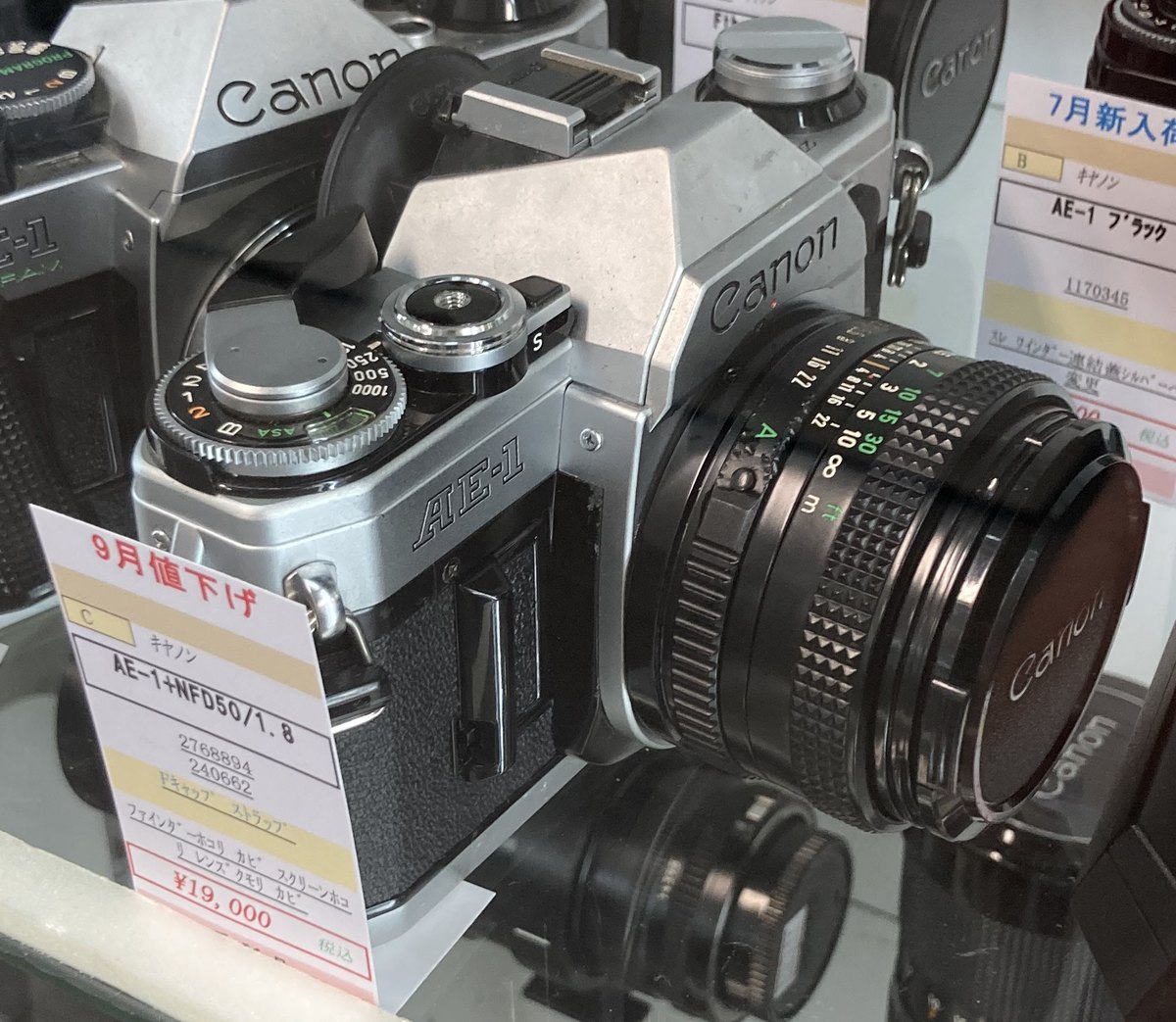
The tag in the photo is on a Canon AE-1 with a 50mm lens. Below the model name, it reads, in Japanese: dust and fungus in the viewfinder, dust on the focusing screen, haze and fungus in the lens. The shop’s rank is C. So when the staff hand you this camera, you already know where to look first.
The words that show up on tags again and again, and how shop ranks work, are in my guide to reading Japanese price tags. Online listings use a different set of words, like “Exc+++”. Those are in Japanese camera condition grades.
Do I need a battery to check a used film camera?
It depends on the camera. For many, yes.
- Mechanical cameras fire the shutter with springs and gears. The battery only runs the light meter. Nikon’s manual for the New FM2, for example, says the shutter works at all speeds with no battery.
- Electronic cameras need the battery for the shutter. Canon’s manual for the AE-1 says the camera does not work without one. With no battery, there is very little you can check.
So in a shop, “the shutter won’t fire” may only mean “there is no battery in it.” The opposite can happen too. On my desk, a PENTAX 645 body looked lovely and its LCD panel lit up perfectly, but the shutter would not fire. I put in fresh batteries, cleaned the contacts and reseated the film insert. Still nothing. A screen that lights up does not tell you the shutter works.
If you know which model you want, look up which battery it takes before you go. Then ask the shop if a battery can go in. Some shops tell you up front. When I visited, Tokyo CAMERA’s Junk Garage in Akihabara had a sign, in English too, that said putting in batteries and mounting lenses were OK. More about that shop is in my Tokyo CAMERA article.
Rules are different in every shop. A sign like that is the shop’s answer. Where there is no sign, ask.
How do I ask to check it?
Start with “excuse me,” as in my article on asking in Japanese camera shops. In that article I wrote that I could not give you a phrase for testing a camera, because I had never asked. I still have not. What I can give you is plain Japanese for each request:
- あの〜すみません (Ano… sumimasen) “Um, excuse me.”
- これを見せてもらえますか? (Kore o misete moraemasu ka?) “Could I see this one?”
- 電池を入れてもらえますか? (Denchi o irete moraemasu ka?) “Could you put a battery in?”
- シャッターを切ってもいいですか? (Shattaa o kitte mo ii desu ka?) “May I fire the shutter?”
- 裏ぶたを開けてもいいですか? (Urabuta o akete mo ii desu ka?) “May I open the back?”
I have not used these in a camera shop myself. Showing them on your phone works too. Sometimes the staff member may hold the camera while showing you. If they work it for you, watch, and listen to the shutter.
What do I check, and in what order?
The same order I use at my desk. Start with what needs no tools, and work inward.
- The outside. Turn it under the shop light. Look at the corners and the top of the camera for cracks and dents. Compare what you see with the tag.
- The power. Battery in, switch on. Do the displays or the meter come on? Point the camera at a bright light, then at a dark corner. The meter should move.
- The viewfinder. Look through it toward a light. Dust, haze, fungus, a dim view. If the tag lists something here, find it.
- The shutter. Ask first. Fire it at a slow speed, like 1 second, then at a fast one. The sound should get longer and shorter. Wind the lever between shots, and set the dial on a click, not between two speeds.
- The film chamber. Ask first. Look at the frame counter before you open the back, so you do not open it on someone’s film. Inside, look at the light seals, the black foam around the edge. Are they melted, crumbling or missing? Does the back close flat? Do not touch the shutter curtain, the thin sheet inside.
- The battery compartment. White powder or green crust is a sign of an old battery that leaked. Do not touch it with your bare hands.
At my desk, one camera or lens takes 5 to 10 minutes. Most of that goes to looking through glass. The body steps above are the quick part.
It won’t fire. Is it broken?
Maybe not. Old cameras have locks that look like faults. These come from the makers’ manuals:
- Not wound yet. Most cameras with a lever will not fire until you wind it all the way.
- The lever won’t move. It may already be wound. It won’t wind twice. Fire the shutter first.
- The lever is pushed flat against the body. On the Nikon New FM2, FM3A and FM10, that position locks the shutter button. Pull the lever out a little.
- A lever at “L”. On the Canon AE-1, the self-timer lever is also the shutter lock. At “L,” the button will not press.
- The dial is on B. The shutter stays open as long as you press, so it doesn’t sound like a normal click.
- The self-timer is set. It fires about 10 seconds later.
On my desk, a Nikon FE’s lever would not move. It had already been wound, and the battery was dead. The camera was fine.
Other models have other locks. If you are not sure, ask the staff. “Looks broken” and “is broken” are not the same thing. If it still will not fire after all this, that is worth knowing before you pay, not after.
What can’t I check in a shop?
Light leaks. Worn light seals can let light reach the film, but only a roll of film will show you. My desk check does not include a test roll either. It stops at what I can see and work by hand.
So run the arrival check again that evening, while you are still in Japan. Keep the receipt and the warranty card with your passport, not in a box you might throw away.
One more option if you want to see before you pay. On Kitamura’s website, you can have a used item sent to a branch near you, look at the actual camera at the counter, and say no there if it is not what you hoped. The site notes you may pay the transfer fee in that case. I explain it in how to find a specific camera in Tokyo.
What about the lens?
The lens is the slow part. Fungus and haze hide from shop lights, and the aperture blades have their own “looks broken” tricks. Can you mount a lens on a body and test it in the shop? That is my next article.
In short
- Check before you pay. Junk is as-is, and a warranty is hard to use from abroad.
- Read the tag first. The faults it lists are your checklist.
- Know whether the camera needs a battery to fire. Ask if one can go in.
- Ask before you fire the shutter or open the back. Each shop has its own rules.
- Outside, power, viewfinder, shutter, film chamber, battery compartment. A few minutes.
- Won’t fire? Check the wind, the locks, the B setting and the self-timer before you decide.
- Ask “Can I return it?” before you pay, and check again that evening.
コメント