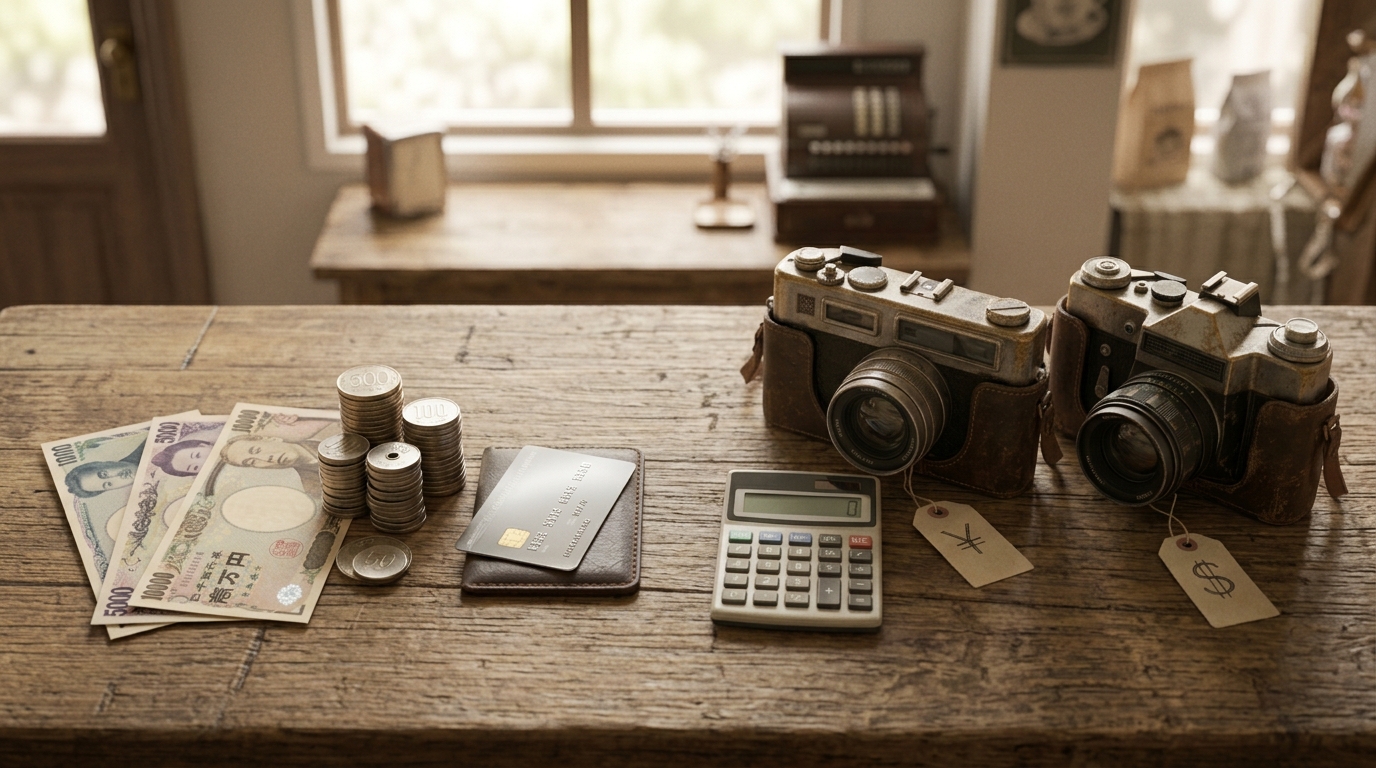
“Japan is a cash society. Bring lots of yen.” You have probably read this advice somewhere. It used to be true, and in some corners of Japan it still is. But if you are coming here to buy cameras, the picture is much friendlier than the old reputation suggests — and in this article I will show you exactly what the big Tokyo camera shops say about payment, plus what I have seen with my own eyes.
This is the second article in my small series about money. The first one asked whether Japan is really cheaper for cameras. This one answers the next question: once you find the camera, how do you actually pay for it?
- The short answer
- What I have seen in the shops myself
- What the big shops officially say (as of September 2, 2026)
- UnionPay and QR payments: ask before you assume
- Why you should still carry some cash
- Getting yen: the convenience-store ATM trick
- Paying and tax-free shopping are separate questions
- The bottom line
The short answer
At the big, famous used-camera shops in Tokyo, you can relax. Credit cards are normal there. My practical advice comes down to this:
- Plan to pay by card at the major shops — it works, and it saves you from carrying a large amount of cash for an expensive lens.
- Carry some cash anyway — maybe 10,000 to 20,000 yen — for small shops, junk-corner treasures, and simple peace of mind.
Now let me show you where this advice comes from.
What I have seen in the shops myself
For this site I have visited camera shops in Akihabara, Nakano, and Shinjuku — the big chains and many of the smaller specialist shops. Thinking back over all of those visits, I do not remember seeing a single “cash only” sign in any of them. I also do not remember ever seeing a minimum-purchase sign for cards, the kind that says “cards accepted only for purchases over X yen.”
Two important cautions about that statement. First, it is my memory of the shops I happened to visit, not a survey of every camera shop in Tokyo. Second, I was not checking payment stickers at every register on purpose — I was looking at cameras. So treat this as one person’s field observation: the “cash society” problem simply never appeared in front of me in Tokyo’s camera districts.
What the big shops officially say (as of September 2, 2026)
Memory is a weak thing, so I checked the official websites of three famous shops on September 2, 2026. The results were more uneven than I expected — not because the shops refuse cards, but because not every shop publishes a neat list.
| Shop | What the official site says about paying in store |
|---|---|
| Fujiya Camera (Nakano) | Publishes a full list: cash, credit cards (Visa, Mastercard, JCB, Amex, Diners), debit cards, PayPay, Amazon Pay, transit IC cards (Suica etc.), iD, QUICPay, UnionPay, WeChat Pay, and Alipay. |
| Map Camera (Shinjuku) | The payment page on its site describes online orders only. I could not find an official list of in-store payment methods. |
| Kitamura (used-camera stores) | The store page for the Akihabara used-camera center lists hours and access but no payment methods. The guide for the company’s Shinjuku flagship mentions paying at the counter by cash or credit card, without a brand list. |
Fujiya Camera: the model student
Fujiya Camera in Nakano is the easiest case, because its official store-information page spells everything out. As of September 2, 2026, the list includes cash, the five major credit-card brands, debit cards, PayPay, transit IC cards like Suica, iD, QUICPay — and, notably for many visitors, UnionPay, WeChat Pay, and Alipay. If your wallet runs on any of those, Fujiya has you covered on paper, in writing, from the shop itself.
Map Camera: cards in store, but read the fine print online
Map Camera’s website has a detailed payment page, but it describes payments for online orders. I could not find a page that lists what the Shinjuku store accepts at the register, so I will not guess at brands here.
There is one detail on that online-payment page that matters a lot if you are reading this from outside Japan: as of September 2, 2026, Map Camera’s own online shop states that it does not accept credit cards issued overseas, because it cannot verify the cardholder’s registered address. In other words, the barrier is on the online side, not the shop floor. If you want to buy from Map Camera with an overseas card, visiting the store in person is the straightforward route.
Kitamura: no neat list, but no alarm either
Kitamura is a huge nationwide chain, and I expected a tidy official payment page. I could not find one for its used-camera stores. The official store page for the Akihabara used-camera center gives hours and directions but says nothing about payment, and the shopping guide for the company’s Shinjuku flagship confirms cash and credit cards at the counter without listing brands. So for Kitamura my written evidence is thin — but nothing I found, online or in person, pointed toward any cash-only situation.
UnionPay and QR payments: ask before you assume
If you pay with UnionPay, Alipay, or WeChat Pay, the safe habit is simple: Fujiya Camera lists all three officially, and for any other shop, show your card or app at the counter and ask. Payment stickers on the register or the front door usually answer the question before you say a word. Shop staff deal with this question every day; a phone screen showing your payment app is a complete sentence. My guide to reading Japanese price tags covers the other half of the register experience — knowing what the number on the tag actually includes.
Why you should still carry some cash
After all that good news, why do I still tell people to keep 10,000–20,000 yen in their pocket? Three reasons.
- I have not checked every shop. Tokyo’s camera districts include tiny one-owner shops that have been there for decades. My observations cover the famous names and the shops I visited, not all of them.
- Junk hunting is a small-money game. When you are pulling 500-yen lens caps and 2,000-yen bodies out of a junk basket, coins and small bills keep things simple. If that sport appeals to you, my guide to buying junk cameras in Japan explains the rules of the game.
- Machines fail everywhere. A card terminal that will not connect is not a Japan problem, it is a planet Earth problem. Cash is the backup that never needs a signal.
Getting yen: the convenience-store ATM trick
Here is the part of Japan’s cash story that surprises many visitors in a good way. You do not need to hunt for a currency exchange counter. Seven Bank, which runs the ATMs inside 7-Eleven convenience stores, officially supports cards issued overseas: as of September 2, 2026, its site lists Visa, Mastercard, Plus, Maestro, Cirrus, UnionPay, American Express, JCB, Discover, and Diners Club, with a note that some individual cards may not work. The machines have an English menu, and 7-Eleven stores are roughly everywhere — including a short walk from every camera district in this site.
Your own bank’s foreign-withdrawal fees are between you and your bank, so check those before the trip. But the machines themselves are not the obstacle they are in some countries.
One small tip for card payments in general: if a terminal ever offers to charge you in your home currency instead of yen, choosing yen is usually the better deal. The “convenient” home-currency option tends to hide a worse exchange rate.
Paying and tax-free shopping are separate questions
A quick note so nobody mixes two topics: how you pay (cash or card) and whether you can buy tax-free are independent. Tax-free shopping depends on your visitor status and your passport, not on your payment method. The conditions and the paperwork are their own subject, and I wrote about them in my guide to tax-free camera shopping in Tokyo.
The bottom line
The “Japan is cash only” warning deserves to retire, at least in Tokyo’s camera world. Fujiya Camera publishes a payment list that would make any airport duty-free shop proud, nothing I saw in the other big shops suggested cards would be a problem, and the 7-Eleven on the corner will turn your overseas card into yen at midnight if a junk basket demands it.
So: card for the big purchase, a modest fold of cash for the small ones, and your attention free for what actually matters — the cameras. If you are still assembling the rest of your trip plan, my Japan camera shopping guide collects all the practical pieces in one place.

コメント