
If you have ever browsed Japanese camera listings on eBay, you have seen the words: “Near Mint,” “Exc+++,” “MINT,” and the mysterious “Junk.” And you have probably wondered the same thing every buyer wonders: can I actually trust these labels?
I sell Japanese cameras to overseas buyers on eBay every day. So today, instead of writing another shop guide, I want to answer that question from the other side of the screen — how one Japanese seller (me) actually decides what to write in that condition line. I can’t speak for every seller in Japan. There is no official rulebook that we all follow — at least, I have never seen one. So everything below is simply how I do it, and what I have noticed while doing it every day. I think that honest, small-scale view will be more useful to you than a fake “industry standard.”
How I grade my own cameras
Here is my real habit: I grade a little conservatively, on purpose. Why? Because I am not always confident. Condition grading involves judgment calls, and when I am not sure, I would rather label an item slightly lower than risk disappointing a buyer.
The result of that habit: “Exc+++” is the grade I use most often. Many of those cameras look very clean. But “MINT”? I almost never write it. Honestly, the word scares me. “MINT” promises perfection, and promising perfection on a decades-old used camera feels dangerous. So a camera has to be truly exceptional before I dare to use it.
What does this mean for you as a buyer? I can only speak for myself, but that is exactly why I aim low on the label: I would much rather have a buyer open the box and feel relieved than disappointed. If other Japanese sellers share this cautious habit (and my impression is that many do, though I can’t prove it), then a Japanese “Near Mint” or “Exc” is more likely to under-promise than over-promise. Take that as one seller’s impression, not a guarantee.
Grading is not a science — even for me
Now the uncomfortable part. Where exactly is the line between “Exc+++” and something lower? For me: a large, obvious scratch pushes a grade down. Beyond that, my honest answer is that “Exc+++” means “it looks pretty clean to me.” That’s it. That’s the science.
And optics are even harder. Judging haze and fungus inside a lens is genuinely difficult — even for someone who handles cameras every day. Light haze can hide from you depending on the angle and the light. I do my best, but I won’t pretend my eye is a laboratory instrument.
So here is the truth I want you to carry: condition grades are a seller’s personal opinion, not a measurement. Two sellers can look at the same lens and write different grades, and neither one is lying.
So what do I look at instead? The seller, not the label
Since I know grades are subjective, here is what I actually do when I look at another seller’s listing: I go check their other listings.
My personal rule of thumb: if a seller has around 100 to 200 items listed, I start to see them as credible. Someone running at that volume is doing this seriously, day after day, and their grading habits — whatever they are — will at least be consistent. Consistency is what you can actually use: scroll through their listings, read how they describe things, look at their feedback, and you get a feel for what “Exc” means in their dialect.
One more honest observation about my fellow Japanese sellers: the photos are usually beautiful. That is nice, but beautiful photos still leave a lot unknown — which brings me to my biggest confession.
Even I don’t buy from photos alone
Here is something that might surprise you: I do not buy cameras based on photos alone. Some resellers in Japan source their inventory entirely online, from pictures. I don’t. Buying something I can’t inspect with my own hands scares me — and I do this for a living.
Please sit with that for a second. A person who photographs, describes, and ships cameras every single day still doesn’t fully trust photos. So if you, buying from another continent, feel uncertain looking at a listing — that is not because you lack knowledge. That uncertainty is built into buying from photos. It never goes away, for anyone.
What can you do about it? The same things I would do:
- Pick sellers with a track record (the 100–200 listings check above).
- Read the return policy before you buy, not after.
- Ask questions — the right way. More on that below.
And if you are coming to Japan in person, this is exactly why buying here is so satisfying: you can hold the camera before paying. I wrote about how that works in my camera shop etiquette guide — asking “Can I hold it?” solves what no photo can.
“Junk” does not mean garbage
This word confuses overseas buyers more than any other, so let me explain how I use it.
In my listings, “junk” mostly means “untested.” If I haven’t confirmed that something works, it goes out as junk — even if it might work perfectly. I also use it when a problem is severe enough that even I can see it clearly, like heavy fungus in a lens. In other words, “junk” is not a description of the item’s value. It is me saying: “I make no promises about this one. You take the risk.”
And here is the interesting part: junk is not worthless, and sellers know it. A camera that doesn’t work can still be valuable for parts. I research before listing, and if similar items are selling even as junk, I list them as junk — and they sell. Some junk-labeled items trade for serious money; I have sold a compact film camera as junk for the equivalent of a few hundred dollars, because the market wanted it anyway.
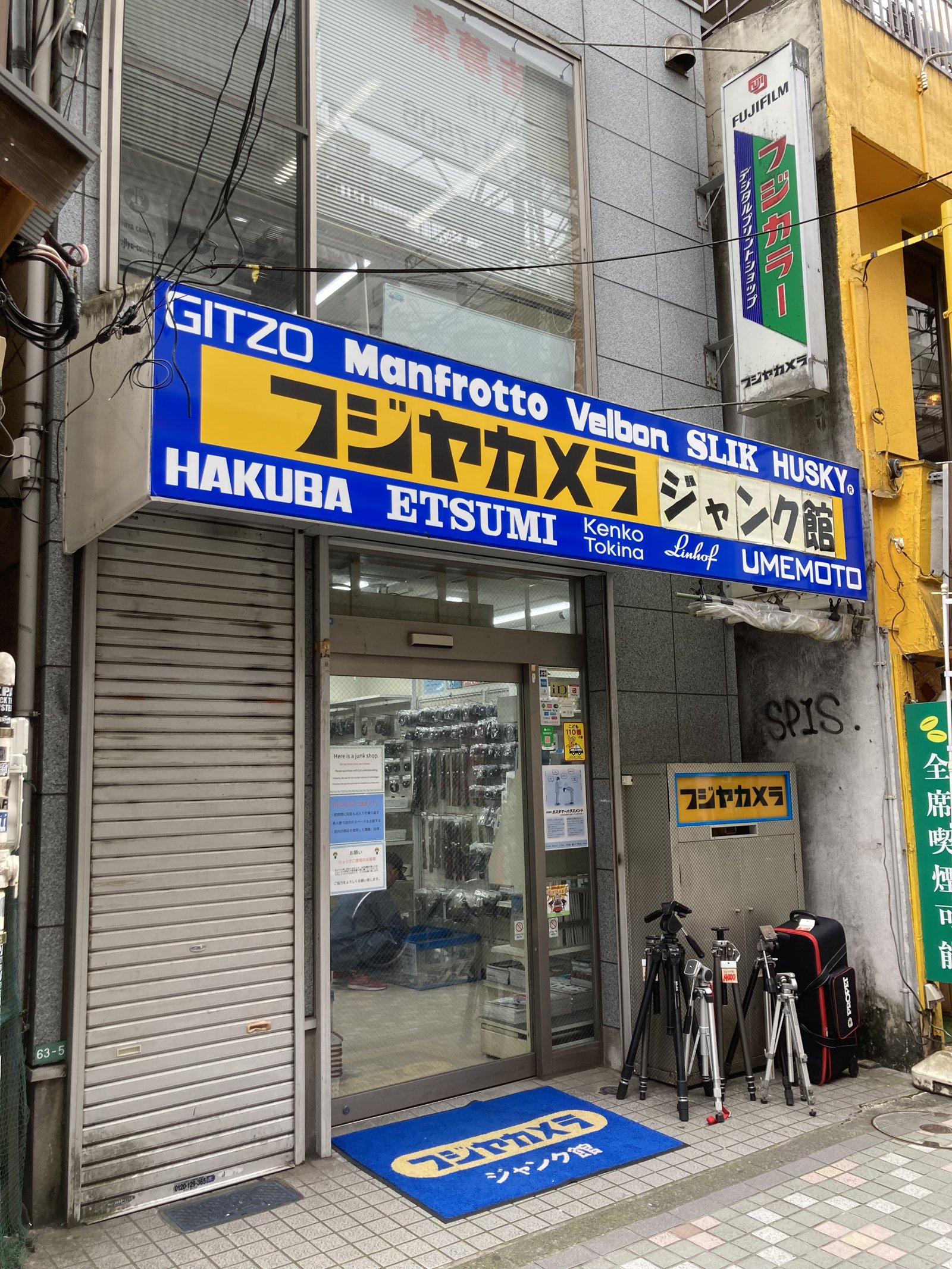
This is the same logic behind the famous junk corners in Tokyo’s camera shops, like Fujiya Camera’s junk annex in Nakano: “junk” means as-is and no guarantees — it has never meant “trash.”
Should you message the seller? Yes — but here’s how
Buyers often hesitate to ask sellers questions. Let me tell you the seller-side truth, from my own desk.
Honestly? Questions are a little bit of work for us. Not because we dislike buyers — but because of what happens behind the scenes. Once I list an item, it is often already cleaned and carefully packed. To answer “is there haze in the rear element?”, I may need to unpack it, inspect it, and pack it all over again. Some sellers store their inventory at a fulfillment warehouse, which makes re-checking an item even more complicated. So if a reply takes a day or two, it does not mean the seller is ignoring you or annoyed with you. There is a good chance they are literally unwrapping your camera to look at it.
So yes, please ask — I would rather answer a question than deal with a disappointed buyer. Just ask in a way that helps us help you:
- Be specific. “Is there fungus or haze in the lens when you shine a light through it?” is easy to act on. “Is it good?” is not.
- Keep it short. One or two clear questions per message.
- Say plainly what you want to know. This one comes from experience: humor and wordplay often don’t survive the language and culture gap. I have received playful messages where I genuinely could not tell what the buyer was asking for. Nobody was at fault — the intent just didn’t cross the ocean. Plain, simple English always does.
The honest summary
Let me put everything on one line each:
- Condition grades are one seller’s opinion, not a measurement. Mine included.
- In my case, I grade conservatively — “Exc+++” is my everyday grade, and “MINT” almost never leaves my keyboard.
- Judge the seller, not the label: 100–200 active listings and consistent descriptions tell you more than any single grade.
- Photos never tell the whole story — I don’t buy from photos alone myself, and I’m the professional here.
- “Junk” means “no promises,” not “no value.”
- Ask questions: specific, short, plain. Slow replies usually mean the seller is re-checking the item for you.
There is no perfect information in used cameras — not for you, not for me. But if my own habits are anything to go by, the label on a Japanese listing is more likely to be modest than inflated. And if you ever come pick one up in person instead, the tax-free rules and the shop etiquette guide are waiting for you.


コメント